
Literary critic William Pritchard collects his articles on the two poets.
William Pritchard is the Henry Clay Folger Professor of English, Emeritus, at Amherst College. He received his A.B. degree from Amherst and his M.S. and Ph.D. degrees from Harvard University. His teaching has focused on 20th century poetry and fiction, but’s also taught on Shakespeare and major English writers from the 17th to the 20th centuries.
His books include Updike: America’s Man of Letters, English Papers: A Teaching Life, Randall Jarrell: A Literary Life, and Frost: A Literary Life Reconsidered. He writes reviews for such newspapers as the Boston Globe, Chicago Tribune, and Times Literary Supplement, and is both an advisory editor and essayist for the Hudson Review.
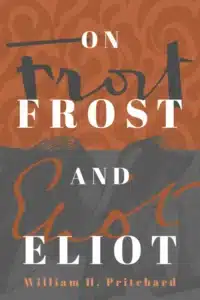 Pritchard is, in short, a literary critic. And he’s collected his reviews, articles and essays on the two most influential poets of the 20th century under the title of On Frost and Eliot. The material has been drawn from newspapers, literary magazines, and journals; the articles were published over several decades.
He acknowledges that what Robert Frost (1874-1963) and T.S. Eliot (1888-1965) have mostly in common is that both are considered great poets, likely the two greatest poets writing in the English language in the 20th century. Yet the two are strikingly different in form, subjects, themes, and style. Pritchard couples them together in essay collection for both their reputations and how their differences highlight what they accomplished and how it happened.

Robert Frost as a young man
What he doesn’t focus on is that both poets were Americans, but even there, they were different. Frost was born in San Francisco but moved to Massachusetts when he was 10. Eliot was born and reared in St. Louis. Both poets had Harvard in common – Frost attended for two years without graduating; Eliot graduated. Both also had England in common – Frost for two years and Eliot for most of his adult life.
Frost was nominated for the Nobel Prize in literature 31 times but never received the award; he did receive four Pulitzer Prizes. Eliot received the Nobel Prize in 1948; he also received three Tony Awards associated with plays, two of them posthumous (for Cats in 1983). Frost is mostly associated with poetry; Eliot was a poet, literary critic, editor, essayist, and dramatist.

T.S. Eliot as a young man
The entries in the collection include book Pritchard’s reviews of books by and about the two poets. His comments are straightforward and occasionally biting; he also seems to know when a writer knows what he’s writing about. (I suspect he’s also not one to suffer fools, gladly or at all.)
It’s always a surprise when something you’re reading connects in a personal way. One of his reviews about Frost is about the Library of America edition, published in 1995; that volume sits directly above my computer screen on a shelf. And he has very commendatory things to say about the 2015 edition of the poems of Eliot, edited by Christopher Ricks and Jim McCue. Pritchard calls Ricks one of the best scholars of Eliot alive. During a trip to London in 2015, I was able to attend a “book event” at the British Library, where Ricks and McCue were launching the two-volume edition.
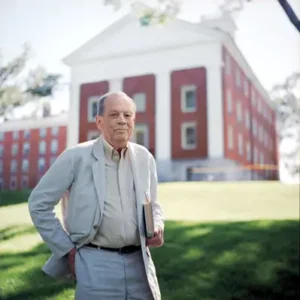
William Pritchard
Another point of personal connection: Pritchard makes a statement about teachers and professors who were in college in the 1950s and what writers they carried forward to their classrooms. Many of my own English teachers were trained in that decade, and it’s one reason I was led toward Ernest Hemingway, Eliot and Frost, William Faulkner, Willa Cather, Edith Wharton, and several others.
On Frost and Eliot is an insightful collection on not only the people who wrote and published on the two poets, but also the poets themselves.
Related:
Robert Frost and The Road Not Taken.
Robert Frost and Stopping by Woods on a Snowy Evening.
Committing Prufrock: The Path to Frost.
Jay Parini Has 16 Robert Frost Poems to Memorize.
T.S. Eliot at the British Library, Part 1.
T.S. Eliot at the British Library, Part 2.
Robert Crawford on the Young T.S. Eliot.
Eliot After The Waste Land by Robert Crawford.
The Art and Music of Four Quartets by T.S. Eliot.
Photo by Hannes Flo, Creative Commons, via Flickr. Post by Glynn Young.

How to Read a Poem uses images like the mouse, the hive, the switch (from the Billy Collins poem)—to guide readers into new ways of understanding poems. Anthology included.
“I require all our incoming poetry students—in the MFA I direct—to buy and read this book.”
—Jeanetta Calhoun Mish
- Matthew Zapruder and “The Story of a Poem” - October 15, 2026
- Poets and Poems: Mischa Willett and “The Gift Card Has Already Been Redeemed” - October 13, 2026
- When a Poem Completely Eludes You - October 8, 2026
Katie Spivey Brewster says
Glynn,
Whenever I read one of your posts I’m struck by the amount of reading and research that go into them. Sometimes with ones like this I think you could build a workshop/class around your findings. Thank you for sharing your vast knowledge.
Gratefully,
Katie