
Marjorie Maddox brings a quiet poetic eye to the stuff of life
Watching kites in the sky. Bounding on a bed. A boy going fishing. Washing clothes. A housemaid making beds at a motel. Mowing a lawn. Adopting kittens. Veterans marching in a Memorial Day parade.
Common, familiar activities and events. These are the kinds of things we do in our lives and work that become part of the background of daily life. We take them for granted. We smile at the memory. But politics and foreign policy and newspaper headlines and online viral sensations soon crowd them out. We pay more attention to our smartphones than to the real life happening around us. If we happen to look up and notice, we immediately start to think about new content for Instagram or TikTok.
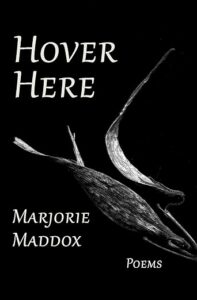
In a very quiet and gentle way, poet Marjorie Maddox says, look around. Her latest collection, Hover Here: Poems, should probably bear that as a subtitle. She doesn’t speak with loud or demanding images and words. That’s not her style, not to mention that loud and demanding soon crowds out understanding and reflection.
Turn the phone off. Watch. Observe. See what’s happening around you, like a friend struggling with grief.
Insomnia/Somnolence
 Her husband dead, my friend can’t sleep;
another’s lost his wife and naps
around the clock. An old house weeps
with all it sees, what it can’t keep
from slipping through the floorboard cracks
to groan, “Your loved one’s dead. Don’t sleep
a second with a grief that keeps
repeating when you wake, the trap
of loss and clocks.” An old house weeps,
counts days and nights by sighs that leap
ahead and back, recurring map
to somnolence. My friends, we sleep
too much to stave off haunting grief
that’s always home. And when awake:
the house won’t rest, our dead won’t sleep,
regret or joy still can’t release
us from our weeping for the past:
the husband/wife, the friend. Asleep/
awake: time’s house, love’s clock, still creaks.
Maddox turns her gentle eye to more than daily life. One of the most moving poems in the collection is “The Rescue Mission of Eleanor and Gilbert Kraus.” It’s a three-part poem in which Maddox tells stories of children trying to flee the Holocaust. One boy is saved because a chosen one gets sick and can’t travel. A group of children are examined to select 25 to make the journey. And then the children board a ship that takes them to safety, leaving behind families and lives. The stories aren’t sensationalized; Maddox tells them simply and clearly. All I can say is bring tissues.

Marjorie Maddox
Maddox is the author of 18 poetry collections, including Nightrider to Edinburgh (1986); Body Parts (1999); Transplant, Transport, Transubstantiation (2004 and republished by Wipf and Stock Publishers); Weeknights at the Cathedral (2006); Local News from Someplace Else (2013); Perpendicular as I (1999 and 2013); True, False, None of the Above (2018); Heart Speaks, Is Spoken For (2022), and Begin with a Question (2022). She is the co-author of the anthology Common Wealth: Contemporary Poets on Pennsylvania (2005) and author of two children’s books, including Rules of the Game: Baseball Poems (2009). She is also a professor emerita of English and Creative Writing at Lock Haven University in Pennsylvania.
Hover Here is a poetic gem. The poems sit there quietly, waiting to be read. They take their turn. They don’t demand; they simply ask you to sit with them and watch. And learn.
Related:
Marjorie Maddox and Seeing Things
Marjorie Maddox Hafer: Poetry, Art, and Spelling
Photo by Rhett Maxwell, Creative Commons, via Flickr. Post by Glynn Young.


How to Read a Poem uses images like the mouse, the hive, the switch (from the Billy Collins poem)—to guide readers into new ways of understanding poems. Anthology included.
“I require all our incoming poetry students—in the MFA I direct—to buy and read this book.”
—Jeanetta Calhoun Mish

- Poets and Poems: Gabrielle Myers and “Go Forth: Lose Yourself into Life” - August 20, 2026
- Jon Nappa Imagines the Life of Longfellow - August 18, 2026
- Poets and Poems: Martyn Hesford and “Ash Light” - August 13, 2026
Leave a Reply