Jon Nappa brings the poet to life in “What Longfellow Heard.”
When I was writing my historical novel Brookhaven, I almost stumbled into using the poetry of Henry Wadsworth Longfellow as a literary device. I had recently read three of his epic poems – The Song of Hiawatha, Evangeline, and The Courtship of Miles Standish. As I child, like virtually every other schoolchild of my generation, I had memorized “The Midnight Ride of Paul Revere.”
After reading and writing about the three epic poems, I read Cross of Snow, the 2020 biography of Longfellow by Nicholas Basbanes. Two years later, I saw the movie “I Heard the Bells,” the story behind Longfellow’s poem that eventually became a popular Christmas carol. And all this while, I kept looking for something that will help me unify a theme for this as-yet-unnamed novel. (Yes, I can ignore the obvious.)
The movie might have been the clincher. And I thought, what about Longfellow’s poetry? If I had searched more or better than I did, I might have found the 2017 novel What Longfellow Heard by Jon Nappa. It might not have mattered; when I’m writing, I try to avoid fiction on any related theme. I did read three Civil War novels while I was writing mine, but nothing in them applied to the story I was trying to tell.
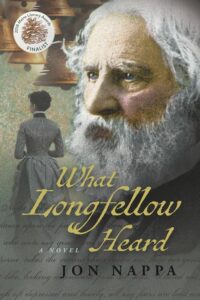 What Longfellow Heard tells the story of Longfellow’s life, and it does so in an engaging, highly readable way. Nappa covers how the poet wrote what he did, but he also describes how Longfellow wrote almost in spite of the tragedies that dogged his life.
His first wife died while they were touring Europe, which Harvard had required before he occupied the professor’s chair he’d been offered. Longfellow was devastated. He eventually married again, and his second wife, after bearing four children, would die painfully after suffering severe burns when her dress caught fire. His oldest child, Charles, almost died from a wound received during the Civil War. Longfellow essentially stopped writing between the death of his second wife and his son’s eventual (and terribly slow) recovery. When he did resume, the poem he wrote was “Christmas Bells.”
Nappa doesn’t try to include every fact and event of Longfellow’s life. Instead, he paints the broad picture, carefully using historical detail to make the story seem real. That’s not as easy as it sounds. In his letters, diaries, journals, and other accounts, Longfellow often redacted himself, blacking out parts he did not want shared. Some materials were burned. But enough remains, and Nappa weaves a narrative that is both true to biographical facts and the story that’s unfolding.

Jon Nappa
Nappa has written two other historical novels, Storm Warriors and Storm Survivors, in addition to several books for children. He was the original writer, producer, director, and co-creator of “Pappyland,” the PBS and TLC series. He was also the creative force behind “The Art, Song, and Story Palace” on the YouTube Channel for children. What Longfellow Heard was a finalist in the Maine Literary Awards.
What Longfellow Heard reads like a biography brought to life. This is a Longfellow driven by ambition, experiencing and overcoming tragedy, and creating narrative poetry that helped defined American culture. And it’s also a great read.
A sidenote: All my “Longfellow stuff” had one unexpected bit of education. In the middle of the research for Brookhaven, I discovered that my great-grandmother, Octavia Montgomery Young and the inspiration of the character of Octavia Jane Montgomery in Brookhaven, was a straight-line descendant of John Alden and Priscilla Mullins, the real-life couple who inspired Longfellow in The Courtship of Miles Standish.
Related:
Cross of Snow: A Life of Henry Wadsworth Longfellow by Nicholas Basbanes.
Longfellow, Whitman, Wheatley: Whatever Happened to Patriotic Poems?
The Mythic and Heroic: The Song of Hiawatha by Henry Wadsworth Longfellow.
The Poem as Modern Myth: Evangeline by Henry Wadsworth Longfellow.
Childhood, Poetry, and History: The Courtship of Miles Standish.
Photo by Sylvia Sassen, Creative Commons, via Flickr. Post by Glynn Young.
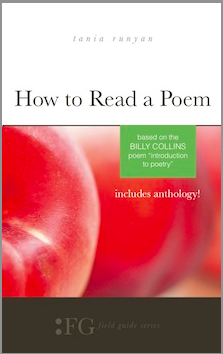

How to Read a Poem uses images like the mouse, the hive, the switch (from the Billy Collins poem)—to guide readers into new ways of understanding poems. Anthology included.
“I require all our incoming poetry students—in the MFA I direct—to buy and read this book.”
—Jeanetta Calhoun Mish
- Reading Paul Celan for the First Time - October 1, 2026
- Poets and Poems: Christian Wiman and “The Dance” - September 29, 2026
- Poets and Poems: James Tweedie and “Love Found, Yearned For, and Lost” - September 24, 2026
Katie Spivey Brewster says
What treasures you bring us, Glynn!
Looking forward to reading Jon Nappa’s book.