Sally Nacker finds nature in her back yard
Poet Sally Nacker lives in a house in or near a woods. That means her home is surrounded by nature. To experience nature, all she has to do is open her door and inhale. It was perhaps inevitable that she would find poetic inspiration here. All she had to do was walk in her yard.
Find it she did.
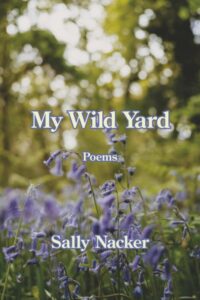
My Wild Yard is a small taste of living in a natural setting. The 16 poems of this chapbook are simple and direct, inspired by the landscape around her. The poems are short; the longest is four stanzas of four lines each.
And what’s on her mind as she observes what’s around her? Snow, punctuated by the sound of a nearby train whistle. Looking through a window at the deep green of the forest outside. Hemlocks in the moonlight, dropping their snow. The experiences of winter snow and spring snow. The surprise of seeing geese sitting completely still near a pond. Sunlight dappling the woods through the clouds. Walking in the woods with “Father Hopkins,” presumably Gerald Manley Hopins’ poetry. (I’ve sat in an English woodland garden and read Sara Teasdale aloud; it’s a wonderful experience.)
Nacker manages to get inside the singing of the wrens. She watches a warbler perform a piece of artwork. She watches the twitching of and the bees in the tall grass. And right there by her porch she sees a red fox in the snow.
Fox Compass
 A few feet from the porch
of my house in the woods:
a fox—red, startling—
against noon snow. So still
it stood facing east, and still
I stood, facing north,
each suspended in time
with bright snow falling
when a second fox
lunged from the east woods
west, and off they
sprang up the road.
It’s startling to see a fox. In my own suburban neighborhood, an old inner suburb of St. Louis, I discovered not one but a family of foxes, living in a drainage culvert. For whatever reason, the three of them emerged one day, looking around. One limped, perhaps from an old injury like a trap. They sat and strolled, unaffected by people walking by, as if knowing these suburbanites would find the watching alone fascinating enough to leave them alone. They were right.
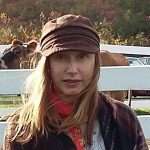
Sally Nacker
That’s the kind of thought the poems of Nacker inspire.
Nacker previously published three poetry collections: Vireo (2015), Night Snow (2017), and Kindness in Winter (2021). Her poems have been published in such literary journals as Canary, ONE ART, The Orchard’s Poetry Journal, The Sunlight Press, and Third Wednesday. She received the Connecticut Audubon Society’s Edwin Way Teale Writer-in-Residence at Trail Wood award in 2020. She received her MFA degree in creative writing from Fairfield University and lives in Connecticut with her family.
You don’t have to live in the woods to be affected, often deeply, by these 16 poems. Nacker serves as a quiet guide to the woods around her home, and in the process she opens our eyes to the nature around our own homes, even if they are distant from woods and in an established suburb.
Photo by Kentama, Creative Commons, via Flickr. Post by Glynn Young.

How to Read a Poem uses images like the mouse, the hive, the switch (from the Billy Collins poem)—to guide readers into new ways of understanding poems. Anthology included.
“I require all our incoming poetry students—in the MFA I direct—to buy and read this book.”
—Jeanetta Calhoun Mish

- “Paul Celan: A Life” by Anna Arno - October 6, 2026
- Reading Paul Celan for the First Time - October 1, 2026
- Poets and Poems: Christian Wiman and “The Dance” - September 29, 2026
Donna Hilbert says
A thoroughly wonderful book.
Sally Nacker says
Thanks, Donna!
Sally Nacker says
Thank you, Glynn, for the beautiful and thoughtful review of MY WILD YARD! I truly appreciate the care and time you took in writing it!