
Alan Jacobs explains how our understanding of “Paradise Lost” has changed.
We were in London in 2024, and I signed up for a London Open House tour that was right by our hotel. London Open House was a two-weekend event in which buildings not normally available to the public (or tourists) were open. Most, like this walking tour, required pre-registration.
The tour was fascinating. I had walked around these streets scores of times and never knew what had happened here. That rather ornate building around the corner – where Winston Churchill recorded all of his wartime addresses. That townhouse on a side street – the original building for the British Museum. That large stone mansion that backed to St. James’s Park – built by John D. Rockefeller as his London home. The rather nondescript office building across from the tube station – where Ian Fleming worked for MI-6 before he wrote the James Bond stories.
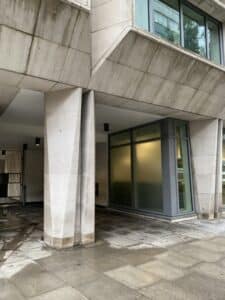
The site where’s Milton’s house stood.
And right there, on a street named Petty France, was a Brutalist building housing the Ministry of Justice (it’s an ugly edifice; we call it the “Darth Vader Building”). At one corner is a small courtyard-like area. And right here, on this site, stood the house where then-blind poet John Milton (1608-1674) lived with his daughters and dictated the entirety of Paradise Lost. The only hint of this is the pub across the street, the one named the Adam and Eve.
Paradise Lost is one of the works that everyone wants to say they’ve read but hope no one asks for details. The fact is that it is one of the great works of English literature, cited by many as equal to or greater than Shakespeare and Chaucer. It’s also one of the greatest poems written in any language.
But as Alan Jacobs points out in Paradise Lost: A Biography, the work is also something else, a kind of cultural bellwether. People’s understanding of the poem has changed rather dramatically over the centuries.
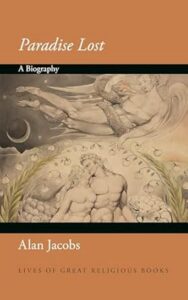 When the poem was first published in 1667, it was not a commercial success, due somewhat to how the publisher managed it. But it did find sales, if not broad critical acclaim. The poem’s greatness was recognized by the poet John Dryden (who had worked for Milton for a time) and later Joseph Addison. Addison especially seems to have promoted the work.
Jacobs provides a brief biography of Milton and an introduction to the work itself, explain its themes and structure. He then examines how the poem has fared over the centuries. Samuel Johnson didn’t like it, seeing it as anti-Anglican. William Blake did like it but thought Milton had been “of the devil’s party” without realizing it. The Romantics embraced it; Blake, John Keats, William Wordsworth, Mary Shelly, and Percy Shelly all wrote about it. The Victorians recognized it as a great work but, Jacobs says, rather marginalized it.
But it was 20th century literary critics who began to deprecate the poem. Religious critics like Charles Williams (friend of C.S. Lewis and the Inklings) found its theology to be deficient. But it was also Williams and later Lewis who recognized that attacked on Paradise Lost were less about the poem and more about what critics didn’t like about Christianity.
Jacobs continues his discussion by tracing the influence of and references to the poem in operas, verse plays, fantasy literature, and even video games. It’s a comprehensive account of how the poem has fared since Milton recited it to his daughters in the early 1660s.

Alan Jacobs
Jacobs is the Distinguished Professor of the Humanities in the Honors Program at Baymor University. He received his B.A. degree from the University of Alabama and a Ph.D. degree from the University of Virginia. He’s taught at Baylor since 2013; prior to that, he taught at Wheaton College in Illinois for 29 years. Jacobs has published numerous books, including two critical editions of W.D. Auden’s works, The Narnian: The Imagination of C.S. Lewis, A Theology of Reading, a biography of The Book of Common Prayer, How to Think: A Survival Guide for a World at Odds.
That the biography suggests is that Paradise Lost has served as something of a cultural mirror. The response to and assessments of it over the centuries often tells us more about the people writing about it and the times they lived in. Like many great works of literature, Paradise Lost serves as a cultural mirror, often telling us more about ourselves than what it’s actually about.
Photo by James Bentley, Creative Commons, via Flickr. Post by Glynn Young.
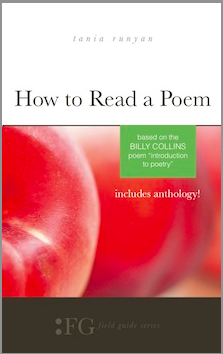

How to Read a Poem uses images like the mouse, the hive, the switch (from the Billy Collins poem)—to guide readers into new ways of understanding poems. Anthology included.
“I require all our incoming poetry students—in the MFA I direct—to buy and read this book.”
—Jeanetta Calhoun Mish

- Poets and Poems: Arlene Demaris and “Instructions for Use” - July 9, 2026
- Poets and Poems: Christy Lee Barnes and “Commodore Rookery” - July 7, 2026
- Philip Freneau: Poet of the American Revolution - July 2, 2026
Leave a Reply