
Gregory was a Beat poet with an unusual history
I have to admit that I was not only unfamiliar with the poetry of Gregory Corso (1930-2001) but I also had never heard of him. That is, until I walked into an exhibition at the St. Louis Art Museum and saw a monumental painting (roughly 30 feet tall), with its title written into the top of the painting: “For Gregory Corso.”
I pulled out my phone and Googled him. A Beat poet, an associate of Jack Kerouac, Allen Ginsberg, Frank O’Hara, Neil Cassady, and publisher Lawrence Ferlinghetti of City Lights Bookstore, among several others. That clicked; it placed him in the 1950s in counter-culture San Francisco, a decade before the hippies. Allen Ginsburg’s famous Howl. Beatniks. Cool, man.
Corso was a Beat poet, but only for a time. He was something of a nomad, roaming from New York to San Francisco, to unofficial student status at Harvard (he never enrolled) to Europe and back. He embraced and was embraced by the Beats, but he flew far beyond.

Gregory Corso
The child of teenaged immigrants, he was given up for adoption. He was sent to prison for theft, and that proved the turning point. For it was in prison that a fellow inmate introduced him to literature and poetry. With no formal education, or not much of one, he made friends with wealthy students at Harvard, and his poems so impressed poet and professor Archibald MacLeish that he created a special “non-student” status for him that allowed Corso to attend classes.
Over the course of his life, Corso published 12 poetry collections, novels, plays, and even albums. It was as if he couldn’t stop writing. As his friend Ginsberg said of him, “Corso is a great word-slinger, first naked sign of a poet, a scientific master of mad mouthfuls of language.” After reading some of his poetry, I think Ginsberg was making something of an understatement.
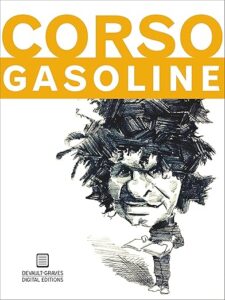
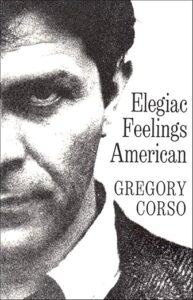
Inspired by the paintings of Anselm Kiefer, which were in turn inspired by Corso’s poems, I acquired two of his poetry collections. Gasoline was published in 1958, close to peak Beat time. In 1970, he published Elegiac Feelings American, a decidedly different kind of collection yet one still retaining features of Beat poetry.
Gasoline contains 31 poems. As Allen Ginsberg says in the introduction, reading these poems is like opening a box of crazy toys. They cover a wide array pf topics and themes – places in Europe, paintings, meals, driving a car, a puma in a Mexican zoo, cats, and visiting the building where Corso was born in New York City, among others. It seems almost like a feverish riot of themes and ideas, sharing one basic characteristic – a love affair with words and language, including some words he invents on his own. It’s as if the prison inmate who discovered literature in a cell stays simply can’t express himself enough. And it all comes pouring out of him, even when he thinks he’s at a loss for words.
No Word
 It is better man a word elongate
And eat up what another spake
For no man is word enough
Who complains, to boot,
The word he ate was tasteless tough
It is better man give up his diction
become mouthless
it is better
that another man, myself,
heed his restriction
I know no word that is mine
and I am tired of his
It is better to sew his mouth
dynamite his ears hearless
drown his vocabulary
It is better
his eyes speak and listen as well as see.
Twelve years later, Corso published Elegiac Feelings American, a collection of 39 poems. What’s happened between the two collections is the 1960s – the protest movement, the Vietnam War, hippie culture, the assassinations of John and Bobby Kennedy and Martin Luther King, the widespread use of drugs, and all the various movements and counterculture events. The title poem is a six-and-a-half page elegy in memory of Jack Kerouac; it is also something of a lament for what Corso believed what America had become.
Many of the collection’s other poems mirror this theme of America. Corso was talking about the “end of history” two decades before it became fashionable if academic and foreign policy circles. Even the five “Poems from Berlin” are less about the German city and more about America. Even though the Beats moment had passed, this poem includes features of that era’s poetry – exclamation points (the Beats loved those punctuation marks), invented words, and a combination of ideas and images that can seem confusing.
One Day
 One day while Peter-Panning the sky
I saw a man,
a man dying over the Eastern Gulf,
and I said to this man:
–The light that makes us a fiend of eagles
has made our poor wounds an interval of clouds,
slow and creeping, calm and sad,
in the skyful dungeon of things. –
And he replied:
–The sky is awful! The sky undarkens!
Hermes, his winged foot, rests old in China!
Rests uncontested while cloudbursts burst
and windleaves fall!
while my tired hands hold back
the violent skirt of night!
while my moss-covered feet crush
the seaports of the day!—
I left the dying man, and he must always die,
for Solitude refuses to lower a gentle hand
upon his long sad face.
Corso is said to have reached his peak in the 1960s and 1970s, but he remained influential until his death from prostate cancer in 2001. He was buried in Rome at the foot of the grave of Percy Bysshe Shelley, one of his poetic heroes, and close to grave of John Keats. One of his poems serves as his epitaph.
_-_Foto_Giovanni_Dall%27Orto,_31-March-2008.jpg%20)
Photo by Giovanni Dall’Orto via Wikimedia Commons
Related:
Finding Poetry in an Anselm Kiefer Exhibition.
Photo by H Mathew Howarth, Creative Commons, via Flickr. Post by Glynn Young.

How to Read a Poem uses images like the mouse, the hive, the switch (from the Billy Collins poem)—to guide readers into new ways of understanding poems. Anthology included.
“I require all our incoming poetry students—in the MFA I direct—to buy and read this book.”
—Jeanetta Calhoun Mish
- When a Poem Completely Eludes You - October 8, 2026
- “Paul Celan: A Life” by Anna Arno - October 6, 2026
- Reading Paul Celan for the First Time - October 1, 2026
Lydia Kann says
Having walked into the St Louis Art Museum yesterday, July 4th, to Kiefer’s monumental lobby installation, I too searched for Gregory Corso info. And here I am, coming across your similar quest. I am a huge Kiefer fan ever since falling in love with his L.A. Exodus installation in 2023 at the Marciano Foundation. Incredible! Thank you for the helpful guide to Corso’s relevance. I will go find his books. As an artist and writer myself, I am influenced by experiences like Kiefer’s Exodus and Becoming the Sea, and try, within my own limitations, to incorporate into my own work something of what has offered a kind of exhilaration. Maybe Corso too will find his way into my meanderings. Thanks for your contribution!
Glynn says
I’ve been a fan of Kiefer’s work since 2014, when I saw an exhibition of his work in London. Many of the paintings were from the 1980s, when Kiefer became among the first German artists to mention the unmentionable in Germany — the Hitler years of 1933-1945. The show was simply entitled “Anselm Kiefer.” I was stunned. For “Becoming the Sea,” I didn’t have to travel — it was right there in my hometown. The exhibition catalogue wasn’t available until after the show had closed, and I finally got my hands on one. The salesperson said they’re a bestseller for the museum, even months later. You may have seen it, but the museum’s blog has several posts on the exhibition: https://www.slam.org/blog/?se=Kiefer. And this was the video overview: https://youtu.be/FI96DMlhm2o.
Lydia Kann says
Thank you for the blog and video links! I saw the catalogue from this show while at the Museum, but decided I couldn’t carry it back this visit. I will find it online, but really would love his Exodus catalogue even more. That exhibit was very Holocaust related, and lots of heavy ladders, shopping carts, canoes attached to the surface. The setting was cathedral-like, no overhead lighting, simply spotlights, so it was dark and cavernous. And the paintings were as high as at the SLAM. But who’s comparing?! Unfortunately, I think it’s hard to convey the intensity of the images in a book. So much depends on the relief work, color, and the scale. Anyway, lovely to find another Kiefer devotee, as excited as I am!