Christy Lee Barnes navigates motherhood in poetry
We just finished watching our youngest son’s wife navigate the first two stages of motherhood — pregnancy and childbirth. She was a trouper, and I spent a lot of time in simple, quiet awe. And now our and her families have been blessed with fraternal twin boys.
Poets have addressed motherhood probably as long as poetry has existed. Elizabeth Barrett Browning (“Mother and Poet”) and Christina Rossetti (“To My Mother”) come to mind, but even Edgar Allan Poe wrote “To My Mother.” Other poets who’ve written about mothers or motherhood include Gwendolyn Brooks, Sylvia Plath, Nikki Giovanni, Sharon Olds, Louisa May Alcott, Langston Hughes, Maya Angelou, William Blake, and Sara Teasdale.

Christy Lee Barnes
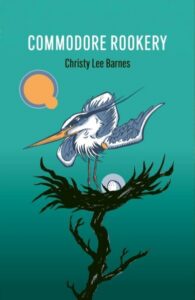
Christy Lee Barnes navigates the territory of motherhood in her 16-poem chapbook, Commodore Rookery. And she does so in a way that’s unexpected. She comes in at an angle, less about the overall experience and more about the small things — the feeling of fragility, the bodily changes, the fears, the breast pump, the experience of watching her own identity change, the waiting, the experience of labor, and the baby nuzzling against her. Small but important things.
She weaves the imagery of birds, nests, and flight through the poems (thus the “rookery” of the title). In their own way, birds tell the experience of pregnancy and motherhood — the naturalness of it, the preparation, the nesting, the care and feeding. (I’ve spent the last two years watching pairs of birds cluster around a birdbath outside our kitchen window, and can confirm that the connections to human motherhood are valid.)
This poem introduces the chapbook, and it sets the tone for what follows.
Late Postpartum Dream Sequence
 You are bound with thick ribbons
knots at your wrists, knees, ankles, waist.
Anywhere you might break.
You might break anywhere.
Bright silk, colorful.
Constricting blood flow.
You tied them all yourself.
Now you pull at a loose end
until it unspools.
Now you flex your naked wrist,
which is healed,
which was never broken.
Barnes has published poems in a number of literary journals and publications, including McSweeney’s, Prairie Schooner, Plume, Tin House, and Spillway. She has worked as a public school teacher in Los Angeles and a poetry teacher in Seattle Public Schools. Barnes lives with her family in Seattle.
A chapbook is a small thing compared to a full collection. But “small” doesn’t mean less meaningful. The poems of Commodore Rookery make an impact, a thoughtful, mindful impact, displaying the words of someone who has thought deeply about the experience of motherhood.
And don’t forget to watch the birds.
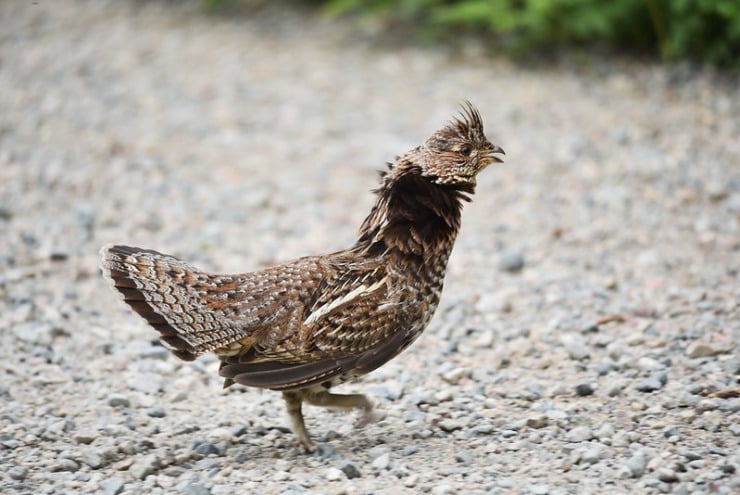
Photo by USFSW Midwest Region, Creative Commons, via Flickr. Post by Glynn Young.

How to Read a Poem uses images like the mouse, the hive, the switch (from the Billy Collins poem)—to guide readers into new ways of understanding poems. Anthology included.
“I require all our incoming poetry students—in the MFA I direct—to buy and read this book.”
—Jeanetta Calhoun Mish

- Poets and Poems: Gabrielle Myers and “Go Forth: Lose Yourself into Life” - August 20, 2026
- Jon Nappa Imagines the Life of Longfellow - August 18, 2026
- Poets and Poems: Martyn Hesford and “Ash Light” - August 13, 2026
Leave a Reply