
Mischa Willett finds grace, purpose, and meaning in poetry.
I’ve talked before about my experiences with the art of Anselm Kiefer. I’d seen two of his works at the St. Louis Art Museum, and then in 2014 I walked into an entire exhibition at the Royal Academy of London. Over this past winter, the St. Louis Art Museum staged a massive exhibition of his works entitled “Becoming the Sea,” named for a line of poetry from Gregory Corso. One work also cited lines from the poet Paul Celan, and I just posted about Celan last week. Yes, I’m a fan of Kiefer’s art, but I don’t think I could quite articulate why.
Until now. I read a poem in This Gift Card Has Already Been Redeemed, the new collection by Mischa Willett. The poem is about Kiefer, and it’s about art, writing, and books. And it’s mostly about the act of artistic creation. The poem explained, to me, at least, what it was about Kieffer’s art that I find so profound.
Advice
 Yesterday, Anselm Kieffer
wrote to tell me I don’t
need to show you everything
I am writing. It is okay
to make things, he said, even
miraculous things and keep
them from view. You made
them, was his point, that is
enough.
He’s always saying such things:
provocative, unimagined and
suddenly true upon reflection.
It’s irritating. The questions
will be easy, like what is a
sculpture and I start to
carve out an answer
and am interrupted by a follow-up
like what is a book, and I
think come on, this is a book
right here. But then he shows
me these pages that are too
heavy to open, and you have to be
there at a certain time when
a specialist turns one
and he smiles or not
really smiles but you know that
way of his, an inverted grin
that says something absurd like
come back next year and I’ll
show you another page.
It’s not about the book, or the artwork, or the poem, or the novel. It’s about the making.
Willett’s new collection contains 64 poems, and it includes references that explain, or point toward, how they came to be made, and where the influences are. Beyond Anselm Kiefer, they include poet Marvin Bell, W.S. Merwin, the Gospel of John, William Stafford, the Book of Psalms, Virginia Woolf (Willett shares a birthday with her), pet Anthony Madrid, Julian of Norwich, Sandro Botticelli, Robert Frost, Pablo Neruda, Thomas McGrath, Denise Levertov, Mark Jarman, literary critics (with their pans and praises), the Spanish poet Anthony Machado, Kurt Vonnegut, and more. You can add his grandmother and a guy in the cafeteria to the list.
You see these reference, and you realize that this is a collection where small, individual streams have gradually come together as a poetic river. The streams blend and move together. And the significant thing is not that you have a river, but that a river has been made. The significance is the making; the purpose and the meaning is the making, not fac that anything will travel upon the river or that there is some destination to reach on the river. As Willett writes in one poem, “Passed Time,” it’s “the memory of moving / I keep coming to the same places / and watching everything disappear.”
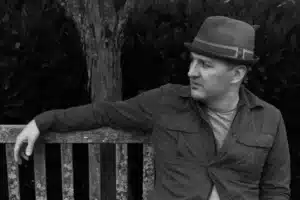
Mischa Willett
Willett teaches English at Seattle Pacific University. He specializes in 19th century British poetry and also teaches Shakespeare, C.S. Lewis and the Inklings, and creative writing. He received his B.A. degree from Wheaton College, his M.A. degree from Northern Arizona University, and his M.F.A. and Ph.D. degrees from the University of Washington. His poetry and writing have been published in First Things, Books & Culture, Mere Orthodoxy, Front Porch Republic, Rio Grande Review, Saint Katherine Review, The Christian Century, and other publications. He’s published two previous poetry collections, Phases and The Elegy Beta, and edited a recent edition of Festus, the Victorian epic by Philip James Bailey.
This Gift Card Has Already Been Redeemed includes an introduction by poet Ben Palpant, which is as beautiful and moving as the collection by Willett he’s describing.
So, thank you, Mischa Willett, for helping me understand my attraction to Kiefer’s art. Thank you for river of poetry that’s shaded by meaning and grace. And thank you for the sheer enjoyment of reading the 64 poems that form that river.
Related:
Mischa Willett and The Elegy Beta.
Finding Poetry in an Anselm Kiefer Art Exhibition.
Ben Palpant Talks with 17 Poets About, Well, Poetry.
Photo by Ken Xu, Creative Commons, via Flickr. Post by Glynn Young.
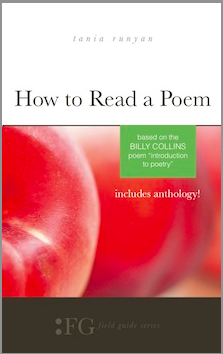

How to Read a Poem uses images like the mouse, the hive, the switch (from the Billy Collins poem)—to guide readers into new ways of understanding poems. Anthology included.
“I require all our incoming poetry students—in the MFA I direct—to buy and read this book.”
—Jeanetta Calhoun Mish
- Poets and Poems: Mischa Willett and “The Gift Card Has Already Been Redeemed” - October 13, 2026
- When a Poem Completely Eludes You - October 8, 2026
- “Paul Celan: A Life” by Anna Arno - October 6, 2026
Maureen says
I do wish I could have seen that exhibition of Keifer work when I last visited St. Louis and its wonderful museum.
Thank you for this review of Willett;s collection, Glynn.