Emily Bright considers what grounds us in our lives
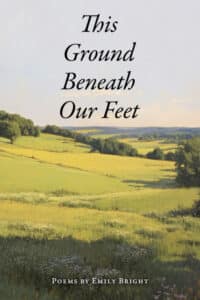
As I read Emily Bright’s new collection of poetry, it was the word “ground” in the title that kept coming to mind. “Ground” has a double meaning. It can be the physical ground we stand and walk upon and that our homes occupy, and it can be the historical, genealogical, emotional, psychological, and social realities that gives shape to and hold our lives in place. While This Ground Beneath Our Feet includes both, it is the second kind that Bright really focuses on.
The collection, appropriately enough, uses the metaphor of a growing tree to organize the poems into four sections. The poems of “Roots” draw from her family history – colonists traveling to a new land, the ocean passage itself, and clearing the land in their new homes. The poems of “Ground” move to both the physical landscape as well what the land produces. These are not confined solely to space; one poem describes interplanetary space travel but still manages to be about ground. The poems of “Branches” move closer to her own contemporary life, and “Seeds” describes not only scenes of childhood but also cultural seeds, like reading poetry in a prison environment.
The poems reflect a love for stories, and Bright tells some fascinating ones. A family packs up its belongings in the 1700s to create a new life in a distant land (and the grandmother refuses to be left behind). A young wife experiences an ocean passage. A father returns home from a whaling ship expedition. A farmer burns hay at the edge of a field. A visitor walks through the capital of Ghana to understand and leave a footprint. A chess tournament in South Dakota becomes a meditation. A driver caught in a storm tries to remember what to do if the car is struck by lightning. A child reaches to her mother to calm nighttime fears.
This is one of the poems included in the “Ground” section. While many of her poems could be considered my own personal favorite, I found myself especially liking this one.
Log Cabin
 You know they were trees, and recently:
stripped down, interlaced like fingers,
four walls rising log by log.
Piled graying trunks await their turn,
straight like phone poles—no, like trees.
So easy to forget the origin of things.
We have planed boards, steel, pre-made
doors that close exactly. Someone rides
a lawnmower across the road, away.
Who is building this log cabin upward
from the dirt? More thistle inside,
Queen Anne’s lace at waist-high.
Bees tasting where the stove should go.
When the roof blocks out the light,
save four-foot door and window slit,
who will notice the elaborate
rippling where each branch was?
The doorframe oozes pitch.
Don’t paint this house, don’t finish it.
The wind stirs from behind me.
Green stalks sway inside the walls and out.
Emily Bright
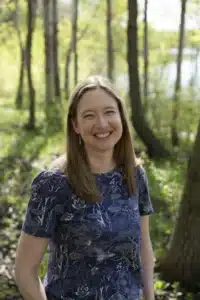
Bright writes middle grade novels, picture books for children, and poetry. She’s also co-authored a non-fiction work, Powerful Ideas in Teaching. Her previous poetry collections were Fierce Delight: Poems of Early Motherhood and the chapbook Glances Back. Her poems have also been published in numerous literary journals and magazines, and she serves as a weekend host for Minnesota Public Radio News. Bright studied English at Williams College and received her MFA degree at the University of Minnesota. She lives in Minnesota with her family.
This Ground Beneath Our Feet is a reminder of just how important storytelling is in our lives. Those stories we hear, and that we tell our children for them to tell their children, shape ourselves and those around us. And they may truly be the real ground of our lives.
Related:
In the poetry collection Fierce Delight, Emily Bright documents early motherhood – National Public Radio
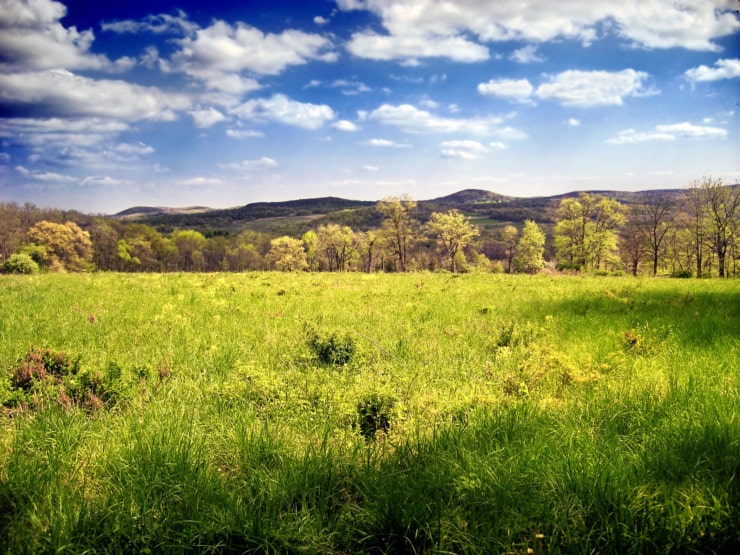
Photo by Nicholas_T, Creative Commons, via Flickr. Post by Glynn Young.

How to Read a Poem uses images like the mouse, the hive, the switch (from the Billy Collins poem)—to guide readers into new ways of understanding poems. Anthology included.
“I require all our incoming poetry students—in the MFA I direct—to buy and read this book.”
—Jeanetta Calhoun Mish

- When a Poem Completely Eludes You - October 8, 2026
- “Paul Celan: A Life” by Anna Arno - October 6, 2026
- Reading Paul Celan for the First Time - October 1, 2026
Leave a Reply