
Longfellow never wrote a poem about Thanksgiving Day.
I went looking for a Thanksgiving Day poem, specifically one by Henry Wadswoth Longfellow (1807-1882). As much as I’ve read Longfellow over the past five years, I thought I remembered one. I found one that wasn’t about the day but about giving thanks in general. And I found one about the harvest, which we’ve featured here at Tweetspeak Poetry before for Thanksgiving Day.
As it turns out, Longfellow never wrote a poem for the day. He was alive at the time President Abraham Lincoln declared Thanksgiving to be a National Day of Observance in October of 1863, after the strategic Union victories in the Civil Wat at Gettysburg and Vicksburg. Like so much else that happened during the Civil War, the holiday was federalized. Previously, it had been left largely to the individual states.
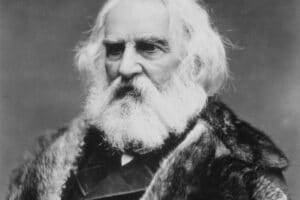
Henry Wadsworth Longfellow
But if there was a poet widely loved during that period and much of the 19th century, it was Longfellow. He helped create national myths like Paul Revere’s ride and the story of Miles Standish; he introduced America to the story of the expulsion of the Acadians from Canada; and he depicted a native American as something other than a “noble savage.” He was America’s poet, and that was the reason I wrote his poetry into my historical novel Brookhaven.
When I was researching Brookhaven, I discovered I didn’t know as much about the Civil War as I thought I did, and I found an indirect connection of Longfellow. As it turns out, my great-grandmother Octavia, who provided the name for the character Octavia Jane Montgomery in the novel, is a descendant of John Alden and Priscilla Mullins of Miles Standish fame. I know there are probably at least two million other Americans who can say the same thing, but still. How cool is that? They were passengers on the Mayflower and likely participants at the first Thanksgiving to boot.
That first thanksgiving was to celebrate a difficult first year for the Pilgrims, and they celebrated with a meal, giving thanks for the harvest (and the generosity of the native Americans). It was the harvest that Longfellow celebrated in his poem.

A first edition of Keramos; photo via Abe Books
The Harvest Moon (1878)
It is the Harvest Moon! On gilded vanes
And roofs of villages, on woodland crests
And their aerial neighborhoods of nests
Deserted, on the curtained window-panes
Of rooms where children sleep, on country lanes
And harvest-fields, its mystic splendor rests!
Gone are the birds that were our summer guests,
With the last sheaves return the laboring wains!
All things are symbols: the external shows
Of Nature have their image in the mind,
As flowers and fruits and falling of the leaves;
The song-birds leave us at the summer’s close,
Only the empty nests are left behind,
And pipings of the quail among the sheaves.
“The Harvest Moon” was published in his 1878 collection Keramos and Other Poems. Longfellow was 71; he would publish two more collections before his death in 1882. By this time, the poet was a legend, something of a national eminence. Over the course of Longfellow’s lifetime, the nation had radically changed; America was now well on its way to becoming an industrial behemoth. Longfellow was the connection to national memory, to the time before the Civil War when life seemed much simpler. Life always seems simpler when you look back.
On this day, the team at Tweetspeak Poetry would like to wish each of you a Happy Thanksgiving. And we want you to know how much we are thankful for each of you and the poetry we feature.
I don’t think Longfellow would mind if I offered thanks on his behalf to you as well.
Related:
Cross of Snow: A Life of Henry Wadsworth Longfellow by Nicholas Basbanes.
Our Best-Known Patriotic Poem: Longfellow Visits a Church.
What Happened to the Fireside Poets?
Photo by Lukas Schlagenhauf, Creative Commons, via Flickr. Post by Glynn Young.

How to Read a Poem uses images like the mouse, the hive, the switch (from the Billy Collins poem)—to guide readers into new ways of understanding poems. Anthology included.
“I require all our incoming poetry students—in the MFA I direct—to buy and read this book.”
—Jeanetta Calhoun Mish

- Poets and Poems: Betsy Mars and “Rue Obscure” - October 22, 2026
- Poets and Poems: Kortney Garrison and “The Fixed Hours” - October 20, 2026
- Matthew Zapruder and “The Story of a Poem” - October 15, 2026
Leave a Reply