I lugged around my Norton and hung out with the English majors.
I still own four of the textbooks I used in college: Investigative Reporting, The History of Journalism, and a two-volume set of The Norton’s Anthology of English Literature. The fact that I was a journalism major explains the first two. But those two volumes of the Norton have their own story. What those four books have in common is that I took those courses all in my sophomore year. You can do the math: my sophomore year was 1970 to 1971.
The vast majority of my sophomore class took the required English 55 and 56 classes – American literature. There was also another option – English 51 and 52, English literature.
No one took English Lit, except English majors. It was notorious for the rigor of its instructors, focused as they were on educating the next generation of English teachers. That’s who generally took the two courses.
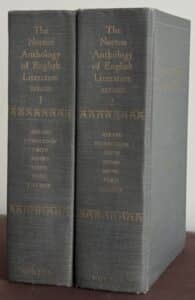
My two-volume set of the Norton
I don’t remember why I decided to go with the English majors. I was in journalism; I was not going to be teaching English literature. I suspect it had something to do with T.S. Eliot, whose poetry I’d discovered in high school. Yet that’s not really an excuse; Eliot was also taught in the American literature course.
There I was sitting in a class of about 15 students in the fall of 1970 and the spring of 1971. The first course covered the beginnings of English literature to the Romantic period; the second covered the Romantics through the moderns. The textbooks were a two-volume set, hardbacks with gray covers and about 2,000 pages each. The Norton Anthology. Yes, you built muscles carrying those books to class.
The English 51 instructor was a quiet, monkish looking man, “monkish” in that he had a tonsured haircut. He never explained why. Perhaps he thought of himself as a modern-day Venerable Bede. But he loved his subject. He especially liked English literature through Geoffrey Chaucer but not beyond. He did not like William Shakespeare.

Geoffrey Chaucer
I was happy to read Canterbury Tales. I’d read it in high school, a modern English version, and I loved it. Now, however, I discovered we had to read it in Old English. Yes, the whole thing in Old English, the version that starts “What that April with his showres soote / The droughte of March hath perced to the roote, / And bathed every veine in swich licour…” I’d practice reading it aloud in my room; my roommate thought I’d lost my mind.
We read Beowulf, which the Norton included in a Modern English prose translation, for which even the English majors wept in gratitude. We read other staples, like Piers Plowman, and Sir Gawain and the Green Knight. We studied medieval ballads like “Barbara Allen” (best known today as a song by Simon & Garfunkel). And Shakespeare? Henry IV, Part 1. That was it. The instructor said he knew we’d all read Shakespeare’s major plays so many times that we’d be bored reading them again. No one corrected him, including the journalism major.
We have a different instructor for English 52, the Romantics through the Moderns. She was young, loved her work, and loved poetry. The was also something of a tyrant. The course started with William Wordswoth, John Keats, Percy Bysshe Shelley, and Samuel Taylor Coleridge, focused on those four poets, wedged in a week for Alfred, Lord Tennyson, and then crammed the rest of the Victorians and the Moderns in the three-week run-up to the final exam. Guess which period the instructor favored?

Keats, Wordsworth, Shelley, and Coleridge
I can look at my second volume of the Norton and see something really odd – the sections on the Romantic poets and Tennyson are falling apart, scribbled on, notated by my pen, and the rest of the volume looks brand new. Including Eliot. We did read The Love Song of J. Alfred Prufrock, The Waste Land, and a few poems by William Butler Yeats, hurriedly taught as the final exam loomed.
The final exam included an essay and a large section of single lines from poems. You had to identify the poet from that single line. The lines were not obvious; there were no references to clouds or daffodils, Grecian urns, albatrosses, or skylarks and Ozymandias. No, these lines were obscure. The English majors howled in protest. I played detective, looking for stylistic clues rather than obvious words or phrases. I must have guessed right most of the time, because I passed the exam and the course. I was expecting a disastrous grade; I ended up with a B+ on the exam and an A in the course.
But those courses, and those two volumes of the Norton, would shape my understanding of poetry for the rest of my life. And I held on to the books. Each volume cost $8.75 in 1970, equivalent to $75 today. On Amazon, the anthologies have grown to a total of six paperback volumes, and you can buy them for about $150 for both sets. English literature hasn’t appreciated much. The description on Amazon says the contents of the 11th edition “demonstrate the relevance of literature to contemporary students and trace the creative arc that has yielded the ever-changing and ever-fascinating body of material called English literature.” I’m not sure why that doesn’t exactly fill me with confidence.
But lugging those volumes around with me, discussing the poems in class, and staring in disbelief at a final exam with obscure poetic lines all taught me important lessons. Old poetry can be beautiful. There’s a reality behind calling something “classic” and “great literature.” I learned that teachers tend to teach what they favor, and a poet can often be recognized by style in addition to substance. The Norton Anthology of English Literature could help build muscles, physical and mental.
And I’ve held to those volumes from 1970, a reminder of where I came from.
Photo by Taz, Creative Commons, via Flickr. Post by Glynn Young.

How to Read a Poem uses images like the mouse, the hive, the switch (from the Billy Collins poem)—to guide readers into new ways of understanding poems. Anthology included.
“I require all our incoming poetry students—in the MFA I direct—to buy and read this book.”
—Jeanetta Calhoun Mish

- How the Norton’s Anthology Shaped My Understanding of Poetry - August 27, 2026
- Poets and Poems: Peter Murphy and “You, Too, Were Once on Fire” - August 25, 2026
- Poets and Poems: Gabrielle Myers and “Go Forth: Lose Yourself into Life” - August 20, 2026
Leave a Reply