
Peter Murphy writes poems candidly, from experience
About the time my mother turned 75, she said something to me that she’d been apparently been saving up. “You know,” she said, “I’ve reached an age when I can say what I think, and I don’t have to worry about what happens because of it.” This was something she learned from her own mother, who’d made some kind of similar announcement at about the same age. Except my grandmother had been doing exactly that long before she announced it. So had my mother.
I remembered those statements as I read deeper into You, Too, Were Once on Fire: Poems by Peter Murphy. Ad those thoughts hit me as I read “Stairs to All Levels,” a poem about Frank O’Hara and New York City and the Twin Towers and 9/11, and you don’t even realize it until the end of the poem hits you upside the head with a smack. It was that poem, followed immediately by “Miss Besieged Sarajevo,” about a beauty contestant during the Bosnian War in 1993, that made me realize I needed to make sure my seat belt was buckled and tray tables were locked securely for takeoff.
I was right.
Murphy writes about the free market, terrorism, the horrors of political torture, banana republics, the frustrations of rush hour, the homeless, the global travels of dust, Dagwood and Blondie as if they lived in the real world, the collapse of a marriage, the experience of a heart attack, his childhood, and more. He writes of New York City and Wales, where he grew and was born, respectively. And all the while, he’s writing candidly, disguising nothing, saying exactly what he means.
The Forgotten Man
 The man who forgot himself rises
out of his cardboard sleep into the concrete morning
to relieve himself of hunger.
Everything has acquired use—trees have become lamp posts,
deer have turned into taxicabs that whistle down
Park Avenue on cloven tires of rain.
He walks among the citizens of this canyon
and sees himself reflected in plate glass, blurred
by blue buses, yellow livery, gray commuters
that dash across his own dim image in the shiny panes.
Eventually, when he recalls his faceless face upon well-fed
mannequins, his life loses sense. He sees himself in shop
window after shop window with his palms open to tokens and change,
open to a currency that will carry him through elements
that are benign, where the trains that rumble beneath
the surface wheeze silently all through the screaming night.
Murphy writes with a raw energy, taking you places you don’t expect to go but understand once you’re there. I flinched at the titles of a few of poems, like “Prostitutes Appeal to the Pope,” until I read them, and I understood what he was saying. I understood enough to know I should trust where this collection was going, and I’m glad I did.
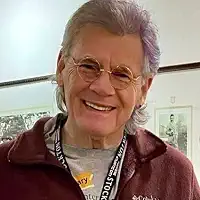
Peter Murphy
One of the poems of You, Too, Were Once on Fire, “The Business of Clouds,” mentions both William Wordsworth and Emily Dickinson. “As you recall Dickinson’s last words,” he writes, “you begin / to feel the damp body of fog touching you where you / do not wished to be touched.” Dickinson also said of poetry to “tell it slant.” Murphy does not tell it slant; he simply and powerfully tells it.
Photo by Scott1346, Creative Commons, via Flickr. Post by Glynn Young.
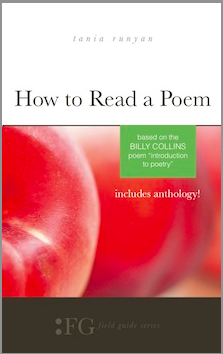

How to Read a Poem uses images like the mouse, the hive, the switch (from the Billy Collins poem)—to guide readers into new ways of understanding poems. Anthology included.
“I require all our incoming poetry students—in the MFA I direct—to buy and read this book.”
—Jeanetta Calhoun Mish

- When a Poem Completely Eludes You - October 8, 2026
- “Paul Celan: A Life” by Anna Arno - October 6, 2026
- Reading Paul Celan for the First Time - October 1, 2026
Leave a Reply