
D.S. Martin pays tribute to the metaphysic poets – with poetry.
Like many literary terms, “metaphysical poetry” was not something that the designated poets themselves invented. Instead, in the decades after they flourished, it was John Dryden (1631-1700) and Samuel Johnson (1709-1784) who popularized the description. They did not mean it as a compliment. Instead, they saw this group of 16th century poets as writers who abandoned the rules of poetry and created something unnatural. It wasn’t until the 20th century, led by figures like T.S. Eliot, that the metaphysical poets were seen as something important and creative in and of themselves.
The five poets usually labeled as “metaphysical” were John Donne (1572-1631), Henry Vaughn (1621-1695), George Herbert (1593-1633), Andrew Marvell (1621-1678), and Richard Crashaw (1613-1649). Sometimes a sixth is added, that of John Milton (1608-1674), but Milton doesn’t quite fit what the other five were about. One of Donne’s short poems has entered the collective consciousness, with its famous lines of “No man is an island” and “For whom the bell tolls.”

Andrew Marvell
Using conversational, everyday language, the metaphysical poets wrestled with big ideas. They often abandoned meter to delve deeper into what they were writing about. Three of them – Vaughn, Marvell, and Crashaw – lived and wrote through the tumultuous decades of the English Civil War, the execution of Charles I, the protectorate under Oliver Cromwell, and the restoration of the Stuart monarchy. Crashaw was an exile who died in poverty.
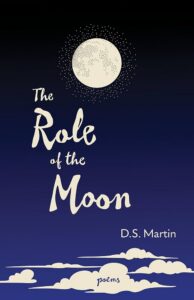
Poet, writer, and editor D.S. Martin finds the metaphysical poets to be inspirational and creative. And he’s published a poetry collection, The Role of the Moon, to pay tribute.
The poems aren’t imitative of the metaphysical poets. Instead, they demonstrate an understanding of what these poets were trying to do, and then the poems create something new that recognizes what they accomplished. Each poem has a subject, to be sure, but each also has meaning beyond that.
Martin consider nature; emphasizing the physical over the spiritual; how the heat of a summer afternoon becomes a meditation on one’s place in the world. He muses on the idea of a carwash for the soul; the poetry of a dove on Noah’s ark; walking on cracks in the sidewalk; and almost playfully reinterpreting Robert Frost’s “Stopping by Woods on a Snowy Evening.” He also suggests what ruins may actually mean.
Ruins Remind Us
 What we do rarely stays done
Not just laundry & dishes
& the trimming of trees
Rembrandts require restoration
castle ramparts crumble & scaffolds
arise along cathedral walls
Remnants of Lamanai & Tintern Abbey’s
ruins remind us nothing remains
forever
Even the sharp edges of Donne’s poems
are weathered by years of linguistic shift
in how our ears receive them
Along the Grand Canal they hide
the repairs in progress behind clever
screens What we do rarely stays done
Even our love will need continual
renewal to keep our precious ones
after we’re gone
Most of the poems occupy a single page. One poem, entitled “Prayer,” is six pages long. It is a conversation with the three persons of the Trinity, talking and asking questions about life and its purpose. If I have to pick a favorite in the collection, this one is it.

D. S. Martin
Martin has published several poetry collections, including Angelicus (2021), Ampersand (2018), Conspiracy of Light: Poems Inspired by the Legacy of C.S. Lewis (2013), Poiema (2008), and the chapbook So the Moon Would Not Be Swallowed (2007). He’s also edited several poetry collections, including poems drawn from his weekly blog posts at Kingdom Poets. Martin serves as Series Editor for the Poiema Poetry Series from Cascade Books, and his poems have been published in such literary journals and magazines as Canadian Literature, The Christian Century, Dalhousie Review, Event, Quadrant, and Sojourners, among many others.
It’s been a long time since I’ve read the metaphysical poets; I can remember reading their poems in English literature in college, especially John Donne and Andrew Marvel. Reading A Role for the Moon makes me want to revisit them and to see how they still inspire the creation of contemporary poetry.
Photo by Naoki Natsume/Ishii, Creative Commons, via Flickr. Post by Glynn Young.
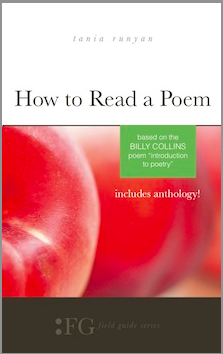

How to Read a Poem uses images like the mouse, the hive, the switch (from the Billy Collins poem)—to guide readers into new ways of understanding poems. Anthology included.
“I require all our incoming poetry students—in the MFA I direct—to buy and read this book.”
—Jeanetta Calhoun Mish

- When a Poem Completely Eludes You - October 8, 2026
- “Paul Celan: A Life” by Anna Arno - October 6, 2026
- Reading Paul Celan for the First Time - October 1, 2026
Leave a Reply