
Alexander Voloshin wrote an epic poem about the Russian Revolution and Hollywood.
Alexander Voloshin (1884-1960) was born in the Ukraine, then part of the Russian Empire. He had a career in theater, but World War I intervened and he became part of the Imperial Army. Then the Russian Revolution happened, and he found himself involved in the White-Red Civil War. When the Communists triumphed, Voloshin remained briefly in the Crimea. That was followed by a travel odyssey to Berlin, Brazil, and then Ellis Island. After a time in New York City, he made his way to Los Angeles and Hollywood, like thousands of other émigré Russians.
In Hollywood, he worked as a waiter and as an extra in movies. He was an actor in some 12 movies, the best known of which was “The World and the Flesh” (1932), starring Miriam Hopkins. The movie, set during the Russian Revolution, is about a rather nasty Communist revolutionary (Hollywood was big on Russian Revolution movies at the time). After his last role in 1937 (“Daughter of Shanghai,” starring Anna May Wong), Voloshin tried founding a theater magazine and writing for other publications.
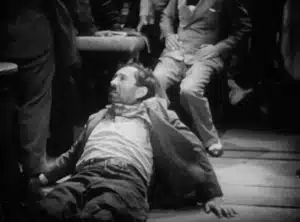
Voloshin in the 1937 film “Daughter of Shanghai”
Dralyuk translated and published Voloshin’s poem under its original title, Sidetracked: Exile in Hollywood. Not knowing Russian, I can’t speak to the quality of the translation. But it rings true. Voloshin is telling the story of thousands of emigres like himself, their lives torn apart by war, revolution, and social upheaval, who try to make a new life in other countries.
Sidetracked is full of exclamation points, asides, and comments by the poet, a surprise when you’re used to reading poems (even sagas and epics) in English. But what is suggested is the depth of feeling, the anger, the rage, and the sorrow caused by a social convulsion like a social revolution (and its murderous aftermath).
Each section, numbered chapters, is introduced by a quotation, proverb, or line from a song. A favorite source is poet and playwright Alexander Pushkin, whom Voloshin would have been familiar with because of his own theater background. This chapter in introduced with a line from Pushkin’s poem “Two Gypsies”: “A noisy band of gypsies roams / all through Bessarabian lands.” (Bessarabia corresponds approximately to present-day Moldova, tucked between Ukraine and Romania. In the time of the Russian Empire and its successor Soviet Russia, it would have something of a frontier area between Russia and Europe.)
Chapter 5
 You can’t put blinders on a bird:
refugee actors soon were lured
by shining spotlights and marquees.
Hard work in shops and factories
was not for them…How they deplore
the clang of metal and the roar
of horns, how quickly they grow weary
of all they seem “mundane” and “dreary.”
A rose cannot bloom in a ditch…
And so, succumbing to the itch,
they all rushed off to Hollywood!
Having saved up as best they could,
they bought, in sets of twos or threes,
suits, pairs of shoes, and BVDs.
Since they were destined for great fame
and millions would be theirs to claim,
they happily ignored all rules
of economics—silly fools!
A cushy sleeper in first class…
The dining car is where they pass
their days…They loosen their new belts
and watch their dollars melt, melt, melt…
The lines have a theatrical quality about them, almost as if they were meant to be projected on stage instead of a printed page. Most of the entire poem is similar. It’s not like reading a play script, but more like watching a stage production in print.
When Voloshin died n 1960, his occupation was listed as cab driver. Dralyuk notes that it seems almost a Russian émigré cliché – so many former army officers and aristocrats becoming cabbies, waiters and other unthinkable occupations for people who held once-lofty positions. Voloshin also signals acceptance of this, seen in the final lines of Sidetrack’s last chapter: “If we must go, then let us go. / We know the drill—we’ll hit the road. / We’re Russians—we won’t come to harm!”
Related:
Boris Dralyuk and My Hollywood.
Photo by John K. Thorne, Creative Commons, via Flickr. Post by Glynn Young.

How to Read a Poem uses images like the mouse, the hive, the switch (from the Billy Collins poem)—to guide readers into new ways of understanding poems. Anthology included.
“I require all our incoming poetry students—in the MFA I direct—to buy and read this book.”
—Jeanetta Calhoun Mish
- “Paul Celan: A Life” by Anna Arno - October 6, 2026
- Reading Paul Celan for the First Time - October 1, 2026
- Poets and Poems: Christian Wiman and “The Dance” - September 29, 2026
Leave a Reply