Bradford Skow turns America’s founding words into verse.
Before the Declaration of Independence and the American Revolution, there was at least some 15 years of growing American disenchantment with Britain. The roots of the American Revolution lie in the French and Indian War (1756-1763), but it’s often said that the American Declaration of Independence has its roots in the Magna Carta.
Fortunately, the historical landscape is littered with documentation of what was happening in the American colonies: statements, declarations, letters, newspaper reports, speeches, and more. The 15 years before the Declaration was a ferment of ideas, debates, and arguments that grew with every new event, every new action by the British government.
What is striking about all this is what a literate ferment it was. Men and women argued literately on both sides of the governance and independence question. You can read only some of these documents before you realize how articulate and passionate they are.
And poetic.
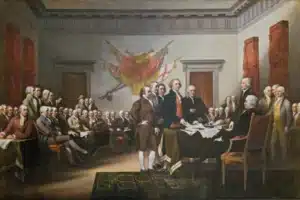
The Declaration of Independence by John Tumbull
Few of these documents are written as poetry, although contemporary poets did write. Perhaps it is the quality of the writing, how well arguments are made, how effective metaphors and language in general are used. But a poetic sense pervades so much of the words that fed the American Revolution.
I suspect MIT professor Bradford Skow sees this as well. Inf act, he sees it so well that he’s assembled documents that were all part of this ferment and structured them into poetry. You read American Independence in Verse, and you are read the poetry edition of the American Revolution. It’s a creative way to use historical documents – take advantage of how well the originals are written and transform them into poems.
The source documents cover the period from 1764, with a statement by former Massachusetts governor Thomas Powell in London, to July 9, 1776, when General Washington issued his general orders for the creation of a continental army. The Declaration of Independence itself is not included; perhaps Skow realized that it was poetry enough to stand on its own, without embellishment or interpretation.
What Skow does include are statements by British royal officials, members of Parliament, the Stamp Act, Patrick Henry, the Declaration of Rights and Grievances against the Stamp Act, Benjamin Franklin, Samuel Adams, ministers from the pulpit, the Sons of Liberty, farmers, newspaper reports, official correspondence from royal governors back to Britain, the Boston Massacre, the committees of correspondence, Thomas Paine’s Common Sense, and more. It’s like reading a history of political and social upheaval through the medium of poetry.
A year before the Declaration of Independence, another declaration emerged, this one during the First Continental Congress (the Declaration came during the second one). It was a straw in the wind, a fairly large and significant straw, and many similar sentiments would be flowing from the congress and the individual colonies themselves. This is how Skow records it.
Declaration of the Causes and Necessity of Taking Up Arms
Congress, Philadelphia, July 6, 1775
 A solemn reverence for the great Creator
Reveals to any man, the aims of government.
But long ago the British Parliament
Abandoned the promotion of its subjects’
Welfare, in a blind lust for limitless
Power. If they abjure the call to show
The larger world the reason of their acts,
We still esteem ourselves obliged to prove
The justice of our cause. Enumerations
Of all the injuries that we have suffered
Are legion, but sufficient case is made
By statutes that declare that Parliament
May bind us “in all cases whatsoever.”
For ten years, with modest supplication,
We have besieged the throne—without effect.
Now, in Boston, martial law is exercised,
And General Gage says all the town’s inhabitants
Are traitors. He exerts his utmost power
In spreading devastation and destruction.
Our choice has thus become submission, or
Resistance by armed force. We choose to fight.

Bradford Skow
Skow is the Laurence Rockefeller Professor of Philosophy at MIT. After studying English and philosophy at Oberlin College, he received his Ph.D. degree from New York University. He’s the author of Causation, Explanation, and the Metaphysics of Aspect, Reasons Why, and Objective Becoming. He’s published numerous articles on metaphysics, philosophy of science, and value theory. He’s also a co-organizer of the MIT Civil Discourse Project and a distinguished fellow of the College of Computing.
American Independence in Verse is a history lesson, a poetry lesson, and a lesson in how the events from 1776 to 1783 occurred. Skow has also produced a creative way to read (and write) history, bringing a contemporary yet respectful feel to the documents that undergird the beginning of what is now the oldest continuing democracy in the world.
Photo by Dan Keck, Creative Commons, via Flickr. Post by Glynn Young.

How to Read a Poem uses images like the mouse, the hive, the switch (from the Billy Collins poem)—to guide readers into new ways of understanding poems. Anthology included.
“I require all our incoming poetry students—in the MFA I direct—to buy and read this book.”
—Jeanetta Calhoun Mish
- Poets and Poems: Betsy Mars and “Rue Obscure” - October 22, 2026
- Poets and Poems: Kortney Garrison and “The Fixed Hours” - October 20, 2026
- Matthew Zapruder and “The Story of a Poem” - October 15, 2026
Leave a Reply