
Paul Willis takes us on a tour of an Italian hillside town.
Travel writer Rick Steves says Orvieto in central Italy is precisely what an Italian hill town should be. Poet Paul Willis agrees.
A walled medieval city. A funicular that transports you from the train station to the old town. Churches. Monuments. Museums. Wine tours. Stone archways bridging across streets. Views of the plains And only 90 minutes from Rome by train.
Willis visited Orvieto, and he’s composed a chapbook of 26 poems about the city, where “the cobblestone alleys / barely keep the walls apart.” He notes other visitors to Orvieto or the region – Sigmund Freud and Mark Twain. He visits the area’s museums, writing about a relief of a Roman wedding and a sculpture of an Etruscan sarcophagus and an Etruscan tomb in a cemetery.
Willis also visits the churches, where he’s struck by paintings – “Simoen in the Temple” in the church of Santa Maria dei Servi, for example, and a fresco behind a wooden statue of Saint Andrew in the church of Sant’Andrea. He includes poems about two paintings by Caravaggio. His poems about the churches serve as a good reminder than in Italy and the rest of Europe, not all great art is in the famous museums.
Leaving the churches, he sees a statue of Pope Boniface VIII that once presided over the city’s major gate. He’s moved by a memorial to World War I and a monument to seven partisans murdered by the Nazis in World War II. He also makes sure to visit the region’s vineyards.
This is one of several of his poems about Orvieto’s churches.
Angel
 Well before dawn, awake in my bed,
shoulder throbbing, arm in a sling,
I thought of an angel at the entrance
to the Church of Santa Maria dei Servi
in Orvieto. The angel is part of a fresco
painting inside the main door and to the right,
in a little side chamber that is usually barred
and locked. Late one night, however,
I found the gate ajar, and entered.
And there on the wall was a sacred scene,
the exaltation of a saint or a day in the life
of the Virgin Mary, with attendant angels
looking on. Except one angel was looking right
out of the wall at me instead. At me, I swear,
with a gaze so direct and severe and knowing
and yet so welcoming as well, straight out
of the Renaissance. There was something pure
about those eyes, and eternally young, and full
of holy energy. And I felt seen, and I
felt known, and I felt transfixed and included,
with or without my will. That is what
I knew that night, and this night too,
though my aching shoulder still throbbed,
and I lay sleepless, and it seemed the pain
would never end.
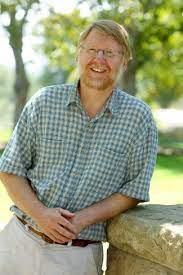
Paul Willis
Willis is emeritus professor of English at Westmont College in Santa Barbara, California. He previously published eight poetry collections, and his poems have been published in Poetry, Wilderness, Christian Century, The Best American Poetry, Amethyst, SALT, Southern Poetry Review, and Turtle Island Quarterly, among many others. He’s also written extensively on nature and wilderness subjects. He received a B.A. in Biblical Studies from Wheaton College in Illinois and his Ph.D. in English from Washington State University.
Orvieto is a kind of poetic travelogue, but it’s also something more. Willis fuses ancient history, religion, modern history, manmade and natural scenery, and even contemporary economics (this vineyards!) into an explanation of what this most medieval, walled city is about.
Photo by isado, Creative Commons, via Flickr. Post by Glynn Young.
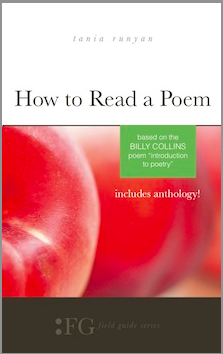

How to Read a Poem uses images like the mouse, the hive, the switch (from the Billy Collins poem)—to guide readers into new ways of understanding poems. Anthology included.
“I require all our incoming poetry students—in the MFA I direct—to buy and read this book.”
—Jeanetta Calhoun Mish

- Poets and Poems: Arlene Demaris and “Instructions for Use” - July 9, 2026
- Poets and Poems: Christy Lee Barnes and “Commodore Rookery” - July 7, 2026
- Philip Freneau: Poet of the American Revolution - July 2, 2026
Leave a Reply