
J.I. Kleinberg visualizes poetry with found poems.
Take a text, any text. It might be a paragraph from a novel, an excerpt of an essay, a newspaper article, a poem, words in advertisements, or your own journal. Then look for ideas, words that stand out, sentences or phrases that can be formed by extracting words. Highlight what you’ve selected, or black out the surrounding text. Assemble the selected words in a new text, or you can simply leave them as is. What you have is a found poem.
It’s not as easy as it might sound. In fact, it can as much time, thought, and effort as writing an original poem. A found poem can both construct and deconstruct a text.
 Ezra Pound extracted words and phrases from historical letters and government documents to help create his Cantos. A poetry collection based on the press briefings of former Secretary of Defense Donald Rumsfeld was published in 2003. Found pounds have been created from baseball calls by the announcer for the New York Yankees. Other sources of found poems have been the etiquette books of Emily Post, the trial testimony of Charles Manson, The Elements of Style by Strunk and White, Wonder Woman comics books, and more.
Poet J.I. Kleinberg collected examples of phrases and texts involved the word “we.” She explains that it is an inclusive word, implying all or at least a group. “We suggests the whole greater than the sum of its parts, the possibility of empathy, humanity, history, we inclusive of good and bad, familiar and surprising, guilty, optimistic, despairing…” She didn’t so much assemble the phrases as she designed the words into found poems (her master’s degree is in design).
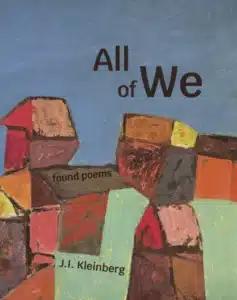
The result is All of We: Found Poems.
The 56 poems initially look very similar. But they each explore a different subject, and Kleinberg connects words and ideas by what she includes in each poem. Here is one example:
We the Silent
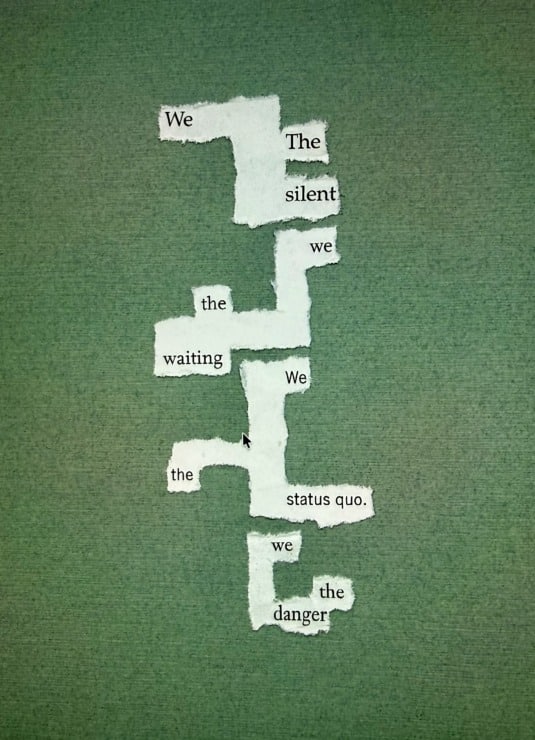
In the context of “we,” she associates silence with waiting, the status quo, and danger. The association forces the reader to consider how the words are connected with each other and with “we.” I easily grasped the connection of silence with waiting and status quo; danger was harder. I considered that silence could be both a source of danger and a symbol of resistance to danger.
You can see the pathways a found poem can lead you down. The pathways are not rabbit holes; they are thoughtful examinations of ideas and themes. And the reader can take these ideas and develop their own mental versions of found poems.
Kleinberg has four poems entitled “We the people.” Among the other 52 ideas in which she connects to “we” include diverse, outsider, new, witness, books, waste, economy, kneeling, fragments, door, dispute, community, fragile, human, and dark.
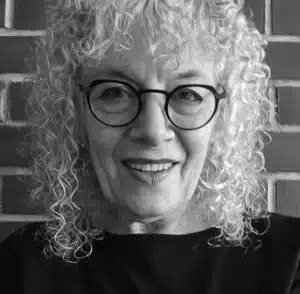
J.I. Kleinberg
All of We looks simple to read, and it is, if all you do is read it. It is something else entirely when you stop to examine how the lines connect to each other.
Kleinber received an M.A. degree in design from the University of California at Berkeley. She’s worked as a fiber artist, marketing director, scuba diving instructor, editor, and copywriter. She hosts a regional poetry blog, The Poetry Department. She’s published four chapbooks and a full-length collection, and her visual poems have been featured in two solo exhibitions. She lives in the state of Washington.
All of We is a visual experience in poetry, but it is also a mental and intellectual experience in how words and idea connect to each other. I don’t have Kleniberg’s design background, but these found poems make me want to try creating some of my own.
Related:
How to Write a Found Poem: The Many Tools to Discover Treasure.
Photo by Arian Zwegers, Creative Commons, via Flickr. Post by Glynn Young.

How to Read a Poem uses images like the mouse, the hive, the switch (from the Billy Collins poem)—to guide readers into new ways of understanding poems. Anthology included.
“I require all our incoming poetry students—in the MFA I direct—to buy and read this book.”
—Jeanetta Calhoun Mish

- Poets and Poems: J.I. Kleinberg and “All of We” - September 15, 2026
- Poets and Poems: Robert McDowell and “The Excellent Assembly” - September 10, 2026
- Poets and Poems: Rosemerry Wahtola Trommer and “The Wonderment” - September 8, 2026
Leave a Reply