
Jen Karetnick examines the familiar in life
A grandmother’s jewelry. A heavy rainfall. The fruit in a pina colada. A soccer game. Accompanying a parent to a medical procedure. Waiting for biopsy results. A can opener. Grief. Riding in the car with your sister. Gardening. A frog. Cicadas. Arthritis. The neighbor who calls you by the wrong name.
What all these disparate things have in common is that they’re familiar. common, everyday. They’re so familiar that we often forget them or overlook them.
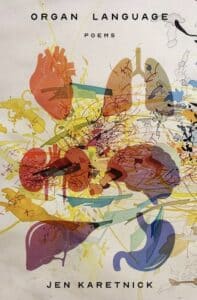
In the hands of poet Jen Karetnick, however, the familiar and the common become something else. She reaches into her own childhood. She considers the experiences of her own children. She looks at the life she’s living now. The subjects are largely what we know as experiences common to all of us, but Karetnick shows us how the familiar will also indicate something deeper, something more profound. That’s the heart and soil of her new collection, Organ Language.
Take this example. A heavy rainstorm floods a car. It can happen, especially in a place like southern Florida, where Karetnick lives. (I lived in New Orleans and Houston, where heavy rains were known to flood streets and driveways, and sometimes even more than that.) But in a just words, a flooded-out car becomes something else entirely.
After My Car Drowns in the Driveway
During a 20-Inch Rainstorm,
 seat cushions soaked as if run through
a washing machine, trunk sealed
like a woman’s mouth, radio absent
of volume, witchy speakers crackling
like crumpled tin foil, the insurance
company totals it, citing corrosion,
citing saltwater invasion, scheduling it
for demolition, adding to the climate change
we aren’t supposed to reference.
My husband retrieves the license plate,
the single item I’m allowed to keep,
to attach to a new vehicle I don’t want,
and snaps one last photo of the bumper
stickers from the kids’ schools,
now that they’ve moved on. I sit shiva
again for my father-in-law, who loved
to help me shop for cars, who put his arm
around me when we bought this little
two-seater, anticipating these heart-opened
days, who said Mazel tov, girlie, you deserve it,
as he always did. And I think about how
this time, all I will hear will be sign here,
and sign here, and initial here, and here.
Several of the poems in Organ Language are about poetry. Poetry is a familiar activity for her, as familiar as any of the other things she’s writing about. She blends the idea of poetry with the subject, as in describing the poet as resembling a kidney stone, or a poem that’s inspired by a facial blemish (somehow, I can’t write the word “zit,” as she does). And she imagines a theoretical conversation “two poets who died by suicide, on whether time heals.” The poets are Anne Sexton and Sylvia Plath.

Jen Karetnick
Organ Language is consistent with Karetnick’s earlier collections, as in consistently good. It looks behind the surface, behind what’s obvious or accepted or generally believed, and delves deeper, looking for the meaning behind the familiar.
Related:
Poetic Voices: Jen Karetnick and E. Kristin Anderson
Jen Karetnick: Pondering the Often Invisible
Ocean as Metaphor: The Crossing Over by Jen Karetnick
Poets and Poems: Jen Karetnick and Inheritance with a High Error Rate
Photo by A Peach, Creative Commons, via Flickr. Post by Glynn Young.

How to Read a Poem uses images like the mouse, the hive, the switch (from the Billy Collins poem)—to guide readers into new ways of understanding poems. Anthology included.
“I require all our incoming poetry students—in the MFA I direct—to buy and read this book.”
—Jeanetta Calhoun Mish

- Poets and Poems: Betsy Mars and “Rue Obscure” - October 22, 2026
- Poets and Poems: Kortney Garrison and “The Fixed Hours” - October 20, 2026
- Matthew Zapruder and “The Story of a Poem” - October 15, 2026
Leave a Reply