
Fanny Howe accounts for her life, and poetry, with poetry.
Fanny Howe (1940-2025) was the author of some 13 poetry collections, five novels, and numerous short stories and essays. Her collection Second Childhood: Poems (2014) was a finalist for the National Book Award. Her Selected Poems received the 2001 Lenore Marshall Poetry Prize, and she received the Ruth Lilly Poetry Prize in 2009.
Shortly before her death in 2025, Howe completed another manuscript, This Poor Book: A Poem. It is and isn’t a poem. It is and isn’t a poetry collection. It is and isn’t a memoir, an autobiography, a poetic essay. It is one of the most unusual works I’ve read.
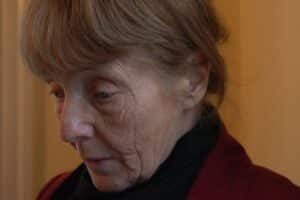
Fanny Howe
What Howe did to create This Poor Book was cull all her poetry collections, add new poems and transitions, and then assemble them into a cohesive whole that tells a story. That story is not a straightforward narrative. At times, I thought I was reading a work of magic realism. Or perhaps it was a transcription of an extended dream, because it has a dreamlike quality to it. Howe has also added some autobiographical elements, suggested by the almost continuous first-person voice. At times the text seems almost feverish, a stream of consciousness account of childhood, war, upheaval, personal relationships, children, and eventually a facing of the end of life.
The suggestion of magic realism is no accident. Some critics have compared her work to South American poets who make use of magic realism techniques. Images of Gabriel Garcia Marquez’s novel One Hundred Years of Solitude and Mario Vargas Llosa’s Conversation in the Cathedral kept coming to mind as I read This Poor Book. This connection was not about content but more about technique.
When Howe subtitled this “A Poem,” she was being deliberate. The work is one extended poem. There are no titles, section breaks, or Roman numerals or numbers to serve as guideposts. There are only spaces between sections of texts.
The result is one long flow of narrative, because she is telling a story, her story, but it is not a straightforward account. Howe includes memories, reflections, recollections, and impressions, adding to the dreamlike quality. What becomes clear is that she is creating an account of her life, using her poems as the essential text.
 Hell changed its plans
And came in the middle
Instead of the end.
This was a good thing
For the burning of karma.
I lay down my life
First for the third time.
Then not the second
But finally ready
To embrace layers all at once.
Fever for medicine
The parting of layers never.
Because my secret wedding
Was enduring and the rest
Was not—I think disclosure
Is dangerous.
What is heavier than lead?
The need for bread.
What s crueler than a boss?
The need for praise.
What is shorter than a step?
An indrawn breath.
My secret wedding was to whom?
A promise not a human.
You can glean specific details – a failed relationship, a secret wedding – but she moves the narrative into speculations, as if she’s admitting or describing something and them moves quickly to conceal it. And you wonder if you’re reading the work of a poet or a magician.
In addition to her extensive published work, Howe received awards and recognitions from the National Endowment for the Arts, the National Poetry Foundation, the California Council for the Arts, the Bunting Institute and the MacDowell Colony. She taught at MIT, Tufts University, and other schools, eventually landing at the University of California – San Diego. She also served as the inaugural visiting writing at the University of Massachusetts – Boston. She died in Cambridge, Massachusetts.
To call a work like this This Poor Book seems almost tongue-in-cheek. There is nothing poor about it. It is unusual, creative, and inventive. It is an account of a life and the work of a life. And it is a poem.
Photo by kirandulo, Creative Commons, via Flickr. Post by Glynn Young.
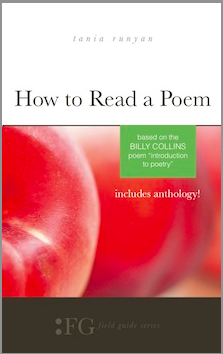

How to Read a Poem uses images like the mouse, the hive, the switch (from the Billy Collins poem)—to guide readers into new ways of understanding poems. Anthology included.
“I require all our incoming poetry students—in the MFA I direct—to buy and read this book.”
—Jeanetta Calhoun Mish
- A Facebook Memory and the Origin of Tweetspeak Poetry - September 17, 2026
- Poets and Poems: J.I. Kleinberg and “All of We” - September 15, 2026
- Poets and Poems: Robert McDowell and “The Excellent Assembly” - September 10, 2026
Leave a Reply