
One Hundred Years of Solitude reads like my family history.
I was sitting in a graduate seminar called “The Nature of Story.” About 20 of us, all in a Master of Liberal Arts program, sat at tables gathered in a U-configuration. We were discussing the first reading assignment, One Hundred Years of Solitude by Gabriel Garcia Marquez.
This was not your typical graduate seminar. The program was designed for people who’d been out of college for a while, and we ranged in age from 30s to 70s. I was 35 at the time – and the youngest in the class. Professors tended to love these classes, and the university had a waiting list of teachers wanting to have a course in the program. We were not the kind of students they were used to; we’d all had life experiences, work experiences, and we tended to challenge the professor (and each other) more than not.
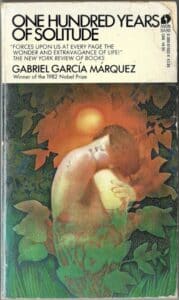 I’d already had several courses in the program, and I loved them. Held once a week in the evening, the courses were always changing, always different. I’d studied the philosophy of science, the West in the American imagination, the history of science, and the Latin American novel, where I’d also read One Hundred Years of Solitude. Since I’d previously read it as a college undergraduate years before, this reading in “The Nature of Story” was my third.
The class discussion centered on the idea that everyone in the class seemed to think it was a ridiculous novel. Flying carpets? Really? Babies born with pigtails? Are you serious? So many characters with the same name? What was the author thinking.
The professor, who taught English in his day job, saw a strange look on my face. “What is it?” he asked. “You’re not saying something.”
I didn’t know if the class was ready to hear my response. This third reading had made something very clear to me, and I wasn’t exactly sure why.
I nodded at the professor. Everyone else was staring.
I finally spoke. “This reads like my family history. This novel sounds like what I grew up in. In fact, it doesn’t seem like a novel at all.”
You could have heard the proverbial pin drop.
“Where did you grow up?” the professor asked.
“New Orleans,” I said.
He smiled. “The northern rim of the Caribbean culture. Garcia Marquez was born on the southern rim.”

Street music in New Orleans, via Unsplash
I explained that, of course, we didn’t have flying carpets and babies born with pig tails. But I’d grown up hearing other stories, like Inez the crazy woman who wandered the streets of the Ninth Ward and scared children (and some adults). And the cities of the dead, also known as cemeteries, with their monuments and ornate memorials. Marie Laveau, the voodoo queen.
I said that I’d gone to school with classmates representing just about every cultural background you could imagine — French, Spanish, Latin American, Black, German, Czech, Cajun French, and “regular” American. That Mardi Gras was not only the big celebration before Lent but also a time when people donned costumes that were often more reflective of their real selves. That the heart of the city, the French Quarter, didn’t have a single building with French architecture but instead was all Spanish colonial. That in the 1000 block of Royal Street, just past the antique shops and art galleries and nice restaurants, you could find the house where a cruel mistress had chained slaves to the wall in the attic, and no one knew until the house caught fire and the slaves had all perished. And it was a block or two from where the Ursuline nuns had had their convent.

French Quarter Street, via Unsplash
I mentioned the time I accompanied my mother to visit her mother and two of her sisters. My grandmother had been ailing, and they had gathered in her bedroom. I sat in the kitchen with two of my uncles. Knowing the women would be talking for a while, they insisted I join them in a glass or two of rye whiskey, what they called rock-and-rye. Straight up, no ice. All three of us drank more than we should have. I was all of 12. I don’t think I’ll ever forget the look on my mother’s face when she walked into the kitchen and saw three glasses and an almost empty bottle, and the three of us with bloodshot eyes.
When I finished speaking in the classroom, there was a silence. The people sitting around that seminar table stared at me like I was an alien. Perhaps I was. Perhaps I still am. No, we didn’t have revolutions and shootings and social upheaval. But I knew One Hundred Years of Solitude like it was my own story, in spirit if not in fact. I shared a culture with it, a culture blended from many others that formed its own unique way of living and being and thinking.
Photo by Alice Popkorn, Creative Commons, via Flickr. Post by Glynn Young.
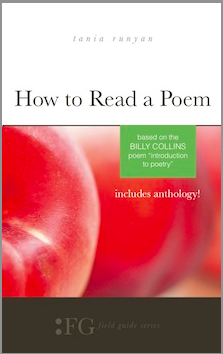

How to Read a Poem uses images like the mouse, the hive, the switch (from the Billy Collins poem)—to guide readers into new ways of understanding poems. Anthology included.
“I require all our incoming poetry students—in the MFA I direct—to buy and read this book.”
—Jeanetta Calhoun Mish

- Poets and Poems: Betsy Mars and “Rue Obscure” - October 22, 2026
- Poets and Poems: Kortney Garrison and “The Fixed Hours” - October 20, 2026
- Matthew Zapruder and “The Story of a Poem” - October 15, 2026
L.L. Barkat says
What a fascinating connection, Glynn. I really enjoyed One Hundred Years of Solitude, though it took growing up a little before I could get into the book and finish it.
Love the rye whiskey story. 🙂 Overall, such a colorful, wonderful telling of times past.