
Tweetspeak Poetry

  • Home
  • FREE prompts
  • Earth Song
  • Every Day Poems—Subscribe! ✨
  • Teaching Tools
  • Books, Etc.
  • Patron Love

Poets and Poems: Sarah Dickinson Snyder and “To Eve”

By Glynn Young Leave a Comment

Young woman Snyder

Sarah Dickinson Snyder uses the figure of Eve as a lens.

The Book of Genesis says that Eve was created from a rib of Adam, to provide a helpmate and companion. Many have pointed out that it was a rib that was used to create her, implying equality or, more pointedly, “equalness” in the eyes of God. The story of the fall is familiar – Eve is convinced by the serpent to eat of the Tree of the Knowledge of Good and Evil, she convinces Adam, and they’re both thrown out of Eden. For their disobedience, Adam has to work the soil, and Eve gets pain in childbirth. And we know the names and stories of her first two sons, Cain and Abel, and the name of her third, Seth, whom she recognizes as a gift.

Beyond those basic facts, there’s no further mention of Eve in the Bible. In To Eve: A Book-Length Poem, poet Sarah Dickinson Snyder doesn’t envision what Eve’s life was like so much as she considers Eve’s mind, her thoughts, her feelings, her hopes and dreams. And she uses Eve as a kind of lens to consider some of her own life and the life of women more generally. The poem is less an imagined biography and more of a reflection.

It’s also an incredibly creative poem. Snyder writes with a depth of feeling that is often moving and always thought-provoking. Eve becomes real, a three-dimensional woman with emotion, hopes, and even a dream of seeing the sea. She’s attracted to her husband. She struggles with the murder of one son by another. She feels the lack of having her own mother. She can’t help but understand that all future mothers will “reach back to your hunger, your banishment, the birth of your sons.”

from To Eve:
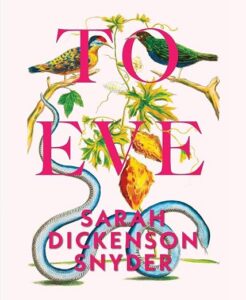
To Eve SnyderIs that you, Eve, come to see
the garden of ferns & lupine
& lilies? Or the raised beds, the way
I pick the outer leaves of each lettuce head?
Have you come to sit with me again?
Mentioned only twice in the Old Testament,
you are a thin thread from the beginning.
How did you recover from one son
killing the other? Do you know
what I say to a god I don’t believe in
every night? Let me die before they do.
Did you wrap your offerings
around the son who lived?
How did you go on?
All the heaviness
of hold & carry.
You are there, here,
the first mother of us –
you, carbon, & stardust.

Snyder delves into what the story of Eve means to her own life and that of her daughter: “I might find myself if I could transcribe hunger, / listen to those narrow seconds again & again / in a black box I’ll never find – / that time you reached for an apple.”

Sarah Dickinson Snyder

Sarah Dickinson Snyder

Snyder previously published four poetry collections: The Human Contract, Notes from a Nomad, With a Polaroid Camera, and Now These Remain. Her poems have been published in numerous literary journals and publications, including Rattle, Verse Daily, RHINO, Birdcoat Quarterly, The Mersey Review, and Solstice, among many others. She’s also been nominated for the Massachusetts Book Award, Best of the Net, and Pushcart Prize and was a teacher of English in middle and high school education for 37 years. She received an A.B. degree from Bowdoin College and an Ed.M. degree from Harvard University.

Reading To Eve is like having a dream. It has a dreamlike quality, a flow that carries you along as you join Snyder in imagining this first woman, this first mother. And this book-length poem (some 46 pages) ends exactly right, with Snyder imagining the mind of her own granddaughter as she realizes “this is how we are reborn.”

Photo by Luciola Correia, Creative Commons, via Flickr. Post by Glynn Young.
Browse more book reviews

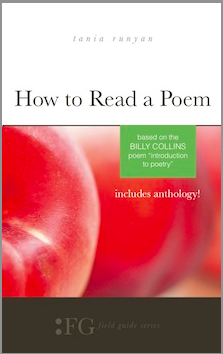
How to Read a Poem by Tania Runyan

5 star

Buy How to Read a Poem Now!

How to Read a Poem uses images like the mouse, the hive, the switch (from the Billy Collins poem)—to guide readers into new ways of understanding poems. Anthology included.

“I require all our incoming poetry students—in the MFA I direct—to buy and read this book.”

—Jeanetta Calhoun Mish

  • Author
  • Recent Posts
Glynn Young
Glynn Young
Editor and Twitter-Party-Cool-Poem-Weaver at Tweetspeak Poetry
Glynn Young lives in St. Louis where he retired as the team leader for Online Strategy & Communications for a Fortune 500 company. Glynn writes poetry, short stories and fiction, and he loves to bike. He is the author of the Civil War romance Brookhaven, as well as Poetry at Work and the Dancing Priest Series. Find Glynn at Faith, Fiction, Friends.
Glynn Young
Latest posts by Glynn Young (see all)
  • Poets and Poems: Sarah Dickinson Snyder and “To Eve” - July 16, 2026
  • Poets and Poems: Tina Kelley and “Field Guide to North American Words” - July 14, 2026
  • Poets and Poems: Arlene Demaris and “Instructions for Use” - July 9, 2026

Filed Under: article, book reviews, Books, Poems, poetry, poetry reviews, Poets

Try Every Day Poems...

Leave a Reply Cancel reply

Your email address will not be published. Required fields are marked *

Take How to Read a Poem

Get the Introduction, the Billy Collins poem, and Chapter 1

get the sample now

Welcome to Tweetspeak

New to Tweetspeak Poetry? Start here, in The Mischief Café. You're a regular? Check out our June Menu

Patron Love

❤️

Welcome a little patron love, when you help keep the world poetic.

The Graphic Novel

"Stunning, heartbreaking, and relevant illustrations"

Callie Feyen, teacher

read a summary of The Yellow Wallpaper

meet The Yellow Wallpaper characters

How to Write Poetry

Your Comments

  • Clara Klein on Fear is a Luxury You Can’t Afford: Just Make Art
  • The Beachy Poem Challenge - Tweetspeak Poetry on How to Write a Catalog Poem (With or Without Words)
  • L.L. Barkat on 10 Things Poets & Writers Can Do with the Small Moments
  • Lydia Kann on The Poetry of Gregory Corso

Featured In

We're happy to have been featured in...

The Huffington Post

The Paris Review

The New York Observer

Tumblr Book News

Stay in Touch With Us

Browse by Topic

Learn to Write Form Poems

How to Write an Acrostic

How to Write a Ballad

How to Write a Catalog Poem

How to Write a Ghazal

How to Write a Haiku

How to Write an Ode

How to Write a Pantoum

How to Write a Rondeau

How to Write a Sestina

How to Write a Sonnet

How to Write a Villanelle

5 FREE POETRY PROMPTS

Get 5 FREE inbox poetry prompts from the popular book How to Write a Poem

Shakespeare Resources

Poetry Classroom: Sonnet 18

Common Core Picture Poems: Sonnet 73

Sonnet 104 Annotated

Sonnet 116 Annotated

Character Analysis: Romeo and Juliet

Character Analysis: Was Hamlet Sane or Insane?

Why Does Hamlet Wait to Kill the King?

10 Fun Shakespeare Resources

About Shakespeare: Poet and Playwright

Top 10 Shakespeare Sonnets

See all 154 Shakespeare sonnets in our Shakespeare Library!

Explore Work From Black Poets

About Us

  • • A Blessing for Writers
  • • Our Story
  • • Meet Our Team
  • • Literary Citizenship
  • • Poet Laura
  • • Poetry for Life: The 5 Vital Approaches
  • • T. S. Poetry Press – All Books
  • • Contact Us

Write With Us

  • • 5 FREE Poetry Prompts-Inbox Delivery
  • • 30 Days to Richer Writing Workshop
  • • Poetry Prompts
  • • Submissions
  • • The Write to Poetry

Read With Us

  • • All Our Books
  • • Book Club
  • • Every Day Poems—Subscribe! ✨
  • • Literacy Extras
  • • Poems to Listen By: Audio Series
  • • Poet-a-Day
  • • Poets and Poems
  • • 50 States Projects
  • • Charlotte Perkins Gilman Poems Library
  • • Edgar Allan Poe Poems Arts & Experience Library
  • • William Blake Poems Arts & Experience Library
  • • William Shakespeare Sonnet Library

Celebrate With Us

  • • Poem on Your Pillow Day
  • • Poetic Earth Month
  • • Poet in a Cupcake Day
  • • Poetry at Work Day
  • • Random Acts of Poetry Day
  • • Take Your Poet to School Week
  • • Take Your Poet to Work Day

Gift Ideas

  • • Every Day Poems
  • • Our Shop
  • • Everybody Loves a Book!

Connect

  • • Donate
  • • Blog Buttons
  • • By Heart
  • • Shop for Tweetspeak Fun Stuff

Copyright © 2026 Tweetspeak Poetry · FAQ, Disclosure & Privacy Policy