
Tina Kelley shows how to use unusual, often obscure words
Poet Tina Kelley seems fascinated with words — unusual, often obscure words. Have you met an aeolist (a person who claims to be inspired), or been blessed by one? Have you experienced a diapause (a period of suspended development)? Have you discovered that you might, at least on occasion, be a prosopagnosic (one who suffers face blindness), or that you can practice steganography (a form of writing that obscures, like invisible ink)?
In Field Guide to North American Words, Kelley takes those unusual words and others and creates poems — poems that are not obscure or unusual. Vivid poems about life, birthdays, aging, hacked passwords, birthdays, the future (as seen through birds), an old doll in an attic — all those rooms that the hallways of unusual words can lead you to. Like any proper field guide, the words are arranged alphabetically.
The poems have a descriptive, almost journalistic quality. Kelley is exploring these words (and some that aren’t unusual) as if she’s a reporting covering a story (her actual day job), taking something that appears complex and detailed and making it comprehensible.
She considers life like studying tree rings (“We tell time by accretion”) in a poem entitled “Dendrochonology,” which turned out to be the one unusual word in the collection that I was actually familiar with. She looks at kissing (and the people involved) as if studying the facets of a gem. She describes something of a “word crush” on the tree guy, who tosses around words like “wind sail” and “meristems” like so many falling leaves.
The collection offers a number of candidates for favorite, but this one, about a word for a particular condition, would be at the top of my list.
After Being Struck with Acyanopsia
n. – the inability to see the color blue
 Out of the blue I’m out of blue,
gone, the dining room, the denim,
blue of mint lozenge, bottom of flame.
A disease spread by splashing rain,
and sky burns white, the ocean gray.
At sea, horizon erased, sight disappears.
Of three million colors, we’ve named thirty.
The eyes of my man are muddy shade.
I hear rhapsody in nothing. I can finally
inhale the grass in bluegrass, wonder
why blue meant puritanical, sad, and profane.
What the verb blue can do: ease inflammation
by coating membranes. Cool my neck while
I read. Bleach. Remind me of shoeless dusks.
Blue becomes my best dead friend,
and the part of the universe I can’t see
because my galaxy soars in the way.
Lost both. Godly, simmering light, gone.
Blue’s when you dream you’re so tired
you have to go to sleep. So I do, dream
a hummingbird in an empty cathedral
hovering in front of the rose window,
hiding white gaps where azure used to be.
When I wake I’ll have nothing but the reds.

Tina Kelley
Kelley previously published three collections of poetry: Abloom & Awry, Precise, and The Gospel of Galore. A former reporter for The New York Times, she currently works as the education reporter for NJ.com. She has also published two nonfiction books, and her poems have been published in such literary journals as Cimmaron Review, Southwest Review, and Prairie Schooner, among others, and included in Best American Poetry 2009. She lives with her family in New Jersey.
Each poem in Field Guide to North American Words takes you deeper into words, language, meaning, and life. They are like the descriptions you write after spotting a particular kind of bird you’ve been seeking for some time. But Kelley goes beyond simple observations, taking you deeper and inviting you to arrive at understanding.
Photo by John Stalzer, Creative Commons, via Flickr. Post by Glynn Young.
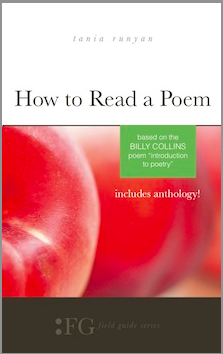

How to Read a Poem uses images like the mouse, the hive, the switch (from the Billy Collins poem)—to guide readers into new ways of understanding poems. Anthology included.
“I require all our incoming poetry students—in the MFA I direct—to buy and read this book.”
—Jeanetta Calhoun Mish

- How the Norton’s Anthology Shaped My Understanding of Poetry - August 27, 2026
- Poets and Poems: Peter Murphy and “You, Too, Were Once on Fire” - August 25, 2026
- Poets and Poems: Gabrielle Myers and “Go Forth: Lose Yourself into Life” - August 20, 2026
Leave a Reply