Discovering My Heritage and Cajun Roots
When I read Evangeline by Henry Wadsworth Longfellow in high school, I had no idea that I was not only reading one of his epic poems; I was also reading a fictionalized account of some of my own ancestry and history.
Yes, I knew I had some French ancestry on my mother’s side, sitting side by side with some German as well. I didn’t know that the German had arrived relatively late, in the mid-nineteenth century, while the French had been there more than a century earlier. And I didn’t know that most of that French had come from Canada, in the maritime provinces collectively called Acadia. A tiny handful of my mother’s French ancestors had come directly from France.
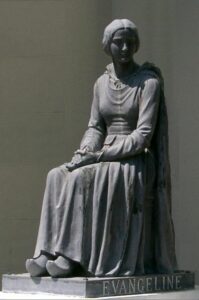
Evangeline, a monument to Acadians in St. Martinsville, La., via Wikipedia
I didn’t know that, at college football games, when I chanted “Hot boudin! Cold coosh coosh! Come on Tigers, poosh, poosh, poosh,” I was using words from my own ancestry. When I read A Cajun Night Before Christmas to my children, I never thought to ask why I could imitate the Cajun accent so well.
Then, a few years ago, after searching through the Family Search web site, I saw my extended my family tree. I saw names on my mother’s side that I’d never heard before. Zeringue. Charbonnet. Madere. Cuvillier. Clement. Picou. Borne. Bernody. St. Amant. I went to elementary and secondary school with classmates who had those names. I realized that I wasn’t one-fourth Creole French, descended from the French Creoles who settled Louisiana. I was one-fourth Cajun French. And those classmates could have been relatives.
Sacre! (An abbreviated form of “Sacrebleu,” or “Good heavens.)
The Acadians, corrupted to “Cajuns,” began arriving in Louisiana after 1755. War had been brewing between Britain and France, and the British, who had controlled Acadia for more 40 years, wanted absolute allegiance, defined as an oath of loyalty and abandonment of the Catholic faith. The Acadians said no. Expulsion followed. Some were able to return to France. Others were dispersed in other British territories. A sizeable group ended up in Louisiana, then a French colony but coming under Spanish control in 1763.
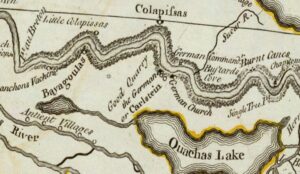
A map the German Coast, 1775, via Wikipedia
They settled in south central Louisiana, with its rivers, streams, and bayous. Most clustered in areas where towns like Lafayette, Breaux Bridge, Kaplan, Houma, and Thibodeaux sprung up. Some lived near what was called the German Coast – a stretch of land along the Mississippi River west of New Orleans settled by German colonists in the 1720s. (Part of it would give way to big sugar plantations and eventually petrochemical plants.) In towns like Des Allemands (“The Germans”), Edgard, and Reserve, Acadians met and mingled with descendants of the original Germans. That’s how Jean Adam Jacob met and married Marie Celetine Charbonnet and produced my grandfather, Joseph Edward Jacob. That’s how French-speaking Germans and Cajun French fused in my ancestry.
My mother was born and grew up in New Orleans, specifically the city’s Lower Ninth Ward. I can vaguely remember her still referring to sidewalks as “banquettes;” she adopted the Anglicized “sidewalk” after we moved to one of New Orleans’ Americanized suburbs. I use the term “Americanized” loosely; our neighborhood of standard three-bedroom ranch homes was a veritable melting pot, with names reflecting English, Irish, Spanish, Italian, French, German, and Czech backgrounds. The O’Donnells lived next door. The Aucoins , the Viennes, and the Barousses lived across the street. The family from Guatemala lived four houses down. All of these names, like those in my schools, were “normal.” You learned to pronounce them early, and you didn’t think any of them were “strange” or “foreign.”
We also often ate what I now understand to be Cajun-influenced food. Shrimp and crawfish etouffee. Shrimp Jambalaya. Boiled seafood boiled with ear of corn. In college, we’d often drive from Baton Rouge twenty miles south to a restaurant in what I now realize was the German Coast. There was no menu. Long picnic tables were covered in newspaper, on which servers dumped boiled crab, shrimp, and crawfish. The beverage of choice was usually a 20-ounce beer, served in a frosted mug. You ate, and drank, your fill. Drivers were allowed one beer only and could not participate in chug-a-lug contests.
When I reread Longfellow’s Evangeline, half a century after the original reading, I now knew I was reading a romanticized version of where many of my ancestors had come from. This had happened to my ancestors – expelled from prosperous lands they knew, forced into exile, finding their way to what must have often seemed like a hostile physical environment (heat and humidity, not to mention alligators), and still being resilient enough to rebuild their lives.
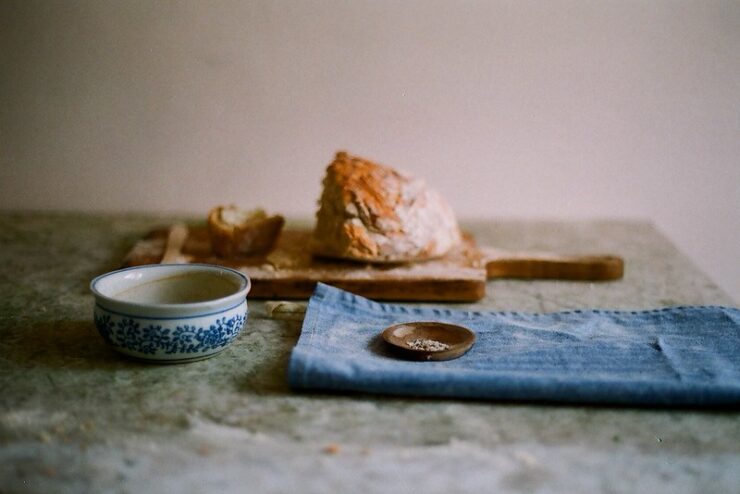
Photo by Barbara W, Creative Commons, via Flickr. Post by Glynn Young.
Explore More “Words to Travel By” Posts



How to Read a Poem uses images like the mouse, the hive, the switch (from the Billy Collins poem)—to guide readers into new ways of understanding poems. Anthology included.
“I require all our incoming poetry students—in the MFA I direct—to buy and read this book.”
—Jeanetta Calhoun Mish
- Reading Paul Celan for the First Time - October 1, 2026
- Poets and Poems: Christian Wiman and “The Dance” - September 29, 2026
- Poets and Poems: James Tweedie and “Love Found, Yearned For, and Lost” - September 24, 2026
Katie Spivey Brewster says
Glynn,
Before I get lost on the Family Search website, wanted to say thanks for sharing about your Cajun ancestry. I learned a lot. Resilient folk, indeed!
Gratefully,
Katie
L.L. Barkat says
Oh, goodness, Glynn. I couldn’t love this more. The food, the history, all those marvelous French names in a row (surely a poem of their own!).
Thank you for bringing us this fascinating (and sometimes funny 🙂 ) view of not just your ancestry but also a region.