Rhina Espaillat looks in the mirror and sees all of us.
Poetry is often associated with the young. We think of the fire of the Romantics, or the young T.S. Eliot upending traditional poetry with modernism with The Love Song of J. Alfred Prufrock. But even younger poets age, banking the fire and passion as they become tempered by experience and understanding.
Two of my favorite contemporary poets are Luci Shaw (1928-2025) and Rhina Espaillat (b. 1932). It’s something of a coincidence, or perhaps it isn’t, that both reached their 90s. Shaw died last December, just shy of her 95th birthday. Espaillat tuns 94 this year. Theirs is not the poetry of youth but instead the poetry of long lives lived – and lived well. It’s also the poetry of understanding and affection for people, in all our wild and crazy humanity.
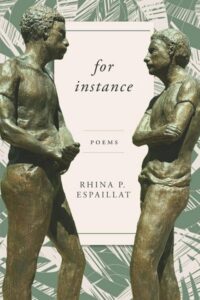
For Instance, the new poetry collection by Espaillat, demonstrates this understanding and affection. She tells stories, often jarring and difficult to read. Not all love stories end well. Not all families are Instagram-perfect. People get sick. Accidents happen. Espaillat understands that we live in a broken world, that humanity has always lived in a broken world. But her poems suggest that, despite the brokenness, we can continue to live our lives in hope.
I’m a couple of decades or so younger than Espaillat, but even I can see myself in this poem.
Encounter
 Do I know you? You’re wearing my nightgown,
brushing your horsey teeth in time with me.
We wash out faces, lay our towels down,
put on our glasses, all in synchrony.
No, I don’t know you, though I trust your face:
it has the look of truth, like whole grain bread.
But such a sober dish! No flair, no grace.
Why not champagne and petits-fours instead?
Why are you here? Who sent you here to spy
on my ablutions, this most private hour,
creases flanking your nose, each pouchy eye
riveting mine with some malefic power?
What does an aging monkey want with one
as young and lively as the rising sun?
We know what’s happening. She’s looking in a mirror as she prepared for the day. Who is this old, aging stranger staring back at us? What are they doing here? We’re a rising sun, not some picture of the world at dusk.
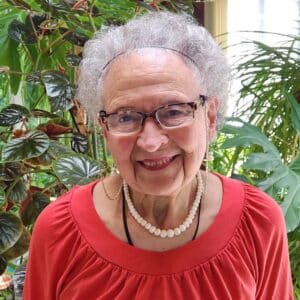
Rhina Espaillat
The collection includes love poems, poems of faith, stories of youth and old age, and a remarkable collection of tales grouped under the heading “The Storyteller’s Hour” that run the gamut of experiences. She includes poems about death, which is, after all, a part of life. She plumbs the questions asked by a child, as deep as any philosopher’s or theologians and considers those death leaves behind, the widows and widowers and parents who’ve lost children. A few of the poems are paired with their Spanish versions, reflecting Espaillat’s heritage (born in the Dominican Republic) and her translations of her own works and those by other poets.
Espaillat is the author of 12 books of poetry, short stories, and essays, and three poetry chapbooks. She’s received numerous awards for her poetry and translations, including the T.S. Eliot Prize, the Richard Wilbur Award, the Howard Nemerov Prize, the May Sarton Award, the Robert Frost Award, and others. Her poetry translations have included works by Richard Wilbur and Robert Frost, translated into Spanish. She is also active with the Powow River Poets, a literary group she founded in 1992.
For Instance is a remarkable collection by a poet sharing what she knows of life. And she knows much. Reading it is looking into a mirror and realizing you’re looking at yourself. Or soon will be.
Related:
Rhina Espaillat and And After All.
Photo by Dziunka DBK, Creative Commons, via Flickr. Post by Glynn Young.

How to Read a Poem uses images like the mouse, the hive, the switch (from the Billy Collins poem)—to guide readers into new ways of understanding poems. Anthology included.
“I require all our incoming poetry students—in the MFA I direct—to buy and read this book.”
—Jeanetta Calhoun Mish
- When a Poem Completely Eludes You - October 8, 2026
- “Paul Celan: A Life” by Anna Arno - October 6, 2026
- Reading Paul Celan for the First Time - October 1, 2026
Katie Spivey Brewster says
Thank you for introducing us to another fine poet. When you included her in the same line as Luci Shaw, I knew she wasn’t to be missed:)