
I come from that stock that regularly pronounces, usually around 15 minutes early for a thing, that to be on time is to be already late.
To be on time, I and my kind can begin to believe, bestows a sort of higher virtue in our direction.
And of course, what we mean by “on time” is what the precise time on the clock means by “on time,” as in the time a thing is supposed to start, or is written in our planner, or is what we agreed to when we made plans.
A friend and I occasionally make plans together. I will admit there have been times when the way I approach being on time and the way she approaches being on time are not exactly, well, the same. And because of these different approaches, there has at times been some mild agitation between us. Once, we had dinner reservations to a fancy place. I checked the directions to the place (a few times) to make sure I understood how long it would take to drive there. I backed out the travel time from the reservation time, added 15 minutes to account for unexpected occurrences like heavy traffic, an accident, a mother and her 7 ducklings crossing the highway. Then, as is my way, I added another 15 minutes for good measure, just in case I’d miscalculated somewhere. I let my friend know what our necessary departure time would be.
She agreed this was reasonable (a testament to her willingness to accommodate me, truly). But when it was time to leave, I was tapping my fingers on the leather arm of the sofa and and turning my wrist to check my watch about every, oh, 30 seconds or so.
In my head, I navigated through this circumstance. I talked myself down from the very high horse I’d mounted, deciding that I’d probably allowed way more time than was needed. And I also worked through a little exercise where I mentally charted the different values my friend and I had with respect to time, and nudged myself toward more patience because it wasn’t that my values were right and hers were wrong. It’s just that they were different.
By the time we left, I was only checking my watch every 60 seconds. As it turned out, we were not impeded in our journey by any number of ducks crossing the road, and arrived more or less on time, even by my rigid standards. I was feeling quite self satisfied at having been such a big person and not exhibiting impatience. I’m not so sure my friend would have fully agreed.
Sometime later, much later, it occurred to me that this was something that could become a source of friction for us and would be better handled before it became a much more difficult conversation. Rather than risking a growing resentment, we decided to ask each other questions about our approach to time: what we mean by on time, whether we value being on time, whether we value other things more. I shared that being late (whether actually being late or just feeling late) makes me profoundly anxious because I don’t like to have people waiting on me or cause a disruption, or, what’s probably the real reason, because even though I’m an actual grownup, I still worry about getting in trouble. What my friend shared was surprising to me. It turned out I was not such a big person after all, and I did not really understand why our clocks seem set to different times. What she told me was that she does always want to be on time, but sometimes the reality of making that happen gets in the way. So it wasn’t that she didn’t value being on time. But what I also discovered was that her approach to being on time was much more situational than mine. My sense of “on time” doesn’t have any favorites. The time is what it is, whether it’s meeting up for a walk in the park or it’s a job interview. At the White House. The time to be there is the time we were told to be there. For my friend, if she is to be somewhere for an event or an appointment, where there are certain consequences for being late (missed opportunities, disruption, etc.), she will of course be on time. But if it is something for her own pleasure, say that tea will be served at a certain time, then arriving a leisurely 10 minutes “late” is completely in keeping with that.
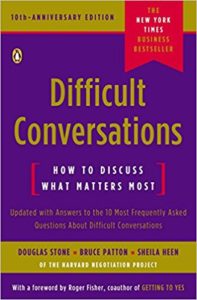
Before I could understand that—and significantly relax my expectations about time—we had to do what Difficult Conversations: How To Discuss What Matters Most would suggest: listen to Aunt Bertha.
The story is told in the book about a young woman who was concerned about the quality of her Aunt Bertha’s mattress. She felt badly that her aunt had ongoing back pain, which she believed was because of her aunt’s mattress being in bad condition. She offered, numerous times, to replace the mattress but her aunt refused. Family members shrugged off the disagreement saying, “Aunt Bertha is just crazy. You can’t reason with her.” The authors describe what is likely happening between Rory and Aunt Bertha:
If this is what we’re thinking, then it’s not surprising that we end up arguing. Rory, for example, cares about her Aunt Bertha. She wants to help, and she has the capacity to help. So Rory does what we all do: If the other person is stubborn, we assert harder in an attempt to break through whatever is keeping them from seeing what is sensible. (“If you’d just try a new mattress, you’d see how much more comfortable it is!”)
If the other person is naive, we try to educate them about how life really is, and if they are being selfish or manipulative, we may try to be forthright and call them on it. We persist in the hope that what we say will eventually make a difference.
But instead, our persistence leads to arguments. And these arguments lead nowhere. Nothing gets settled. We each feel unheard or poorly treated. We’re frustrated not only because the other person is being so unreasonable, but also because we feel powerless to do anything about it.
The authors suggest listening to Aunt Bertha about this, who will tell us that she knows the mattress is in bad shape but that it is the one she shared with her husband for many years and “it makes me feel safe.” The mattress, they explain, provides her with some “sense of control over her life. When she complains, it is not because she wants answers, but because she likes the connection she feels when she keeps people current on her daily comings and goings.” As they explore a little further with Aunt Bertha, we find that she thinks Rory “doesn’t listen or care much about what other people think.”
In the end, they both think the other person is the problem.
In Rory’s story, Rory’s thoughts and actions are perfectly sensible. In Aunt Bertha’s story, Aunt Bertha’s thoughts are equally sensible. But Rory is not just a character in her own story, she is also a visiting character in Aunt Bertha’s story. And in Aunt Bertha’s story, what Rory says seems pushy and insensitive. In Rory’s story, what Aunt Bertha says sounds irrational.
Joan Didion (and others) have said that “we tell ourselves stories in order to live.” The authors here suggest that “difficult conversations arise at precisely those points where important parts of our story collide with another person’s story. We assume the collision is because of how the other person is; they assume it’s because of how we are. But really the collision is a result of our stories simply being different, with neither of us realizing it.”
The authors break these hard interactions we have with one another into three conversations, suggesting that “everything problematic” that happens in these discussions falls into one of these conversations: the “What Happened?” Conversation where we disagree about what did or should have happened; the Feelings Conversation which explores whether our or the other person’s feelings are valid and what should be done about them; and the Identity Conversation which is an internal dialogue we have with ourselves about what this situation says about us as a person. The interaction between Rory and Aunt Bertha is a “What Happened?” conversation, where both individuals are in disagreement about what happened. (“She wouldn’t listen to me.” “You can’t reason with her.”)
The better conversation for us to have, they suggest, is the Learning Conversation, where we move beyond our initial purpose in the conversation in the first place: “to prove a point, to give them a piece of our mind, or to get them to do or be what we want. In other words, to deliver a message.” Moving to the learning conversation takes us from wanting to get our own way to working “together to find a way to manage the problem going forward.” Doing that together, they argue, is the key:
Changing our stance means inviting the other person into the conversation with us, to help us figure things out. If we’re going to achieve our purposes, we have lots we need to learn from them, and lots they need to learn from us. We need to have a learning conversation.
My friend and I invited each other into that kind of learning conversation. I still like to be on time as much as I ever did. So does she. But we understand more what the other means by that now, without either of us having had to give up a part of ourselves. When we do things together, I spend less time feeling anxious. She’s able to take the time she needs.
Sometimes, even, she has to wait for me.
***
We’re reading Difficult Conversations together this month as part of the Friendship Project. Are you reading along? What was most interesting to you as you read this week’s chapters? Were you able to think of a “What Happened?” conversation that you’ve had that? How have you been able to shift to a learning stance in the past? Share your thoughts with us in the comments.
Reading Schedule:
October 11: Chapters 1-4
October 18: Chapters 5-7
October 26: Chapters 8-12
Browse more Book Club
Browse more Pod Club
Photo by Pacheco, Creative Commons license via Flickr. Post by Will Willingham.

- Earth Song Poem Featured on The Slowdown!—Birds in Home Depot - February 7, 2023
- The Rapping in the Attic—Happy Holidays Fun Video! - December 21, 2022
- Video: Earth Song: A Nature Poems Experience—Enchanting! - December 6, 2022
Katie says
A friend of mine says, “We shouldn’t treat others as WE want to be treated, but as THEY want to be treated.”
Will Willingham says
This is good advice, Katie. 🙂 It recognizes that we don’t all want the same things, and so it’s really important that we’re willing to listen to each other to understand what another is thinking and perceiving. 🙂
L.L. Barkat says
I wonder, sometimes, why this isn’t more obvious to us: the need for a Learning Conversation. Are we simply not taught it as children? Are we afraid of what we might learn? Do we lack curiosity about the inner lives of others?
And, depending on the answers to those questions, how can we then come to take the Learning Conversation as our first stance? I mean, what might it take?
That image of you checking your watch made me chuckle (sorry! :). If we lived without watches and clocks, would our concept of time be different? What would guide us, regarding when we go somewhere? Something more organic, perhaps. (I have a fascination with how cultures view time and experience it. For me, semi-urban dweller though I am, I tend to be influenced quite a lot by where the sun is in the sky. I rather like that. 🙂 )
Will Willingham says
There are cultures where people will sometimes run “past time,” which I suppose we could call it instead of “late,” because it is more important to continue the conversation that one is already having. In the time I spent in South America, this was typical and a constant … opportunity … for me to allow my process to be more expansive. It was a reminder to me that the things I value are not always the same as what another values (or at least not to the same degrees) and that the alternate is also true. I don’t always value the same things (or in the same way) as someone else. There’s no evidence I can find that the things I find most important are superior to another. It is important *to me* and that’s about all that can be said with any certainty. 🙂
L.L. Barkat says
That’s an interesting end note. I’m going to consider that perhaps there are things that are superior—life-giving over soul-sucking or physically harming, for example.
Now, what entails life-giving may be up for discussion, but if we’d reach for this with each other, rather than questions of whose way is right, that might go a long way. We might find that each of us has something important to contribute to the whole and that we are pleasantly surprised at times to find a new way to be in the world.
I’ve often thought that if we could discuss ways and means in this manner, we could, as a society (and as smaller communities and families and friends), move towards something more whole. But, instead, we end up defending something in its entirety (a cultural view, a political or religious view) for fear that any movement at all will mean we’re ruining the whole.
Maybe we could use to take more of a “play” stance with one another. Playing for a while doesn’t mean I have to “sell the farm.” (Though I might decide it is indeed a better idea to grow carrots rather than turnips, as a result. 😉 )
Will Willingham says
This would be a possible solution, finding ways, maybe even through play, for people to be able to explore the viewpoints of others in a way that doesn’t commit them to anything. I think there’s this fear that people can have that if they listen to another, they may end up somehow inadvertently endorsing that viewpoint, or at the least, somehow eroding the standing of their own.
I was observing a Facebook “conversation” the other day between individuals on opposite sides of an issue. Almost exactly one half of the conversation started with “You’re missing my point. I’m saying that…” On that half of the conversation, I don’t think I ever heard the person ask a question to expand her understanding of what the other person was saying. For his part, he was asking here and there, giving her a chance to put her thoughts on the table, even while also making clear his own. There seemed to be a real fear that not only could she not listen to the other viewpoint, but there was something enormous at stake if her perspective kept being misunderstood.
Perhaps some block play and tower building would have been helpful for them. 🙂
Laura Brown says
Maybe everyone should memorize that William Stafford poem. In middle school or the equivalent. And recite it for graduation.