
Brett Foster remembers a life just as his is coming to an end
Brett Foster (1973-2015) was a professor of English at Wheaton College in suburban Chicago. He was a Renaissance scholar, anthology editor, and a poet. He had been Wheaton’s Poet in Residence since 2005. He was known for his work on William Shakespeare, John Donne, and Renaissance Rome. He had been a Wallace Stegner Fellow at Stanford University.
He received his B.A. degrees in English and journalism from the University of Missouri, where he met his wife. And the man was born in Kansas. You have to be a native of Missouri or Kansas to know just how contrary it is for a Kansan to attend a college in Missouri, and vice versa. The enmity is a legacy of the pre-Civil War “bleeding Kansas” battles over slavery. He did receive his masters in English from Boston University and his Ph.D. from Yale.

Brett Foster
At the time of his death, he had published one full poetry collection, The Garbage Eater (2011) and a chapbook, Fall Run Road (2011). He was working on a new collection, Extravagant Rescues, at the time of his death. It was eventually published in 2019. His poems had been included in numerous anthologies and published in such literary journals as Anglican Theological Review, Books & Culture, Bostonia, The Christian Century, Harvard Review, and Yale Review.
I started reading Extravagant Rescues without knowing any of this background or even that Foster had died in 2015. But as soon as I started reading the introduction by Jeffrey Galbraith, a colleague of Foster’s at Wheaton College, I knew I was reading a man’s final published work. I’m of an age when you don’t take understanding something like that lightly. He was working on these poems when he knew he would not see the publication of the collection. It’s safe to assume that he would be focused on the important rather than the secondary or the superfluous. As I read the collection, I could see that is exactly what he did.
While the poems are diverse, two related themes emerge – love and family. He recalls his own youth, like visiting Times Square with friends for the first time and his favorite Bollywood film, he abruptly shots to his wife’s delivery-room video and memories of pictures taken with a Polaroid camera. He remembers his first apartment as a newlywed and living almost hand to mouth from wedding gifts (that resonated; been there, done that). And he recalls a visit to the in-laws.
Recovery, Gulf Coast
 Visiting in-laws outside Corpus Christi,
I feel whole again, healthy in swell weather.
silent in this deck chair near the mesquite.
Chicago and the snow seem far from here,
my hacking cough that fogged the windshield.
Calm prevails like sailboats off the balmy bay.
Not this place only, but because everyday
recedes against the yard’s edge. Then the children—!
They play behind me, where it laps the curb.
Buoyant in their running bodies, our two squeal
in sweaty chorus with the neighbor kids,
who all have lovely names: Celeste, Camille,
Chloe. Three graces: zealous, undisturbed.
Or heavenly virtues: trio fresh from hiding.
He continues to write of more recent memories, the children, and experiences he and his wife had, like teaching at Oxford. Slowly you come to realize that he is writing it all down, not for him to remember but for his family to read, remember, and know. His one foray with a “nature poem” is what he observes looking from a plane window west of San Diego, and it’s less about nature than it is about returning. And he wishes his wife, his great love, goodnight, in what seems more like a wistful goodbye (that one nearly broke me).
The final poem is addressed to the reader. Entitled “Horatian Valediction,” the poem says this isn’t the time for “deeper, troubled things,” nor for “lyrical greatness.” Instead, Foster writes this:
I sing simply of Love, of grace, and those graces
who are your friends, warm with life and giving
you grief, playfully—these late evenings in December.
And I sing of such beautiful people, even closer,
Safe and asleep nearby, here and there, her
and her and him, so pleasing
and peace be with them,
and you, too, Reader, you too.
It’s something any of us might want for our valedictory. Not fame, not great poetry, not spectacular teaching or accomplishment or awards or honors, but the love we had for those closest to us, and for our readers.
Related:
Letters from Brett: A Poet and Professor Remembered Ten Years Later – Aaron Brown at Relief Journal.
Brett Foster, 1973-2015 – Anthony Domestico at Commonweal Magazine.
Photo by Maja Dumat, Creative Commons, via Flickr. Post by Glynn Young.
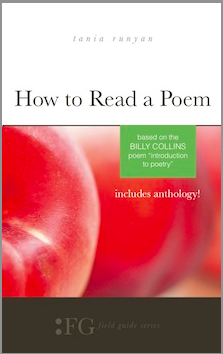

How to Read a Poem uses images like the mouse, the hive, the switch (from the Billy Collins poem)—to guide readers into new ways of understanding poems. Anthology included.
“I require all our incoming poetry students—in the MFA I direct—to buy and read this book.”
—Jeanetta Calhoun Mish
- When a Poem Completely Eludes You - October 8, 2026
- “Paul Celan: A Life” by Anna Arno - October 6, 2026
- Reading Paul Celan for the First Time - October 1, 2026
Leave a Reply