
An early collection by Hedy Habra translates art into poetry
Sometimes I find myself backing into a poet’s work — starting with the most recent work and then working my way backwards to earlier works. Such is the case with Hedy Habra, whose Or Did You Ever See the Other Side? (2023) I considered here last year.
Then I read her first collection, Tea in Heliopolis (2013). I realized she has been writing about art — paintings, sculpture, music, architecture, and history — from the beginning. Her background suggests this is not by accident; she has always been exploring the cultural heritage of her family through poetry.
Under Brushstrokes was published in 2015. As the title suggests, many, even most, of the poems are about art. Habra is going to take us on something of a tour, with our informed tour guide showing us what is and isn’t obvious.
She begins with a series of prose poems that set the stage for the tour. Our itinerary includes travel by liner, and one stop is the Sargasso Sea in the Atlantic Ocean, closer to the United States than to Europe. We’re venturing far from home, and Habra invites us to “think of a houseboat over a sea of foaming moss so thick it seems anchored in green dunes.” We’re on our way, wondering how long it will take to sail through this massive sea of seaweed. Time is an element here, perhaps the most important.
 Next, she’s leading us through ruins, much like she led her child so that he could see what his mother is seeing — their personal family history. But it’s not only ruins; their tour includes the desert, for how do you understand a desert land without understanding the desert itself? He looks for a desert rose, but finds only a fossil, again emphasizing age and history.
The poem “Brushstrokes” is the pivot point, a summary of the journey so far. It portrays a personal scene as a painting, a woman stepping out of a black evening dress as a man reads a newspaper and a man in a white wig plays a requiem on the piano. The scene includes remnants of the Sargasso Sea, with algae on the curtains and waves permeating the floor.
A later poem, “Hiding Under Brushstrokes,” will bring the subject of art into complete focus. We will see or be inspired by works by Gustav Klimt, Egon Schiele, and Oscar Kokoschka. We will dine with Francisco Goya at “The House of the Deaf Man.” Then we arrive at the Borghese Gallery in Rome.
Walking Around Bernini’s Apollo & Daphne
Borghese Gallery

The statue of Apollo and Daphne by Bernini via Wikimedia
You can feel the wind in their faces,
lifting their clothes.
Frozen in flight, bodies strung,
unable to surrender,
his hand on her waist
is the closest to possession.
Stretched between earth and sky,
her raised arms reach
the highest leaves,
feet anchored, veins
merge in a web of darkness
as her skin hardens
under his touch,
she yearns to feel a while longer
the warmth invading
a body no longer hers,
enveloping
like breeze through long curls,
numbing her steps,
face leaning towards
her pursuer, eyes lowered,
looking back in vain,
unable to contemplate the cause
of her change,
sadness
fills her with its sap.
The poems continue with thoughts on family, water, storms, and times of day (like the “yellow hour” and “violet hour,” infusing artistic colors and scenes). She returns to art when she writes about a natural disaster — the Fukushima tsunami in Japan in 2011. Here she looks to “The Great Wave” by Hokusai and offers what she calls “cherry tree laments” for the death and destruction.

Hedy Habra
Habra has published three other poetry collections: Tea in Heliopolis, Or Did You Ever See the Other Side?, and The Taste of the Earth. She has also published a collection of short stories, Flying Carpets, and a book of literary criticism on the work of Peruvian writer and Nobel laureate Mario Vargas Llosa. In addition to a B.S. degree in Pharmacy, she has also earned M.A. and M.F.A. degrees in English and M.A. and Ph.D. degrees in Spanish literature. She’s received numerous awards and recognitions for her work, and she’s published multilingually in a wide array of literary journals and anthologies.
Under Brushstrokes is a strong, vivid collection. Habra poetically ranges across the art landscape, never remaining in one place for too long; this is a journey with an itinerary. It also helps illuminate both her first and most recent collections.
Now I have one more to go — The Taste of the Earth. I’m looking forward to the trip.
Related:
Reading Poets’ First Collections: Hedy Habra and Andrew Calis
Poets and Poems: Hedy Habra and Or Did You Ever See the Other Side?
Photo by chany crystal, Creative Commons, via Flickr. Post by Glynn Young.
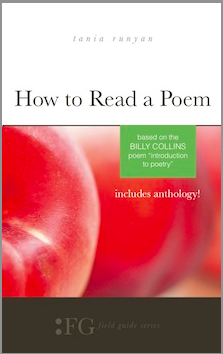

How to Read a Poem uses images like the mouse, the hive, the switch (from the Billy Collins poem)—to guide readers into new ways of understanding poems. Anthology included.
“I require all our incoming poetry students—in the MFA I direct—to buy and read this book.”
—Jeanetta Calhoun Mish

- When a Poem Completely Eludes You - October 8, 2026
- “Paul Celan: A Life” by Anna Arno - October 6, 2026
- Reading Paul Celan for the First Time - October 1, 2026
Leave a Reply