
A manuscript version of “The Waste Land” by T.S. Eliot explains how the poem developed

A favorite place of mine to visit in London is Waterstone’s Bookstore in Piccadilly. reputedly the largest book shop in Europe. The store has eight stories but only five floors. Because the building includes a lower ground floor (we Americans would say basement), a ground floor (our first floor), a mezzanine level followed by four official floors and the official fifth floor being the restaurant.
The restaurant looks down to Jermyn Street and south toward Trafalgar Square. From a window table, you can see some of the famous St. James-area shops below, and a straight view from the window depicts rooftops and spires of some of the best-known buildings in Westminster. Piccadilly Circus is about a block east, and Hatchards Bookstore (oldest in London) and Fortnum & Mason a block west. The Royal Academy of Arts is across Piccadilly, and the Ritz Hotel is about a two-minute walk away. St. James Palace, which fronts the complex that includes the royal residence of Charles III at Clarence House, is “down the block and around the corner,” give or take a couple of blocks.
Piccadilly is always jammed with traffic and sidewalk throngs, and, despite its size, Waterstone’s is always an oasis of quiet. The upper floors have places to sit and read, and the restaurant is good for full meals as well as snacks. Adjacent to the restaurant is a bar, if you’re so inclined.
 On our last visit, I was roaming the floors in an upward direction, intent on reaching the official first floor and the poetry section. Arriving at last, I looked through the stacks. I usually look for new poets or new works by established poets. But this time, one oversize book caught my attention.
It was The Waste Land by T.S. Eliot (1888-1965). There must be hundreds of editions of The Waste Land, but this one was clearly different. First, there was no clean typescript of the poem to be found until the end. Second, single poem editions might run as long as 30 pages (if you add illustrations); this one was 160. My edition of Eliot’s collected poems has The Waste Land at 22 pages with no illustrations. (The poem as we know is reproduced at the end of this edition; it runs 11 pages.) Third, the cover highlighted the editor – Valerie Eliot (1926-2012), T.S.’s second wife. And fourth, this edition included the annotations made by Ezra Pound (1886-1972), who had read the manuscript before it was submitted to the publisher.
This was the centenary edition of the poem, first published in 1922. Yet I knew Valerie Eliot had died in 2012, and this edition was copyrighted 2022. The mystery was quickly solved. This facsimile edition was first published in 1971; Faber & Faber, the publisher, had republished with some additional content in 2022 as the centenary edition of the poem.
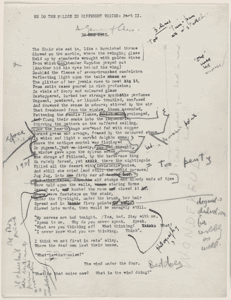
A page from the manuscript
The is a facsimile edition, so the original pages as Eliot wrote (or typed) them are positioned against a typeset version showing the actual corrections. The manuscript version includes Pound’s handwritten edits, questions, and comments.
It also includes Valerie’s introduction, which explains how Eliot wrote and published the poem; a short note by Pound, who outlived Eliot by several years; and
The first and most obvious thing you see is that Eliot struck his original introduction, some 54 lines, so that the poem began with the now famous line “April is the cruelest month.” Had the poem begun with the original line, “First we had a couple of feelers down at Tom’s place,” one wonders if it might have had a lesser impact.
That’s the beginning; many more such changes exist in the manuscript. In some cases, Eliot handwrote new sections rather than type them. Because the facsimile was printed in color, you can see the different kinds of paper Eliot used, and which edits were made in pencil and which in red ink.

T. S. Eliot
And while all of this might be somewhat arcane to most readers, aside from fans like me, one cane almost watch Eliot’s creative process unfold as he wrote one of the great poems in the English language. He was also not a “first-draft” poet; he worked and revised his manuscripts.
As I stood there in Waterstone’s poetry section, I knew I would buy this book, and it would join quite a few others to be boxed up and shipped home by Waterstone’s. (The box also would include three poetry books, The Great Post Office Scandal by Nick Wallis, and Surviving Katyn by Jane Rogoyska, among many others.)
This centenary edition of The Waste Land is a poetry reader’s delight and an Eliot fan’s dream. I’ve been a fan since I read The Love Song of J. Alfred Prufrock, Four Quartets, and The Waste Land in high school and studied them in college.
Eliot ushered in the modern era poetry, writing some of the most remarkable poems of the 20th century. And here, with this manuscript facsimile edition, I had an in-depth glimpse into how he did it.
Related:
T.S. Eliot at the British Library, Part 1 and Part 2.
Photo by Andrew Kuznetsov, Creative Commons, via Flickr. Post by Glynn Young.

How to Read a Poem uses images like the mouse, the hive, the switch (from the Billy Collins poem)—to guide readers into new ways of understanding poems. Anthology included.
“I require all our incoming poetry students—in the MFA I direct—to buy and read this book.”
—Jeanetta Calhoun Mish

- How the Norton’s Anthology Shaped My Understanding of Poetry - August 27, 2026
- Poets and Poems: Peter Murphy and “You, Too, Were Once on Fire” - August 25, 2026
- Poets and Poems: Gabrielle Myers and “Go Forth: Lose Yourself into Life” - August 20, 2026
Leave a Reply