
Gabrielle Myers writes the poetry of the everyday
I love reading big poetry epics and sagas. My idea of a fun time might be reading Beowulf in the J.R.R. Tolkien or Seamus Heaney translations, or even the translation I read in my college textbook, the Norton Anthology of English Literature. (I still have it, more than 50 years later.) Then there’s reading and rereading the stories told in verse form by Henry Wadsworth Longfellow — The Song of Hiawatha, Evangeline, and The Courtship of Miles Standish.
Epics and sagas are feasts, but a diet exclusively composed of feasts would quickly become boring and meaningless, losing any sense of “special-ness.” The vast majority of what we consume is everyday meals; the vast majority of the poetry I read is what I would call the poetry of the everyday. And few poets excel at the poetry of the everyday like Gabrielle Myers. Consider her new collection, Points in the Network.
A memory of a grandmother. A kiwi vine opening to the sun. A run with the dog. A hint of spring. The humidity of the South. Seasons. The fears of childhood. Clouds. None of these subjects are foreign to poetry; they’ve been written about thousands of times, perhaps more. But in Myers’ hands, and the words and phrases she uses, they take on a freshness, a newness, and almost make you think you’re reading about them for the first time.
She also uses the subjects as a launching point, starting with a simple observation that soon becomes something else again. Look at what she does with flies (one of my favorite pests).
Stop Time
 To have time to watch flies circle above the chicken pen,
watch their dance, turn, shift in slight wind, count them
to 18, shift focus to ash’s thin new leaves
waving in a cool spring morning. Sit, be still,
think, but not too much, rest, let the mind pause,
sleep, breathe in clean air, dig dirt-stained nails
into soil, plant tomato, pepper, artichoke, basil,
again and again, run and be thankful
for each breath’s blooming jasmine and honeysuckle,
cooking tomato sauce, frying garlic’s sweet fragrances,
smell the earth awakening, feel lemon blossom’s pollen sticky on
hands, tomato vine resin holding fingers together, inhale cilantro’s
tang, push into rotting zucchini blossoms, lifted, gifted to arrive
at this stop time in between life’s rush.
Every poem in the collection is like this, taking an everyday subject and broadening it into an observation, an insight, or a meditation. Most of the poems are relatively short; one longer one that I particularly like is “Time Machine,” which begins with an observation about the wind in March and becomes a search for personal identity.

Gabrielle Myers
She does especially well with poems that include some aspect of nature, and most of the poems in the collection have some connection to nature. They hark back to the poems of her previous collection, Break Self: Feed, which are largely about nature and the place of humanity within it.
Myers is a writer, poet, teacher, editor, and chef who lives in California’s Sacramento Valley. She previously published a memoir, Hive-Mind, which describes her awakening and transformation on an organic farm. Her previous poetry collections include Too Many Seeds and Break Self: Feed. Her poems have been published in The Adirondack Review, San Francisco Public Press, Fourteen Hills, Evergreen Review, pacific-REVIEW, Connecticut River Review, Catamaran, and other literary journals. She worked as a cook and chef at several San Francisco-area restaurants and catering companies. She is currently a tenured professor of English at San Joaquin Delta College.
The poems of Points in the Network don’t compete against each other for the title of “my favorite poem.” Too many of them would qualify equally. I thoroughly enjoy how Myers uses words to sharpen and hone what she’s trying to say. There’s not a wasted or superfluous word in the lot.
Related:
Gabrielle Myers and Break Self: Feed.
Photo by Ajay Goel, Creative Commons, via Flickr. Post by Glynn Young.
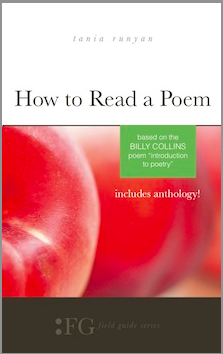

How to Read a Poem uses images like the mouse, the hive, the switch (from the Billy Collins poem)—to guide readers into new ways of understanding poems. Anthology included.
“I require all our incoming poetry students—in the MFA I direct—to buy and read this book.”
—Jeanetta Calhoun Mish

- Reading Paul Celan for the First Time - October 1, 2026
- Poets and Poems: Christian Wiman and “The Dance” - September 29, 2026
- Poets and Poems: James Tweedie and “Love Found, Yearned For, and Lost” - September 24, 2026
Leave a Reply