
A few weeks back, as I was reading A Poet’s Guide to Britain, I discovered a poem by Norman Nicholson (1914-1987) called “Scafell Pike.” It is a landscape poem, an unusual one, as it explores an industrial landscape imposed upon a natural landscape, but the industrial landscape is becoming a ruin and being reclaimed by nature.
In a sense, the poem is also a story poem, the story of the great industrialization of Britain in the 19th century and the deindustrialization of Britain in the 20th. Nicholson’s landscape was very specific—the region of Cumbria on the western side of England’s Lake District and butting up against the Irish Sea.
I looked for more poems by Nicholson, and found them. I looked for biographical information online, and found it. Then I went looking to see if I could find any of his poetry collections online, and I could. But few had been republished; generally, what’s available are used editions at various book shops in the UK. (some priced reasonably and some not).
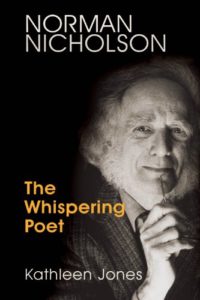 One resource I did find was a biography written in 2013, Norman Nicholson: The Whispering Poet by Kathleen Jones, written at the request of the Norman Nicholson Society and available in Kindle format. It’s highly readable and covers Nicholson’s life and his works in detail.
Born in 1914, he was the only child of a shopkeeper in Millom, a town in Cumbria known for iron ore mining and refining. His mother died when he was five, and his father would eventually remarry. As a boy, he wasn’t sports-oriented like so many of his peers but was recognized as something of a scholar. He would have gone on to university, except that he was diagnosed with tuberculosis when he was 17.
There were no antibiotics or cures for TB at the time, and he was sent to a rather expensive sanitarium in southern England for two years. His room was in a forest, usually open to the elements for the fresh air, and he was only allowed to speak in a whisper to preserve his larynx (and thus the title of the biography, the “whispering poet”). It was a formative experience in his life and eventually for his poetry. When his father’s money ran out, he was sent home, still not completely cured. He would live the rest of his life in the home above the shop in Millom.
His health improved, and slowly he began to write. He had a succession of girlfriends and friends who were girls, and was even engaged for a decade, but only married in his 40s. His poems began to be published in newspapers and journals, and eventually he was connected to T.S. Eliot at Faber & Faber, who published his first collection, Five Rivers, in 1944. He published novels and verse plays, but it is his poetry for which he’s best remembered. He also published biographies of H.G. Wells and poet William Cowper, and the Cowper biography is still considered the best biography on the 18th century poet.
In the biography, Jones notes that Nicholson, because he wrote so much about landscape and the beauty of the region, was something of an environmental poet long before environmental issues were broad public concerns.
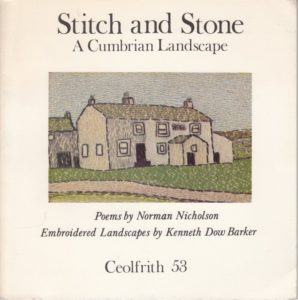 His style of poetry faded in popularity, and he published little in the 1960s. But in the 1970s, he published a new poetry collection, A Local Habitation; a booklet of poems combined with pictures of embroidered landscapes called Stitch and Stone: A Cumbrian Landscape in 1975; a memoir of his early years; and an anthology on writings about the Lake District. He also wrote extensive literary criticism and reviews for newspapers and journals throughout his life.
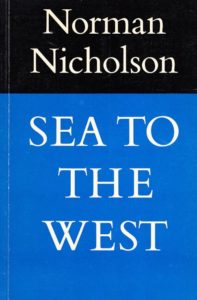
In 1981, he published the collection Sea to the West, and it was this collection that reestablished his work with contemporary critics. This is the title poem, and it is one of the best of his poems that I’ve read.
Sea to the West
 When the sea’s to the west
The evenings are one dazzle –
You can find no sign of water.
Sun upflows the horizon;
Waves of shine
Heave, crest, fracture,
Explode on the shore;
The wide day burns
In the incandescent mantle of the air.
Once, fifteen,
I would lean on handlebars,
Staring into the flare,
Blinded by looking,
Letting the gutterings and sykes of light
Flood into my skull.
Then, on the stroke of bedtime,
I’d turn to the town,
Cycle past purpling dykes
To a brown drizzle
Where black-scum shadows
Stagnated between backyard walls.
I pulled the warm dark over my head
Like an eiderdown.
Yet in that final stare when I
(Five times, perhaps, fifteen)
Creak protesting away –
The sea to the west,
The land darkening –
Let my eyes at the last be blinded
Not by the dark
But by the dazzle.
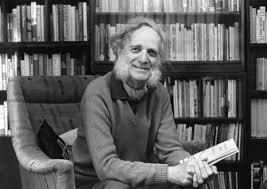
Norman Nicholson
A slim volume, Selected Poems 1940-1982, was published in 1982, and it was the last work published in his lifetime. He had hoped to see an edition of collected poems published, but that didn’t happen until 1994, seven years after his death. He died in his home at Millom; his wife had died from cancer several years before.
He was a provincial poet, or at least was generally considered as one, and he knew that fame required residence in London. But he was also more than “provincial.” His environmental concerns, particularly with nuclear energy, preceded public concerns by many years. His almost intuitive understanding of landscape and topography rivaled that of more well-known poets. He was a generous poet, championing younger poets like Ted Hughes.
And he wrote some beautiful poems, for which he deserves to be remembered.
Related:
Another biography: Norman Nicholson: A Literary Life by David Boyd.
British Poetry, British Poets, and Brexit
Photo by Stewart Black, Creative Commons, via Flickr. Post by Glynn Young, author of the novels Dancing Priest and A Light Shining, and Poetry at Work.
__________________________
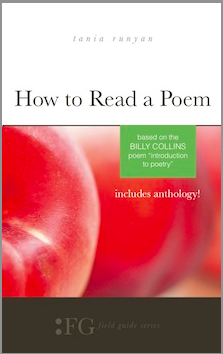 How to Read a Poem uses images like the mouse, the hive, the switch (from the Billy Collins poem)—to guide readers into new ways of understanding poems. Anthology included.
“I require all our incoming poetry students—in the MFA I direct—to buy and read this book.”
—Jeanetta Calhoun Mish

- Poets and Poems: Beth Copeland and “I Ask the Mountain to Heal My Heart” - July 10, 2025
- A.E. Stallings: the Parthenon Marbles, Poets, and Artists - July 8, 2025
- Poets and Fables: Steven Flint and “The Sun and the Boy” - July 3, 2025
Jerry says
Thanks for the introduction to his work. Excellent review Glynn.
Maureen says
What a marvelous line, ‘The evenings are one dazzle- ‘.
Bethany says
Thank you for bringing his poetry to my attention. Absolutely love the “Sea to the West” poem. What lovely lines:
“Sun upflows the horizon”
and
“Let my eyes at the last be blinded
Not by the dark
But by the dazzle.”
And how cool is it that he published poems alongside embroidered landscapes? I’ve never seen that before.
Barry Tebb says
Nicholson was an outstanding poet,lucky that Eliot took him on,unlucky to have fallen out of favour in the sixties.Ted Hughes work-grossly overvalued-shows some debt to Nicholson’s work-note the exquisite use of alliteration in Nicholson,a favourite trope of Hughes.