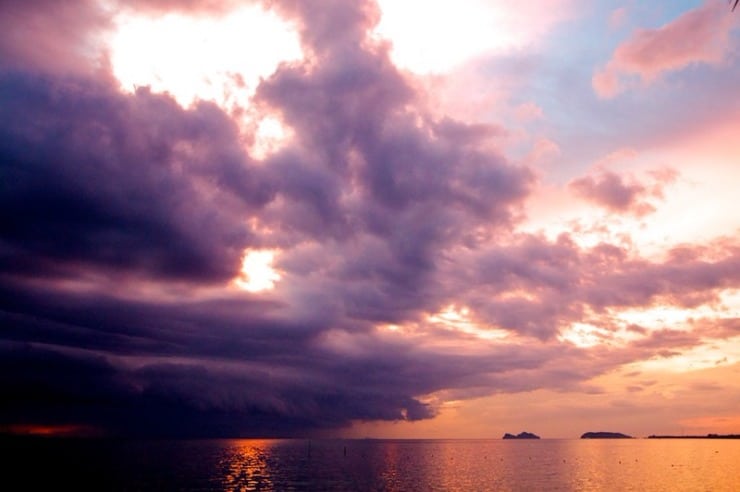
Science influenced Tennyson in his early poems.
It’s not exactly a confession, but I have the textbook I used for English in my senior year of high school, England in Literature. It’s not the one I actually used, but a copy I found at a used book fair. And I’ve also held on to the texts from my two courses in English Literature in college – the Norton Anthology of English Literature, published in 1962 and revised in 1968. I’d prefer not to think about how many editions have occurred since then (the most recent is 2024).
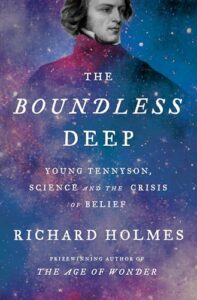
I pulled both texts from the shelf recently to see what poems were included from Alfred, Lord Tennyson (1809-1892). I’ve been reading The Boundless Deep: Young Tennyson, Science and the Crisis of Belief by Richard Holmes. Holmes cites Tennyson poems I’d never heard of, and I wondered how many of them had been included in those textbooks.
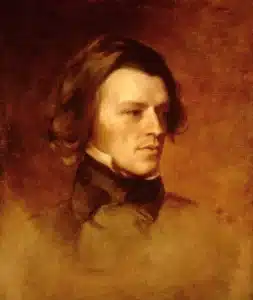
Tennyson as a young man
When you think of Tennyson’s poems, you think of Idylls of the King, In Memoriam, “The Charge of the Light Brigade,” and perhaps “Morte d’Arthur” and “The Lady of Shalott.” All of them were written after 1850, when Tennyson had reached middle age. My high school text conformed to that list.
My college text included two poems written when Tennyson was young, “Mariana,” which reached a gold medal in 1830 while Tennyson attended Cambridge University, and “The Kraken,” also written that year. I had carefully placed an asterisk against several of the poems in the table of contents; these were the ones we’d be responsible for knowing. “Mariana” had an asterisk. “The Kraken” did not.
I associated “kraken” with a cryptocurrency or charges about voter fraud. The name actually comes from a mythical sea monster, believed to exist off the coast of Norway. That was the kraken Tennyson had written about.
The Kraken
 Below the thunders of the upper deep,
Far, far beneath in the abysmal sea,
His ancient, dreamless, uninvaded sleep
The Kraken sleepeth: faintest sunlights flee
About his shadowy sides; above him swell
Huge sponges of millennial growth and height;
And far away into the sickly light,
From many a wondrous grot and secret cell
Unnumbered and enormous polypi
Winnow with giant arms the slumbering green.
There hath he lain for ages, and will lie
Battening upon huge sea worms in his sleep,
Until the latter fire shall heat the deep;
Then once by man and angels to be seen,
In roaring he shall rise and on the surface die.
Holmes begins his biography of the poets as a young man by asking what at first sounds surprising: was there ever a young Tennyson? It full on stopped me. Well, of course there was. His real question is more complicated: was there ever a young poet named Alfred Tennyson? We know the poet from his later poems. But they didn’t arise from nothing. Tennyson had been writing poetry from a young age; his two older brothers had as well.
When Holmes looked hard at the poetry of the young Tennyson, he found something else – the enormous influence of science. Science was in profound ferment in the first half of the 19th century. And it was in ferment across virtually all fields – geology, paleontology, biology, and more. Those ideas were permeating Cambridge, and they were finding an outlet in poets like Tennyson. His tutor, William Whewell, would in fact coin the term “scientist” in 1833. And once you know to look for it, the influence of science of what Tennyson wrote becomes obvious.

Richard Holmes
Holmes, retired professor of Biographical Studies at the University of East Anglia in the U.K., is the author of numerous works on the Romantic poets and their era, including Shelley: The Pursuit (2003); The Age of Wonder: The Romantic Generation and the Discovery of the Beauty and Terror of Science (2010); Coleridge: Early Visions and Coleridge: Darker Reflections (2011 reissues of the earlier two-volume biography); The Romantic Poets and Their Circle (2014), a companion guide to an exhibition at the National Portrait Gallery in London; and two literary research memoirs, Footsteps: Adventures of a Romantic Biographer (1996) and Sidetracks (2011 reissue).
I’m still reading The Boundless Deep. It’s an excellent biography, well-written and engaging and aimed at reader understanding. I’ve learned something new about Tennyson. I’m reading poems I hadn’t read before. I’m watching a revolution in science unfold in poetry. It’s a wonder.
Related:
Richard Holmes’ Dr. Johnson and Mr. Savage.
The Romantic Poets and Their Circle by Richard Holmes.
Photo by Matthias Meuller, Creative Commons, via Flickr. Post by Glynn Young.

How to Read a Poem uses images like the mouse, the hive, the switch (from the Billy Collins poem)—to guide readers into new ways of understanding poems. Anthology included.
“I require all our incoming poetry students—in the MFA I direct—to buy and read this book.”
—Jeanetta Calhoun Mish
- Poets and Poems: Peter Murphy and “You, Too, Were Once on Fire” - August 25, 2026
- Poets and Poems: Gabrielle Myers and “Go Forth: Lose Yourself into Life” - August 20, 2026
- Jon Nappa Imagines the Life of Longfellow - August 18, 2026
Leave a Reply