Sometimes, language isn’t needed to communicate.
Our missions trip was scheduled for September 2001. We’d been preparing all summer. But 9-11 intervened, and the trip was postponed.
We were an unusual missions team. The mission we’d be visiting had specifically asked for it – a small team devoted to communications to help the mission tell its story, produce a short film for a building fundraiser, and interview missionaries who could use videos and stories to send reports to financial supporters and home churches. We were a team of three: team lead/logistics guy/organizer/general factotum; the videographer, aka the guy with the camera; and me, the writer, the guy with the laptop who would be typing away in airports, planes, homes, offices, and in the car.
We’d be in central Europe for a week, with a schedule so packed I thought we’d need slotted times for breathing. Four countries, five languages, cultural shocks, and no time to detox from jet lag.
I could probably write pages about that trip, story after story, detail after detail. But what sticks with me were a few examples of how communication didn’t depend upon language.

Budapest; Nicolas Perdoni via Unsplash
Our first full day started with a church service held in an old movie theater in downtown Budapest. Most of the service was in Hungarian, with a few parts of the sermon translated into English. The congregation, except for the handful of Americans, was Hungarian. The liturgy was in Hungarian. The hymns were sung in Hungarian.
But the hymns were recognizable from the music. They were familiar. I could hum along and think the words in English because I knew them. And that music folded me into the Hungarian congregation that day.
Monday morning, driving to Prague, I noticed the occasional woman alongside the road suddenly lifting her blouse and flashing us. The first time I thought it might be a prank. The second time I looked at out driver, a native Chicagoan who worked with the mission in Budapest. He explained that he should have mentioned that prostitution was legal in Hungary and the Czech Republic. “Well,” I said, “that’s one way to get a message across.”
After spending the night in Prague, where the only English we heard was our own, we drove northwest toward the Sudeten Mountains. This area of the Czech Republic was heavily ethnic German – the area Adolf Hitler wanted and got via the Munich Agreement in 1938. We stopped for dinner in a small town. Th restaurant was right by the highway, and our driver said we would likely find authentic German and Czech food, the kind the locals ate.
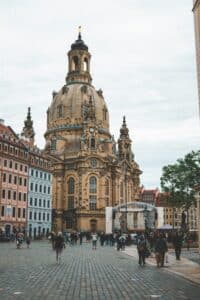
Dresden, by Lukas D via Unsplash
The entrance into the restaurant was the bar, which was smoky and packed with men. All conversation stopped as every pair of eyes focused on the four of us standing by the door. Finally, the bartender – the only woman we could see – walked up. She didn’t speak English, but the fact she was holding menus said she’d guessed what we wanted. Rather than seating us in the bar, she escorted to the large adjacent room, which was clearly the restaurant. It was empty. It stayed empty the hour or so we were there.
“I think we’ve been segregated,” our videographer said.
We looked at the menus, which were in German and Czech. I’d taken German in college, but that had been 25 years before. I recognized only two words – kaffee and Weiner schnitzel. I knew what I’d be ordering. Our team leader followed my example. Our driver and the videographer decided they would be adventurous, and they simply pointed to something when the bartender returned for our order. She raised her eyebrows but nodded. When the orders arrived, the Weiner schnitzel looked wonderful. The mystery orders remained just that. The driver took one bite and said, “It tastes like tripe, but I think it’s something else.”
We arrived late in Dresden and spent the night at a bed-and-breakfast owned by a doctor. We interviewed people in a church and two elderly missionaries who worked in what was a massive Soviet-style apartment complex in a Dresden suburb. Then we took the autobahn to Erfurt. We stopped for a to-go lunch in Chemnitz – at a McDonald’s. The drive-thru menu was in German, but every listing had a picture, and a Big Mac in Chemnitz looked just like a Big Mac in St. Louis.
Erfurt had not been part of the itinerary. When we were waiting for our place in St. Louis, we saw the reports of a school shooting in Germany, with 16 students and teachers killed, including the shooter, who was a former student. While we were over the Atlantic, the mission leaders had decided we should go to Erfurt – if we agreed. Everyone knew the schedule. Everyone knew it would force a complete rethinking of the entire trip. Erfurt was best known as the city where Martin Luther had attended seminary. Now it was famous for a school shooting.
They left the decision to our team, and we were divided. The team leader saw a wrecked schedule. The videographer was noncommittal; he could go either way. I was in favor of going. Ultimately, that was what we decided to do.

The church in Erfurt
We were met just off the highway by the young pastor of a church in Erfurt. By this time, the team had developed a process. I’d join whoever was meeting us; I’d use the time to talk with the contact, outline the story we were doing, and answer questions. The prep work in the car allowed for the team to go straight into the interview setup.
That’s how it started in Erfurt. I knew the young pastor’s name, that he was originally from Hamburg, and that his church in Erfurt was about 100 people, small by American standards but large by those for a church in what had once been Soviet East Germany. I also knew that the church building was a former Communist Party social hall; the irony wasn’t lost on us. And he spoke passable if not fluent English. But his English was vastly better than my German.
As soon as I got in his car, I knew this would be unlike anything else we’d done. He looked exhausted; he’d been ministering to the families of victims almost non-stop for several days. He was physically and emotionally drained. We introduced ourselves and looked at each other. And then we simultaneously began to do something totally unexpected.
We started laughing. We laughed hard. We laughed until we had tears in our eyes. The team members in the car behind us could see something was happening but didn’t know what. At that moment, a young German and a middle-aged American crossed language, cultural, and experience barriers. It was if we’d known each other for years.
I still can’t explain the laughter.
We interviewed him at the church. The camera was rolling, I started my questions, he replied with his answers. And the second strange thing happened. It was as if all of the physical and emotional exhaustion caught up with him at that moment. He began to weep.
It didn’t last long, perhaps only a few minutes. But when he composed himself, the videographer and I both discovered tears on our own cheeks.

The school in Erfurt
We drove to the school. Mountains of flowers covered the entrance. The place was packed with people, all sitting quietly without speaking. Some were alone; others were with groups. What had happened in the church interview had been a preparation for the scene we now walked into. We sat as well. The word spread quickly through the crowd. We could hear the murmurs. Americans were here. And if anyone understood what a school shooting was like, it was Americans.
We didn’t speak. Someone would say, “American?” And I’d nod. That was sufficient. In a very odd way, it was as if our presence there at the school communicated something far beyond words.
We drove back to Dresden for the night. On our return to home base in Budapest, we stopped and interviewed missionaries in a small Czech town. We finished with more office staff interviews in Budapest.
That trip became part of my experience, part of my life. Erfurt became part of my soul. Communication on that trip had happened with menus and music. It had also happened with unexplained laughter and silence in front of a school. Language itself had been secondary.
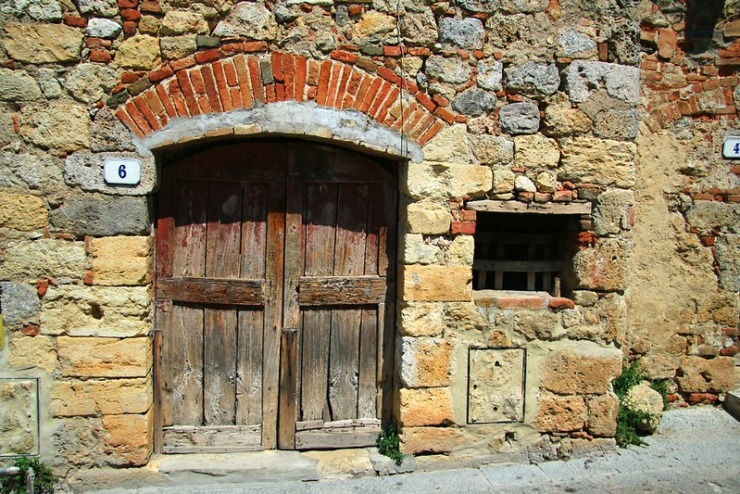
Photo by Taz, Creative Commons, via Flickr. Post by Glynn Young.


How to Read a Poem uses images like the mouse, the hive, the switch (from the Billy Collins poem)—to guide readers into new ways of understanding poems. Anthology included.
“I require all our incoming poetry students—in the MFA I direct—to buy and read this book.”
—Jeanetta Calhoun Mish
- Poets and Poems: Kortney Garrison and “The Fixed Hours” - October 20, 2026
- Matthew Zapruder and “The Story of a Poem” - October 15, 2026
- Poets and Poems: Mischa Willett and “The Gift Card Has Already Been Redeemed” - October 13, 2026
L.L. Barkat says
Glynn. Oh. This leaves me in silence. So very, very touching. I could feel it as if I were there.