Julia Alvarez revisits her life in poetry.
Have you ever read a poetry collection that catapults you back three decades?
Another lifetime ago (35 years, to be exact), I wrote book reviews for the St. Louis Post-Dispatch. It was an offshoot from a graduate seminar on the Latin American novel. I had more than liked the assigned readings; I’d discovered a world that went beyond the one Latin American novel I’d previously read, One Hundred Years of Solitude by Gabriel Garcia Marquez.
At the time I started writing book reviews, publishing was in the midst of a Latin American boomlet, an echo of the original “boom” in the 1960s and 1970s. After an introductory conversation, the newspaper’s book editor began routing any book relating to Latin America, Spain, and Hispanic culture in the United States.
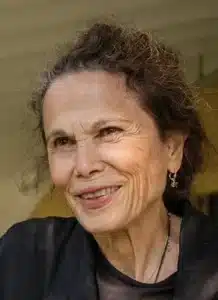
Julia Alvarez
One of the books I reviewed was How the Garcia Girls Lost Their Accents (1991) by writer and poet Julia Alvarez. It’s a story about four sisters in the Dominican Republic whose father is forced to flee the Trujillo regime. Her parents return to New York City, becoming with their children people of two cultures. It’s a novel, but it’s drawn from Alvarez’s own family history.
Thirty-five years later, I picked up her new poetry collection, Visitations: Poems. And, suddenly, I was back in 1991, reading How the Garcia Girls Lost Their Accents. For these poems, Alvarez has drawn from the same family heritage and dual cultures: “Here I am starting again where I first began / in a pink party dress with a flaring crinoline.”
She remembers deciding on Sunday which parent to accompany on outings, mass at the cathedral with her mother or the beach with her father. At family dinners, her grandfather slices his mango into wedges. Her sister recites the menu at her restaurant. Erasing the blackboards at school. Watching her mother dress for a charity gala.
The remembered or imagined scenes from the Dominican Republic abruptly move to New York City, and Alvarez is waiting for her father to pick her up at the library. She dreams of candy stores. Later, she records a visit to Bloomingdale’s and describes her first marriage. In a series of eight poems, she describes herself and her sisters.
from The Four Girls
Julia
 Second child, I wanted to be first.
You’ve all endured my list of firsts:
first one to talk, dance, draw, recite poetry.
First one to get her period, kiss a boy, have sex,
smoke cigarettes. The first to run away,
but also the first to come home,
to start the revolution, to topple mami and Papi,.
First one to break down and leave school
for emotional reasons, first to starve herself,
to marry the wrong man and divorce him.
Last time I dragged myself home, a sick skinny girl,
I found you all gone to the right or wrong men,
your failures omitted, your successes
reported long distance to Mami and Papi,
who retold them as parables for my own life.
I resolved, then and there, to bury the myth of us,
and as each of your faces rose like a ghost
from the corpse of the four girls, I began
to believe in a self of my own, relived of
that brace of our bones, an inviolate woman
who liked poems, my own room, friends
who were clever with language,
men who kept their own counsel.
Julia, the last of the four to be born.
The poems continue, embracing adulting, recording a late winter’s walk, falling in love in the late fall, walking into a conga line of retirees, turning the lights off when the guests leave a party.
Alvarez was born in 1950 in New York City but lived as a young child to the Dominican Republic. She has published several novels, poetry collections, non-fiction, and numerous books for young readers. Her recognitions include several awards, including the F. Scott Fitzgerald Award and the National Medal of Arts. Alvarez was also the subject of an American Masters documentary on PBS, “Julia Alvraez: A Life Reimagined.” She lives in Vermont.
Visitations is not a poetry collection about regrets; it is a memoir of a life lived fully and well. Alvarez is looking back on her life with candor and a clear eye, wrapped in a deep sense of appreciation.
Photo by gnuckx, Creative Commons, via Flickr. Post by Glynn Young.

How to Read a Poem uses images like the mouse, the hive, the switch (from the Billy Collins poem)—to guide readers into new ways of understanding poems. Anthology included.
“I require all our incoming poetry students—in the MFA I direct—to buy and read this book.”
—Jeanetta Calhoun Mish

- When a Poem Completely Eludes You - October 8, 2026
- “Paul Celan: A Life” by Anna Arno - October 6, 2026
- Reading Paul Celan for the First Time - October 1, 2026
Leave a Reply