
Researching family history can take some odd twists and turns.
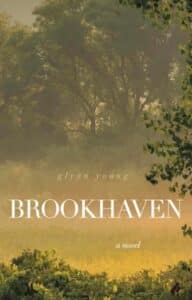
The writing of my historical novel Brookhaven took about 150 years.
I must have seen something like this before, but I can’t recall a specific example. Many novels include an acknowledgement page, cutting the people who helped or inspired the author. My historical novel Brookhaven has an author’s note explaining some of the novel’s background. But it also has something you don’t usually see in a novel – a nine-page bibliography.
I included it more as a reminder to myself of where the novel came from.
 A grandmother who referred to the Civil War as the “War of Northern Aggression.” A father who told slightly mangled family stories, including one that sounded like an epic journey. A research paper in high school on what the “plantation system” really looked like. A family Bible with a mystery embedded in the birth and death records. A mountain of reading old and new American history books. An aunt who spent decades researching family history, long before the invention of the internet. Discovering I liked, as in really liked, the poems of Henry Wadsworth Longellow, once the top-selling poet and author in the United States who was dropped into the dustbin of literary criticism.
Brookhaven actually began its life when, about 1872, my great-grandfather bought a large family Bible and began to write birth and death entries, beginning with his own father. He made entries for about 25 years, when he stopped when he ran out of space. Somehow, the Bible ended up in the hands of his youngest son, my grandfather (descendants of the oldest son still have something to say about that).
Then it passed to my father and on to me. It sat on a shelf for a long time, until I brought it to a book conservator who repaired the cover and the family record pages. Restoration of the entire Bible was out of the question; it would have required something larger than a small fortune. Somewhere in that process, I matched the family records to family stories, and Brookhaven began its journey.
I turned to other resources as well. The internet had made genealogical and historical research almost easy, with the challenge being how to sift through everything out there. But here are five ways to research family history that I found to be invaluable.
#1 Study that old family Bible.
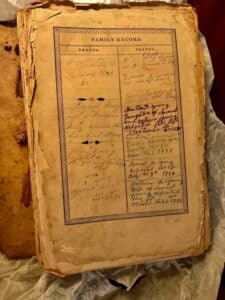
A family Bible page, pre-preservation
Bibles like the one my great-grandfather bought and used were sold by the tens of thousands in the 1870s and 1880s. They were a tool families used to memorialize and record the deaths of loved ones, especially those who died in the Civil War (it’s estimated that up to 10 percent of the U.S. population died during the conflict). And the records can often contain mysteries. In my case, a death was recorded of someone not obviously connected to the family. It had been a family mystery for more than eight decades. I found the answer on an online site – he’d been the husband of my great-grandfather’s sister, a man who had died at the Battle of Shiloh in 1862. He became a presence in Brookhaven.
#2 Listen to those old family stories.
When you’re young, you might roll your eyes when grandparents and other elderly relatives start reminiscing. You will never regret paying attention. The central premise of Brookhaven – the journey home to Mississippi from the surrender at Appomattox – came from one of those stories, treated as absolute truth until it fell apart during my research. That it happened while I was in the middle of the writing was nearly a train wreck. But the truth became another theme. And my mother’s stories of hunger during the Depression years became an element that found its way into the story.
#3 Use online genealogy sites.
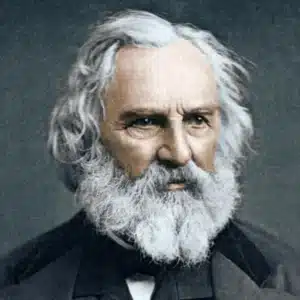
Henry Wadsworth Longfellow
I used both FamilySearch.org and Ancestry.com. They’re free. You must be careful of some of the crowd-sourced entries; I’m still not convinced of certain connections that someone made of the Young family in the 1700s. But I could see my family tree like a display fan, click on names, check connections, and see how far back family lines had been traced. This is how I discovered that my great-grandmother, Octavia Montgomery, was a descendant of John Alden and Priscilla Mullins of Mayflower fame, not to mention the central characters of Longfellow’s The Courtship of Miles Standish. That had some influence on the use of Longfellow in Brookhaven.
#4 Use history for context.
Brookhaven’s bibliography tells the context story. I read a lot of books and articles, both older ones and newer ones. I particularly looked for works that stripped away the romance of the Civil War; I wanted less Gone with the Wind and North and South and more Cold Mountain. I also needed both general and specific information – general about the war and Reconstruction and specific like could deer meat be kosher, what would a woman from a well-to-do family be wearing in 1915, and when did autism become an identifiable condition? Some books even offered short scenes for my novel – like a 2023 account of the 1913 celebration of the 50th anniversary reunion of the Battle of Gettysburg. I haunted used and rare book sites to find books long out of print. I also spent an inordinate amount of time at the Emerging Civil War web site.
#5 Read historical fiction and poetry.
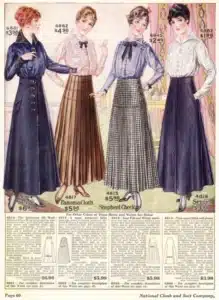
Women’s dress lengths in 1915
Fiction and poetry may not tell you specifically about your own family, but they can suggest what your ancestors might have been reading, and the kinds of works that would have been popular. One of Brookhaven’s main characters, Samuel McClure, becomes identified closely with Longfellow’s poetry. Longfellow was not a famous Civil War poet, although he was alive during the time. The only poem of his clearly linked to the war is “I Heard the Bells on Christmas Day.” But his poetry would have been read (and read aloud) by Northern soldiers. (During the war, the poet best known as “the Civil War poet” was Herman Melville.)
The experience of writing Brookhaven remains a hallmark of my own life. I learned about my family and what they lived through. I saw how they dealt with great grief. I studied the hand of my great-grandfather has he painstakingly entered births and deaths in the family Bible, not knowing that his simple entries would become a novel written by a great-grandson.
Related:
10 Great Resources for Teaching the Civil War.
Photo by Gabriel Caparo, Creative Commons, via Flickr. Post by Glynn Young.

How to Read a Poem uses images like the mouse, the hive, the switch (from the Billy Collins poem)—to guide readers into new ways of understanding poems. Anthology included.
“I require all our incoming poetry students—in the MFA I direct—to buy and read this book.”
—Jeanetta Calhoun Mish

- “Paul Celan: A Life” by Anna Arno - October 6, 2026
- Reading Paul Celan for the First Time - October 1, 2026
- Poets and Poems: Christian Wiman and “The Dance” - September 29, 2026
Leave a Reply