
Fred Chappell’s final poetry collection considers final things
I came to the writing of Fred Chappell (1936-2024) through his novels. A friend at work, who had grown up in the mountains of West Virginia, recommended I read I Am One of You Forever. It’s set where most of Chappell’s novels are set — the mountains of western North Carolina. And it’s a wonder. Over the years, I read several of his other novels and story collections. Superficially, Chappell might sound like North Carolina’s answer to Kentucky’s Wendell Berry. Even though they’re approximate contemporaries writing about family, heritage, and place, they’re very different kinds of writers.
It was only in 2015 that I discovered how Chappell had first made his name — through poetry. I happened across a used copy of his 2000 collection, River: A Poem. It’s one poem with 11 divisions, and it tells a story, the story of his grandparents. It’s aptly named; reading it is like wading through a river of memory and family history.

Fred Chappell
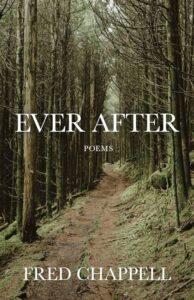
As it turns out, River is one of some 18 collections of poetry that Chappell published between 1971 and 2009. In fact, he published more poetry volumes than works of fiction. In 2024, the year of his death, LSU Press published his last collection, Ever After: Poems.
It’s tempting to think of the poems of Ever After as “observations on the end of life,” but that would be a mischaracterization. Instead, the poems are consistent with Chappell’s fiction and River. Chappell is always thoughtful, always resonating, typically profound. He captures even mundane scenes and ideas in a way that makes you see something you didn’t see before or might have missed until he pointed it out.
Poems are how we see with our eyes closed, Chappell writes.
An oak tree in a park dances to the night music. A man weeding his garden becomes an exercise of cleaning a room. A nameless brook offers a music of wisdom. A man looks at the child wrapped in the body of what he is. The joy of a memory often returns as mockery. Seeing crows sitting on a power line evokes a meditation on the inner workings of the outer world. Dreams fly across the sky, inspecting the minds of sleepers. The might arrives for a woman to become aged. A death in wartime feels like betrayal.
And then there are the things we describe as “lost.”
Sum Total
 Lost is the adjective we bestow
on things that have become anonymous
in time and over time. We claim to know
what random circumstance has brought upon us,
though now that bright event has lost its name
and every distinct feature to stand alone
amid the crowd of others all the same,
each now featureless one by one by one,
like soldiers in ranks or bottles in a shelf,
all of them together without a self,
every lonely one never alone,
They come and go and none is ever gone;
they go and come and none is ever here;
they crowd a past wherein they never were.
Chappell published more than 30 books of poetry, fiction, and nonfiction. His works received numerous prizes and recognitions, including the Bollingen Prize, the T.S. Eliot Prize, and the Thomas Wolfe Prize. Chappell served as North Carolina’s poet laureate from 1997 to 2002 and taught English at the University of North Carolina-Greensboro for 40 years.
My response to Ever After is a decision: to seek out more of Chappell’s poetry and to begin rereading his fiction. Too much wisdom is here not to read, and reread, his works.
Related:
Photo by Fred Friggens, Creative Commons, via Flickr. Post by Glynn Young.

How to Read a Poem uses images like the mouse, the hive, the switch (from the Billy Collins poem)—to guide readers into new ways of understanding poems. Anthology included.
“I require all our incoming poetry students—in the MFA I direct—to buy and read this book.”
—Jeanetta Calhoun Mish

- When a Poem Completely Eludes You - October 8, 2026
- “Paul Celan: A Life” by Anna Arno - October 6, 2026
- Reading Paul Celan for the First Time - October 1, 2026
Leave a Reply