
Julian Peters draws comics to illustrate classic nature poems
It’s one of those “Aha!” moments. I was reading an illustrated poem, William Shakespeare’s Sonnet 18 (“Shall I Compare Thee to a Summer’s Day”) when I realized I’ve been long fascinated with mixing artistic genres.
Robin Robertson’s The Long Take is a classic detective novel written as poetry. Sara Barkat has taken classic stories and novels and transformed them — The Yellow Wall-Paper, The Picture of Dorian Gray, Dr. Jekyll and Mr. Hyde, H.P. Lovecraft’s The Colour Out of Space, and even Dracula.
I didn’t think this was some great personal revelation, but I was struck by how I tend to gravitate toward graphic treatments of classic or contemporary texts.
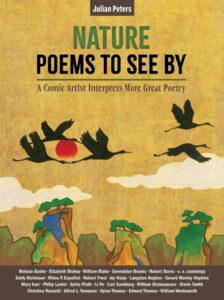 The work that included Shakespeare’s Sonnet 18 was Nature Poems to See By by Julian Peters. It’s a collection of 24 classic nature poems, arranged by season (six poems each), and illustrated with what is a literary comic strip.
Peters is a comics artists and illustrator. He has a master’s degree in art history, and he’s focused on using graphic art to adapt classic poems. While I never expected to see the poem “God’s Grandeur” by Gerard Manley Hopkins adapted into a comic book format, I can now say I have. (William Blake wouldn’t surprise me, since he was an artist as well as a poet. But Hopkins did.)
Along with Shakespeare, the volume includes poems by Langston Hughes, William Blake, Gwendolyn Brooks, Dylan Thomas, Sylvia Plath, Emily Dickinson, Joy Harjo (U.S. poet laureate from 2019-2022), Japanese haiku poets, Robert Frost, Christina Rossetti, and William Wordsworth, among several others. The work is like his previous book, Poems to See By; the difference is that this new one focuses on well-known nature poems, as the title indicates.
Mixing classic texts with drawing and illustrations allows a different kind of perspective. It’s a visual interpretation of the printed words. I’ve read “Adlestrop” by Edward Thomas many times before, but I’ve never seen it illustrated. It’s a World War I poem, and the writer is remembering a train trip and what he sees at a particular stop. Peters’ comic drawings capture the sense of homesickness that pervades the poem. They also demonstrate the writer’s loneliness.

Julian Peters
It works surprisingly well. I say “surprisingly,” because it sounds counterintuitive; I initially was startled to see great poems embedded within comic art. Illustrating a poem with comic art? Yes. Exactly.
Peters’ work has been exhibited internationally and published in numerous poetry and graphic art publications. I’d first seen some of his work in Plough Magazine. In 2015, he served as “cartoonist in residence” at Victoria University in New Zealand. Nature Poems to See By uses full-color comic art; you can see an example of some of his black-and-white cartoons on his website (like the one he did for T.S. Eliot’s “The Waste Land”). He lives in Montreal.
Nature Poems to See By didn’t fundamentally alter my perception and understanding of poems I was familiar with. But it did enhance and deepen that understanding. Perhaps it was the seeming simplicity of how comic art frames them. Perhaps it was seeing words I knew through the artistic sense of someone else. Whatever it was, it added depth. And an occasional smile.
Photo by Diego Torres Silvestre, Creative Commons, via Flickr. Post by Glynn Young.
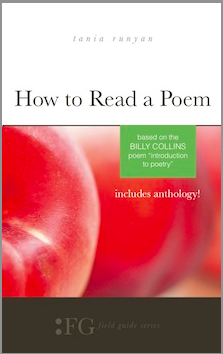

How to Read a Poem uses images like the mouse, the hive, the switch (from the Billy Collins poem)—to guide readers into new ways of understanding poems. Anthology included.
“I require all our incoming poetry students—in the MFA I direct—to buy and read this book.”
—Jeanetta Calhoun Mish

- Artists and Poems: Julian Peters and “Nature Poems to See By” - March 31, 2026
- Alan Jacobs Writes a Biography of “Paradise Lost” - March 26, 2026
- Poets and Poems: Marjorie Maddox and “Hover Here” - March 24, 2026
Leave a Reply