
Sarah Carey uses poetry to describe the family she knows and loves.
I’d read, a long time ago, that certain things become more important as you age. These included art, as in visiting museums, and family heritage, as in genealogy. I must have read it and dismissed it, so I can’t cite the source, but I later discovered it to be true.
An older cousin researching the family had led her to the old family Bible in my possession. The call became an extended conversation about old family stories, including one about the great-grandmother who allegedly killed a man and got away with it, and the great-grandfather who had reportedly walk home from Virginia at the end of the Civil War (I wrote a novel about that story).
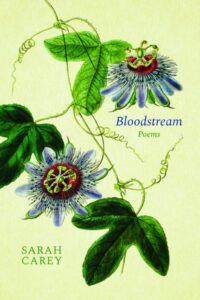
Poet Sarah Carey has taken a related but different approach. She’s written an arresting poetry collection, entitled Bloodstream, about family, heritage, and stories about odd relatives (if you’re from the South, as Carey and I both are, every family has odd relatives. In fact, in the South, odd and relatives may be redundant. She even writes about family pets.
Bloodstream has an apt title. We are each part of that great steam of humanity, carrying the DNA of all those who came before us. And “blood” implies family, so you would expect a poetry collection with this title to tell stories. Carey does not disappoint.
She looks back to her Irish and German heritage, connecting to her father’s German background. She goes to funerals, like that of her grandmother, making sure to salvage the dying philodendron on her grandmother’s porch. She recalls trips and shopping at Montgomery Ward’s department store. She tells those yet unborn but who will come after her that her “endless strands / of DNA bespeak other passages: / maiden voyage of a train full of emigrants / to a promised land…”
Carey also tells her own origin story.
An Origin Story
 In the cabin where I was conceived,
where my great-uncle let us stay,
Mother organized belongings
for our move, while Father, Straight
out of seminary, ministered,
as was his want, at a school
with mandatory chapel and vespers.
Where righteousness could be
compartmentalized, though I always believed
I came from some imagined justice.
In this tiny Southern town
where it was wise to not be too theological
or over-speak, Father spoke for the students
during the protests, sit-ins beginning
in bigger cities not far up the road.
In the era of Jim Crow.
Inside Mother’s belly, where her blood
pumped parallel to mine, feeding my veins,
my heart in intervillous chambers,
I drew a way of knowing
from her body about the world that was
and yet was yet to be.
She writes of art, like the paintings of Andrew Wyeth and Vincent Van Gogh, connecting memories to family members. (For herself, she thinks of a longleaf pine and a royal palm as her self-portraits, likely a reference to the two states where she’s lived – North Carolina and Florida.) A chair becomes a focus for her mother’s room in assisted living. She imagines her father dreaming in his apartment in independent living. “We are all our dust, Father says.”
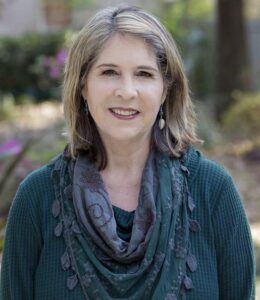
Sarah Carey
Carey has been a journalist and university communicator as well as a writer and poet. She previously published two poetry chapbooks, The Heart Contracts (2016) and Accommodations (2019), and the collection The Grief Committee Minutes (2025). Her poems have been published in such literary journals as Gulf Coast Review, Valparaiso Review, Sugar House Review, Florida Review, Atlanta Review, and many others. Her work has been recognized with several prizes and awards, including three separate recognitions for The Grief Committee Minutes. She is recently retired as the director of Communications for the University of Florida College of Veterinary Medicine, and she lives in Gainesville with her family.
You can’t read a collection like Bloodstream without thinking of your own family, almost with every poem. And that’s the power of these poems, which take something as personal as one’s own family and suggest something so personal about our own families. And ourselves.
Related:
Sarah Carey and The Grief Committee Minutes.
Photo by Jason Parrish, Creative Commons, via Flickr. Post by Glynn Young.
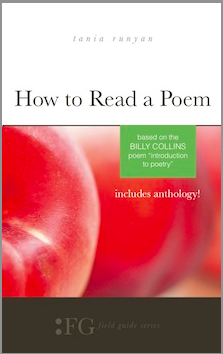

How to Read a Poem uses images like the mouse, the hive, the switch (from the Billy Collins poem)—to guide readers into new ways of understanding poems. Anthology included.
“I require all our incoming poetry students—in the MFA I direct—to buy and read this book.”
—Jeanetta Calhoun Mish
- Poets and Poems: Peter Murphy and “You, Too, Were Once on Fire” - August 25, 2026
- Poets and Poems: Gabrielle Myers and “Go Forth: Lose Yourself into Life” - August 20, 2026
- Jon Nappa Imagines the Life of Longfellow - August 18, 2026
Leave a Reply