
Linda Nemec Foster visits Europe in prose poetry
One can visit Europe in lots of ways — cruise ship on the rivers, cruise ship on the ocean, bus, car, backpacking, bicycle, airplane, even on foot. I don’t know exactly how poet Linda Nemec Foster has visited Europe, but her 2024 collection Bone Country shows she has at least visited in prose poetry.
Bone Country is not a travelogue or tourist guide. Instead, it’s a deep dive into people, history, major upheavals, and small events. She watches a man with a spiked mohawk drink tea in Istanbul. An artist from Serbia insists he’s painted her face. She watches undercover policewomen and ghosts among the trees in Warsaw.
 And she goes on, to Krakow and southern Poland, Bratislava, Lithuania, the Jewish ghetto in Prague in 1942, and Zurich and the Alps. She watches the indigo sky in Spain and the waterfalls in Silesia. A man scatters the ashes of his wife on Lake Geneva. She remembers the last place she saw her friend Lara in Vienna. She has a series of short postcards (Foster calls them “foreign subplots”) from the United Kingdom, Holland, Belarus, and Ukraine, and later follows them up with a poem entitled “Postcards” with short paragraphs about different locations.
Some of the poems seem like short fiction; “Lipstick in Geneva” describes a woman discovering the price of a cosmetic in a place that caters to the wealthy. One observes the hotel maid in Bialystok who takes all day to make a bed. Some of the poems seem only too real — being called out of the security check line at the Zurich airport; getting your rental car stuck in the lake district of Italy; finding fake Tex-Mex in the Polish mountains.
What all the poems have in common is a richness of language. Foster uses words extraordinarily well to place the reader right into the scene. Here she watches a young woman, possibly her daughter, seated in the Colosseum in Rome, drawing nearby pine trees, with the view framed by an arch.
The Daughter Draws the Pines of Rome
The daughter who rarely talks to her mother sits in the
Colosseum, surrounded by the silence of the past. She
likes the indifference of history, the cool reticence of the
ancient marble that has witnessed so much pageantry and
spectacle, so much pain and blood, but still maintains its
distance. A distance she doesn’t have to bridge. From her
vantage point, she can see a grove of Roman pines across
from the amphitheater. The archway perfectly frames one
particular tree. As if the monument’s anonymous architect
placed his building at this intersection of stone and air
just to capture the tree for this woman in the distant 21st
century. In turn, she tries to capture it on the empty page
of her notebook. The pale white comes alive with her pen
and ink sketch: the thin trunk, the symmetrical umbrella
of dense branches. She draws the tree as an answer to the
question she knows her mother will ask back home.
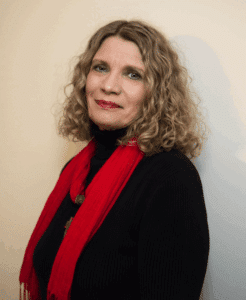
Linda Nemec Foster
Foster has published 14 poetry collections, including The Lake Huron Mermaid, her most recent. Her books and poems have received numerous awards and recognitions, including a nomination for the Pulitzer Prize for The Blue Divide. Her poems have been published in such literary journals and magazines as The Georgia Review, Nimrod, North American Review, New American Writing, Witness, Quarterly West, and Paterson Literary Review. She served as the first poet laureate of Grand Rapids, Michigan, and is the founder of the Contemporary Writers Series at Aquinas College. She received her B.A. degree from Aquinas College and her M.F.A. degree from Goddard College in Vermont.
Bone Country is set entirely in Europe, but it’s less about the sites and more about the people, natives and tourists alike, inhabiting the landscapes. Foster has a fine eye for imaging stories and real events, and you may come away with a better understanding of a place than what you find in travel guides.
Photo by H Mathew Howarth, Creative Commons, via Flickr. Post by Glynn Young.
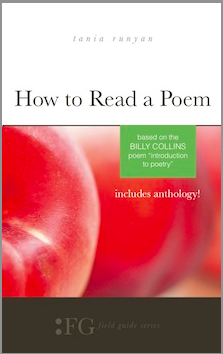

How to Read a Poem uses images like the mouse, the hive, the switch (from the Billy Collins poem)—to guide readers into new ways of understanding poems. Anthology included.
“I require all our incoming poetry students—in the MFA I direct—to buy and read this book.”
—Jeanetta Calhoun Mish

- Matthew Zapruder and “The Story of a Poem” - October 15, 2026
- Poets and Poems: Mischa Willett and “The Gift Card Has Already Been Redeemed” - October 13, 2026
- When a Poem Completely Eludes You - October 8, 2026
Leave a Reply