
Erin O’Luanaigh used illness to explore books and film – and write poetry

What do you do when you’re sick, as in bedridden sick? Poet Erin O’Luanaigh did what many of us do – read a lot of books and watch a lot of television. She also did what many of us might not do – she used her experience to write poetry.
O’Luanaigh had an illness in childhood that confined her to her bed for a considerable period. It was so serious that many of the adults thought she might not survive. But she did, and during the illness and recovery she read some of the great works of literature. She also had a grandfather who loved old movies, and together they watched a considerable number of classic films from the 1930s and 1940s.
The child survived the illness, and she remembered what she read and what she watched. And she put that experienced to good use when she wrote what would become her first poetry collection, Avail: Poems.
The term “ekphrastic” refers to a work or art (or a poem) based upon or inspired by another work of art. O’Luanaigh’s poems are not ekphrastic, although you might be tempted to think that when she writes a poem inspired by a poem or a work of literature. The experience of her illness meant that those works became part of her own experience, her own frame of reference, and her own being, and so they move far beyond description.
Take the 1940 movie His Girl Friday, starring Cary Grant and Rosalind Russell. It was the second movie version of the 1928 play The Front Page. The film itself is considered a classic romantic comedy and would eventually give way to more plays, more movies (The Front Page in 1974 starring Walter Matthau, for example), and the cited inspiration for Lois Lane in Superman. That 1940 film entered our cultural consciousness as much as it did O’Luanaigh’s. This is what she did with it.
His Girl Friday
 She loves him in a loathsome sort of way
gives one last sigh for life in Albany,
and at the fade, decides that she will stay.
He fixed it so she couldn’t get away,
played his Svengali act for comedy.
She loves him in a loathsome sort of way.
He jammed the presses, framed her fiancé
with phony dough, a tawdry mashing spree—
but by the fade, she knows that she will stay.
He trotted out every newsroom cliché:
“For truth! For freedom of the press! For me!”
She love shim in a loathsome sort of way.
Their bickering is, after all, just play.
She shows her decoy lover to a taxi
before the fade. She knew that she would stay.
When lust settles down, hate saves the day;
divorce can cure a marriage’s ennui.
She loves him in a loathsome sort of way,
and at the fade, admits that she will stay.
She does something similar with the life Judy Garland in her poem “Frances Gumm” (Garland’s real name). That’s followed by poems for Nick and Nora Charles (The Thin Man) and Weekend in Connecticut (Cary Grant and Irene Dunne).
That’s only the introduction. She then moves to a series of poems bearing the heading “Avail,” the collection’s title. The prose poems play with the meaning of avail and how similar and dissimilar it is to the word “veil.” She then takes us back for a return to the movies with Barbara Stanwyck and Rita Hayworth. It’s almost dizzying to read how O’Luanaigh whirls us through images of saints, movie stars, skyscrapers, and road trips.
Avail is one of most unusual and arresting poetry collections I’ve read.

Erin O’Luanaigh
O’Luanaigh’s poems have been published in several literary journals and magazines, including The Southern Review, The Yale Review, Bad Lilies, Subtropics, The Hopkins Review, the Los Angeles Review, and others. She received her MFA degree from the University of Florida, and she’s currently a Ph.D. student in English Literature and creative writing at the University of Utah. At the University of Utah, she’s a Steffensen Cannon Fellow and the senior poetry editor of Quarterly West. She is the co-host of the film and literature podcast (sub)Text, and she lives in Salt Lake City. (And she’s also a jazz singer.)
Avail will take you into the world of film and literature, translated into poetry. It’s a striking collection, one that resonates over and over. Or, as O’Luanaigh writes, “Resemblances are / just the shadows of differences…The end / of my world is the beginning of yours.”
Photo by Pai Shih, Creative Commons, via Flickr. Post by Glynn Young.
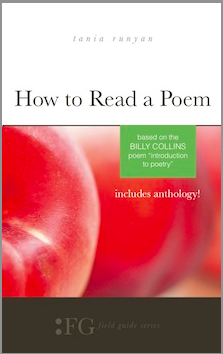

How to Read a Poem uses images like the mouse, the hive, the switch (from the Billy Collins poem)—to guide readers into new ways of understanding poems. Anthology included.
“I require all our incoming poetry students—in the MFA I direct—to buy and read this book.”
—Jeanetta Calhoun Mish

- When a Poem Completely Eludes You - October 8, 2026
- “Paul Celan: A Life” by Anna Arno - October 6, 2026
- Reading Paul Celan for the First Time - October 1, 2026
Leave a Reply