
For so many of us, Luci Shaw was a presence in poetry.
Poet Luci Shaw died last week, age 96. She would have turned 97 on Dec. 29. The news prompted an outpouring of memories, comments, shared experiences, and posts about how important she’d been in the lives of so many poets and writers.
I never met Luci, and yet it seems like she was an old friend. I never thought of her as a mentor, and yet she influenced my own writing.

Luci Shaw
I knew Luci Shaw by reading her poetry. And I read her poetry because I visited a place that knew her and that she knew.
For some five or six years, I was one of the writers who contributed to The High Calling, an online publication of the Butt Foundation. Its retreat center was, and remains, Laity Lodge, in the Hill Country of Texas not far from Kerrville (or an hour or so from San Antonio). Laity Lodge had a small bookstore, and it was there I discovered Luci Shaw, her poetry and her non-fiction writing.
I came away with two of her books in hand, The Crime of Living Cautiously and a poetry collection, Harvesting Fog. Perhaps it was significant that I read the non-fiction book first; it served as an unintended introduction to her poetry.
Harvesting Fog became one of those seminal events. Tweetspeak Poetry editor L.L. Barkat selected it as the prompt source for one of our Twitter poetry jams. We’d had several by that time (2011), but this was one different. Barkat convinced Luci to participate, helped her create an account on Twitter, and showed her how the slams worked. And participate she did, a bit tentatively at first as I remember, then, getting the hang of it, with all the gusto of a Twitter jam pro.

 The result was “The Cinnamon Beetle,” a series of six posts on Tweetspeak that presented all the tweets assembled as poems. I was the assembler; I participated in the jam itself, but my main role was editing the mass of tweets into poems. I took special care to make sure Luci’s lines were included. And she had some good ones; it was as if she was amplifying her own words from the prompts. I’ve included links to all six posts below.
That same year, Laura Boggess, another High Calling alum and writer here at Tweetspeak, hosted a book discussion of Luci’s Breath for the Bones. It’s wonderful work in which she describes how she sees the interaction between art, imagination, and the sacred.
We never met face-to-face, but that experience cemented by interest in her poetry. I featured one of her poems for National Poetry Month in 2011; I went on to review four of her collections: Scape, The Generosity, Reversing Entropy, and her final collection, An Incremental Life.
What did I find in her poems? A deep appreciation of the sacred in nature. A focused precision in how she used words; every word mattered. The connections between the temporal and the eternal. What you notice as you age that you pay little attention to when you’re younger.
This is one of Luci’s poems that we featured here, in which she explains how a poem enters her mind.
 How It Happens
When the words begin to arrive in my mind,
like tourists with cameras primed for the views,
they show up to be introduced. Yesterday they
arrived late morning, bringing with them
bunches of exotic wildflowers and birds
with songs like bells ringing. For snacks, they
unpacked fragrant fruit to be nibbled
under the jacaranda trees. I inhaled their syllables’
soft breath, allowing them time to simmer into
some crisp internal identity, some fresh, surprising
sound or color. The words arrive visible,
like dandelion seeds that speak themselves into the air.
Then, surprise, a fresh phrase shows up,
tingling, excited to be invited, welcomed to
the party. I begin to sense the phrases thinking back
at me, thinking me in a sweet, internal colloquy—
interested in how our words sound
when spoken together into the bright air.
This is how my mind disputes amicably with
itself, one of the ways creation happens,
how freshness breaks in. How a new, crunchy
poem can begin, impatient, demanding to be
written down. And that is how a poem happens.
Luci didn’t only write poetry. For many years, she was an editor at Radix Magazine, helping discover and publish other writers. She also established the Luci Shaw Writer’s Fellowship at the Chrysostom Society. She saw encouraging young writers as part of her own art.
Many people knew Luci as a friend, a mentor, an inspiration, and an encourager. I knew her as a poet. She leaves her poetry and writing as a legacy, not only of herself but to all of us. We all have much to be grateful for.
Related:
The Cinnamon Beetle: Part 1, Part 2, Part 3, Part 4, Part 5, Part 6.
In Conversation with Luci Shaw – Ben Palant at The Rabbit Room.
Photo by Missie, Creative Commons, via Flickr. Post by Glynn Young.
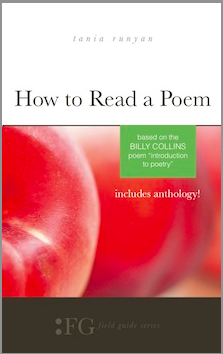

How to Read a Poem uses images like the mouse, the hive, the switch (from the Billy Collins poem)—to guide readers into new ways of understanding poems. Anthology included.
“I require all our incoming poetry students—in the MFA I direct—to buy and read this book.”
—Jeanetta Calhoun Mish

- Poets and Poems: Arlene Demaris and “Instructions for Use” - July 9, 2026
- Poets and Poems: Christy Lee Barnes and “Commodore Rookery” - July 7, 2026
- Philip Freneau: Poet of the American Revolution - July 2, 2026
Bethany R. says
So glad you shared this wonderful tribute and collection of memories, Glynn. What an incredible person and poet. Love the featured poem of hers you shared here.
“I begin to sense the phrases thinking back
at me, thinking me in a sweet, internal colloquy—
interested in how our words sound
when spoken together into the bright air.”
May I ask, what does it feel like to edit that mass of poetic lines from several people into one poem? I find it wondrous how you sew them together and create a colorful cohesive piece.
L.L. Barkat says
I enjoyed this walk down memory lane with you and Luci. Some good times, for sure.
Luci was also a publisher, as I understand it, publishing her friend Madeleine L’Engle along the way. (Harold Shaw Publishers). One of our patron-exclusive podcast posts has a lovely section about that: https://www.tweetspeakpoetry.com/2018/08/02/podcast-episode-1-luci-shaw/ It’s such a gift to be able to re-listen to her speaking with Laura Brown.
The Cinnamon Beetle is just such a fun title for the Twitter party after-poetry. Love. 🙂 And, as always, it’s a delight to see the poems woven by you from the experience.
Katie Spivey Brewster says
Glynn,
Many thanks for this lovely tribute to Luci Shaw- much to pour over, savor, and grow on:)
What a wonderful person and poet. Our loss is heaven’s gain.
Gratefully,
Katie