
Linda Nemec Foster uses poetry to find her heritage – and herself.
If the information on the Family Search website is accurate, my paternal ancestors can be traced back to 1520s England. A few would eventually emigrate to America in the 1620s and late 1600s. On my mother’s side, the first group arrived in the 1720s; more followed in the 1760s. The final group arrived in the first great German migration to America in the 1830s. I’m not sure when one’s ancestry becomes important, but I can say I discovered it fairly young, put it on hold for a few decades, and then came back to it.
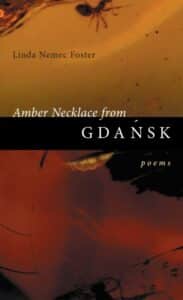
In 2001, poet Linda Nemec Foster published a poetry collection, Amber Necklace of Gdansk, that reads like a study of where she came from. In this case, it’s Poland. Ancestors had emigrated from Poland to America, settling in Cleveland. Growing up in the Cleveland area, Foster became aware of the stories of the old country and the family customs that carried over.
But when a family heritage is powerful, it’s not surprising that those stories will give way to desire to see the old country itself. After nearly a century, the country of Poland – once divided between the German, Russian, and Austrian empires, then made independent, then invaded by Nazi Germany, then occupied by communist Russia, and now once again independent – will be a very different place.
Foster begins by describing what she knows, what she herself has grown up in –her childhood, her neighborhood, the dreams immigrants brought with them, even an oak tree in her grandparents’ backyard that almost died but was saved by a mysterious salve concocted by her grandfather. Then she begins the transition, and she does it by writing of the two rivers in her story.
The Two Rivers in My Story
 I. Cuyahoga
The river’s name sounds like a chant
and it probably is. A n ancient Indiar
chant born in northern Ohio when it
wasn’t called Ohio but Place of Green
water, Place of Tiny Gorges Where Trees
Come to Be Born. The chant floats
along the river’s steady current
a s the waters twist through gray rocks,
yellow earth, and leaning trees
like a snake wrapping around itself
until it slithers into Lake Erie
and becomes uncoiled and silent.
II. Vistula
Who could not fall in love
with the name of a river that sounds
like water? Caressing the air
that leaves your mouth with such moist
nonchalance, it takes your breath away.
River that is half-woman, half-fish:
mermaid that seduces all or nothing,
her song the last fragment you hear
before the current sweeps you away.
Imagine her as a young child, the object
Of desire as virgin, as the unexplored
heart. Nothing in her veins but melted snow.
Afte the poems of the transition, Foster arrives in Poland. She writes of Chopin, visiting her grandmother’s house, walking through a park, watching people going about their lives, observing how the land took over to regenerate everything after World War II. She watches the color and the clouds take over, not knowing the place “where death lived for so long.”
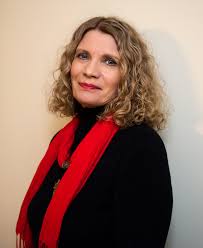
Linda Nemec Foster
The final section of the work continues Foster’s experiences and observations but ends with a kind of resolution – pride in a Pole winning the Nobel Prize for literature, conscious of her heritage, and dancing with her sister “in a smoky bar in Detroit / where two women dancing together can scandalize / any pimp within range.” The dance reminds her of those Polish weddings in Cleveland, where they both learned to dance.
Foster has published 14 poetry collections, including The Lake Huron Mermaid, her most recent. Her books and poems have received numerous awards and recognitions, including a nomination for the Pulitzer Prize for The Blue Divide. Her poems have been published in such literary journals and magazines as The Georgia Review, Nimrod, North American Review, New American Writing, Witness, Quarterly West, and Paterson Literary Review. She served as the first poet laureate of Grand Rapids, Michigan, and is the founder of the Contemporary Writers Series at Aquinas College. She received her B.A. degree from Aquinas College and her M.F.A. degree from Goddard College in Vermont.
Amber Necklace of Gdansk will take you back to your own roots, your own ancestry. It reminds you that that land your ancestors came from still inhabits your DNA.
Related:
Linda Nemec Foster and the Extraordinary Ordinary.
Photo by Gabriel Caparo, Creative Commons, via Flickr. Post by Glynn Young.

How to Read a Poem uses images like the mouse, the hive, the switch (from the Billy Collins poem)—to guide readers into new ways of understanding poems. Anthology included.
“I require all our incoming poetry students—in the MFA I direct—to buy and read this book.”
—Jeanetta Calhoun Mish

- Poets and Poems: Linda Nemec Foster and “Amber Necklace of Gdansk” - April 2, 2026
- Artists and Poems: Julian Peters and “Nature Poems to See By” - March 31, 2026
- Alan Jacobs Writes a Biography of “Paradise Lost” - March 26, 2026
Leave a Reply