
Filling in the spaces about my family heritage took work.
When I was writing my historical novel Brookhaven, I initially relied upon two main sources – the records of births and deaths in the old family Bible, and the charts and genealogical lines in the Family Search web site.
My ancestors in Mississippi served as the approximate inspiration for the McClure family in the novel. I borrowed many of the first names outright from the family Bible. I borrowed one name wholesale, to remind me of what I almost missed.
The Bible records mentioned the death of a Jarvis Seale in 1862. It didn’t mention birth, marriage, or anything else about the man. Some research in Family Search told me who he was – the husband of a great-great aunt. He was the only in-law included in the Bible records. The Family Search information only had the relationship reference and date of death. I still didn’t know what my great-grandfather had included him when others had been left out. Another web site, Find-A-Grave, showed his monument stone in a small-town cemetery in north Texas, which really made no sense.
 I found a partial answer when I was reading a history of Civil War battles. Jarvis Seale had died on April 6, 1862, the first day of the two-day Battle of Shiloh. But how did his grave end up in north Texas?
I knew I’d gone down a rabbit hole, but something suggested this might be important for the novel I was writing. So, I went digging on the web, in books, and articles. And I found the answer.
The Confederate dead at Shiloh were buried in nine mass graves, which nothing to indicate who was in what grave. Seale was the first (but not the last) of the extended family to die in battle. He left a widow with five children. His oldest daughter would eventually marry and move to north Texas, and she was the one who had erected a monument stone to her father decades after his death. This was not uncommon for families whose loved ones died in battle and were buried in mass graves.
This also partially explained his reference in the family Bible. My great-grandfather Samuel, who wrote all of the entries, most likely wanted to remember the brother-in-law lying almost forgotten in some unraked mass grave at Shiloh.
Going down that rabbit hole taught me what a genealogical chart or entry in the family Bible never could. It taught me about motivations, and feeling, and a few of the emotions swirling around that great cataclysm of American history.
Similar deep dives into tiny aspects of history taught me other things as well. I’ve organized them as seven tips.

A page of records in the family Bible
#1 Researching family heritage isn’t the same as researching genealogy. Genealogy gives dates and names and shows family linkage. Heritage provides the context and is far more difficult to understand. For a historical novel, heritage explains what people ate, what they used for amusement, how they thought about family and community, what their homes were like, and how they lived day-to-day.
#2 But genealogy can help a lot. When I look at my own personal genealogy chart on Family Search, I see my ancestors’ names spread out like a fan. I see how first names are often repeated down through generations. And I find puzzles, like why a young man of 19 would move from Savannah, Georgia in 1820 to Pike County, Mississippi. (I learned the answer: Alabama and Mississippi were the new frontiers, lands of opportunity for people looking to create a new life.)
#3 Be prepared to delve into obscurity. Some of the topics I researched for my novel included disease in Civil War prisons, when lumber manufacturing became big business in Mississippi, how spies operated in the Civil War, women’s fashions in 1915, and the physical layouts of one of Boston’s oldest churches and one of Brookhaven, Mississippi’s smallest.
#4 Amazon and other book sites can be your friend. Many times, I turned to Amazon, Alibris, and Google to find long-out-of-print books. One particular gem I found was an oversized collection of photographs of how Mississippians lived during the Civil War and after. Not only could I read the accompanying texts, but I could also see people and places.
#5 Be available and helpful to relatives working on genealogy. I know how I came to possess the Young family Bible – my father gave it to me, as his father had given it to him. But my grandfather wasn’t the oldest son; he was the youngest. And from various genealogy online discussion boards, I discovered there was still simmering resentment that the Bible had never been given to the oldest of my grandfather’s brothers.
I wasn’t about to surrender the Bible, but I did photograph all of the eight pages of family records and provide them to another family member doing research. That opened doors – and suddenly I learned about family stories about the Civil War I’d never heard before.
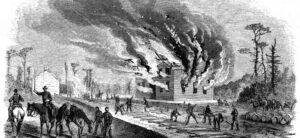
The burning the Brookhaven train station by Union troops (Harper’s Weekly)
#6 Don’t trust family stories. A story about my great-grandfather and what he did in the Civil War had been passed from my grandfather to my father and then to me. It was about a boy too young to serve in the war who enlisted anyway and had to walk home from Virginia when General Lee surrendered at Appomattox. It turned out to be a complete fabrication. (Full disclosure: I held on to it to form the heart of Brookhaven.) My father also told me that we came from a family of shopkeepers and had never owned slaves. My grandfather had been a shopkeeper, but he was born on the family cotton plantation. I learned the truth from old U.S. Census records. We all tell family stories, but when it comes to writing a novel or history about them, always verify.
#7 Don’t forget two helpful aids – fiction and poetry. The post-Civil War era saw an explosion of literature about the war – memoirs, biographies, battle accounts, novels, short stories, and poetry. They can teach you what history books often leave out – individual stories of how people fought the war, survived it, and started new lives. Some of the best-known American poems and stories are about the Civil War – think of Walt Whitman writing the lines “O, captain,! My captain! or Stephen Crane’s The Red Badge of Courage. Louisa May Alcott wrote about the time she spent in a soldier’s hospital in Washington, D.C. E.L. Doctorow wrote a novel about Sherman’s march through Georgia. Historian Shelby Foote wrote one about the Battle of Shiloh. Fiction and poetry can give you insights that history texts can’t.
I didn’t expect one lesson of writing a historical novel: humility. The more I read and researched, the more I understood how people had experienced, survived, and sometimes even flourished the most extreme of conditions. The Civil War is but one example. I realized what so many of my ancestors had gone through, and just how much I had to be thankful for.
Photo by Diego Torres Silvestre, Creative Commons, via Flickr. Post by Glynn Young.

How to Read a Poem uses images like the mouse, the hive, the switch (from the Billy Collins poem)—to guide readers into new ways of understanding poems. Anthology included.
“I require all our incoming poetry students—in the MFA I direct—to buy and read this book.”
—Jeanetta Calhoun Mish

- How the Norton’s Anthology Shaped My Understanding of Poetry - August 27, 2026
- Poets and Poems: Peter Murphy and “You, Too, Were Once on Fire” - August 25, 2026
- Poets and Poems: Gabrielle Myers and “Go Forth: Lose Yourself into Life” - August 20, 2026
Leave a Reply