
I was born (and raised) without a New Orleans accent
When you’re born and raised in a city like New Orleans, you become aware of certain things very early on.
First, there’s food. The basic New Orleans food groups are red beans and rice (on Mondays), crawfish, shrimp, beignets, and drive-thru daiquiris to go. A fifth food group might be the muffuletta. When I’d stay with relatives in Shreveport in north Louisiana, one aunt would make sure she fixed rice, because she worried I might be homesick.
Second, there’s weather. You’ve never met humidity like what saturates New Orleans. When you live in a place bounded by a lake, a river, and a gulf not too far away, and it’s built on swamp and bayous, then you will know what real humidity is like.
Third, there’s the accent. It’s not exactly unique; there are echoes of the New Orleans accent in Brooklyn and even south St. Louis. It’s a multicultural gumbo of influences, including French, Spanish, Cajun, Black American, Jewish, Italian, and German, embedded within (or riding atop) American English. New Orleanians would be completely at home ordering in a crowded deli in Brooklyn.

Beignets by Julian Rosser via Unsplash.
The accent, in fact, was my yardstick for authenticity in fiction about New Orleans. Writers would pen novels set in New Orleans and invariably use the Southern accent. Big thumbs down. The only people who have Southern accents in New Orleans are those who move there from other parts of the South. Natives don’t talk like other Southerners. In fact, the only novel I know of that caught the New Orleans accent perfectly was John Kennedy Toole’s A Confederacy of Dunces, and he was a native New Orleanian. In my opinion, it deserved the Pulitzer Prize it won for fiction in 1981 on the basis of getting the accent exactly right.
My mother, her four sisters, and her brother had the accent. My older brother and younger brother had the accent. Both of my sisters-in-law had it. All my cousins, including the ones my age I grew up with, had the accent. Every kid in my block, except for one Chicago transplant, had it. Most of my classmates in school had the accent; my two closest friends in high school had it. Most of my teachers had it.
In short, I grew up in an environment saturated by the New Orleans accent. What was weird was to find someone who didn’t have it.
Like me.
I never had it. Ever.
No native New Orleanian could believe I was one of them. I talked like a Yankee. Well, not a New England Yankee or Bostonian, of course, but like someone from the Midwest (Ohio was the usual guess). Salespersons in department stores would ask if I was a tourist or from some of part of the country. My teachers would ask the same thing. Nope. I was a native.
Nobody could believe it. I was an anomaly. Or a mutant. I had to move to the Midwest to sound normal.

St. Louis Cathedral – the heart of New Orleans -by Jimmy Woo via Unsplash
I don’t have a good explanation for why I never had the New Orleans accent. My father had a slight Southern accent; he was from Shreveport, and service in World War II honed a heavy accent down to a slight one. My mother, who had dreamed of being a teacher, developed a cultured New Orleans accent, at least in public. At home and when she was with her family, she reverted to the familiar New Orleans accent.
But that’s not an explanation. After thinking about it (a lot) over the years, I finally concluded there was no answer. It simply happened. Or I was an extraterrestrial. I wasn’t scarred for life, but it did contribute to the sense that I wasn’t like the rest of my immediate and extended family. (It worked with same way with my father’s relatives in Shreveport. I sounded like a Yankee to them, too.)
One thing the awareness of difference did accomplish: it made me sensitive to accents and language. I’d hear a different accent, and I’d look up and listen. I paid attention to how people said things, the expressions they used, and how they pronounced (or mispronounced) words. Gradually I came to see language as a way culture manifests itself.
And it attracted me to poetry. Poetry was different. It wasn’t like reading a novel or short story or a history book. The words in poetry were / are recognizable, but they occupy a different place. Poems often seem a little weird, when everyone else is reading and speaking prose.
I understand. I get it. It’s the story of my early life.
Related:
Photo by coniferconifer, Creative Commons, via Flickr. Post by Glynn Young.
See all Words to Travel By posts…

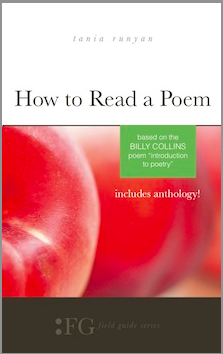

How to Read a Poem uses images like the mouse, the hive, the switch (from the Billy Collins poem)—to guide readers into new ways of understanding poems. Anthology included.
“I require all our incoming poetry students—in the MFA I direct—to buy and read this book.”
—Jeanetta Calhoun Mish
- Poets and Poems: Arlene Demaris and “Instructions for Use” - July 9, 2026
- Poets and Poems: Christy Lee Barnes and “Commodore Rookery” - July 7, 2026
- Philip Freneau: Poet of the American Revolution - July 2, 2026
bill (cycleguy) says
I still get the “Pittsburghese” language here and there.
L.L. Barkat says
This greatly amused (and intrigued) me!
Were you a big reader as a child? Listener to music? Watcher of movies?
Of course we need to get to the bottom of this to prove you are not an extra-terrestrial. 😉
Glynn says
Big reader, yes. Music, no. Movies – my father hated movies, while my mother loved them. From age 5 to 11, I was her movie partner. The Disney stuff for sure, but also movies no kid should have been taken to see — Some Like It Hot, Last Voyage, and others. Her heart always belonged to Clark Gable in Gone with the Wind. She did take me to see the John Wayne / William Holden movie The Horse Soldiers, based on a true story. Sixty-four years later, the true event became the launching idea for my novel “Brookhaven.”
L.L. Barkat says
Perhaps those special movie outings with you and mother influenced your sense of speech. (A little Clark Gable inspiration? 🙂 )
And of course reading could do the trick, too.
I wonder if somewhere inside yourself you knew what you were doing and wanted it to be that way.