One day, the subject of Wendell Berry came up at work.
I first saw the news Monday about the death of Wendell Berry rather obliquely. Two Facebook friends independently posted poems by him. I stared, realizing the coincidence meant only one thing. He’d died, aged 92.
Some news events shock you, upending what you understand about the world. An assassination. The fall of the Berlin Wall. A terrorist attack like 9/11. Others reduce you to a sense of profound quiet. It was that second kind I experienced on reading those two poems. Neither post mentioned his death. They didn’t have to. I knew.
I don’t have a personal story about Wendell Berry. I know people who’ve gone to his lectures, and people who’ve made pilgrimages to his home in Kentucky. People who’ve met him. But I don’t have a personal story. What I have is a one-off story, which probably tells you more about agriculture, biotech agriculture, and the wars that raged over genetically modified organisms, or GMOs, for three decades. The story also tells you more about Berry’s impact and influence than many obituaries.
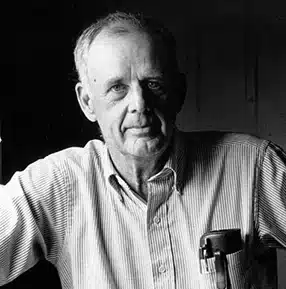
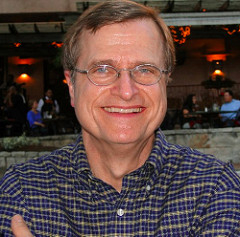
Wendell Berry (1934-2026)
I don’t remember when exactly I started reading Berry, but I know I was writing about it by 2010. I love his Port William novels, including Marce Catlett: The Force of a Story, the last of the series published in 2025. I’ve enjoyed his poetry and read almost all of it, including The Mad Farmer Poems. I’ve read his short stories.
I’ve also read most of his non-fiction and essays, and many, if not most, of those writings are about agriculture. He didn’t so much advocate a system or practice of agriculture as he did a philosophy of it, a philosophy of the land and community and faith and how all of these things were bound together.
I read those two poems on Facebook, and then I saw the news stories begin. When a man is 92, the report of his death is not a surprise. The quiet I felt took me back years, more than 20 but how many precisely I don’t recall. What I do remember is what happened and where it happened.
I was at work, in a meeting with several senior executives. My job at the time was unusual – a highly specialized job handling communications about the bankruptcy of a former spinoff. Someone had heard that I’d also written executive speeches; the CEO needed a speechwriter, and I was involuntarily elected to help. The meeting was about a speech, which explains why I was sitting with senior executives. My job was mostly to listen and take notes for the speech.
At some point, the discussion turned to all the opposition to agricultural biotechnology, which was the company’s primary business. The executives were handwringing over why so many people seemed to deliberately misunderstand what the company did and was trying to do. They blamed the media. They blamed environmental groups. They blamed competitors. But they couldn’t see the philosophy or motivation behind the opposition.

Berry walking his farm in Kentucky
I’d been silent up to this point. When the discussion paused, I said one thing. “Have you read Wendell Berry?”
They looked at me like I’d grown two heads. The actual response was classic.
“Who’s Wendell Berry?”
I’d been reading his essays and some of his poetry by that time. I answered something like this: “For more than 40 years, Berry has been living on a farm in Kentucky and writing about agriculture. Specifically, he’s been articulating a very quiet understanding of agriculture that you might at first think is a throwback to the early 19th century. But it’s not. And the people who’ve agree with him have steadily grown in numbers. He’s even written an essay that mentions our company by name. He unintentionally became the intellectual inspiration, a quiet but powerful force, for everything you’ve been describing. And until you find someone who can articulate the company’s and the industry’s position as well as he does, you’re going to keep losing this battle.”
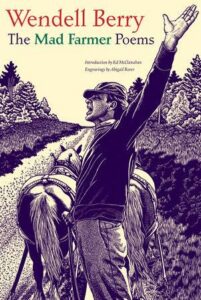
I was only the weirdo speechwriter. Most of the participants looked at me like I was some wacko who’d slipped into the company by mistake. One executive knew better; we’d worked together or a project years before where the weirdo speechwriter, then the weirdo communications guy, had been right about the need to voluntarily reduce toxic emissions. He asked me to send him some titles of books by Berry that I’d recommend. One of those was The Mad Farmer Poems.
 He actually read what I recommended. He caught me in the hallway some weeks later and said, “I read them. We’re going to lose this, aren’t we?” He knew it, and I knew it. Set against Berry’s compelling vision of agriculture, his understanding of people and community, and his faith, was a company that believed in itself, its science, and its mission. Yes, the company was going to lose this.
The company and the industry didn’t completely lose; agricultural biotechnology still exists. What it did lose was the battle for the public’s hearts and minds. I don’t think Berry would say that he won; he would fight the good fight and keep fighting. He would continue to document the disappearance of the life he’d been born into and continued to believe in.
And I think he’d smile to know that he had at least one convert, possibly two, in that industry he saw as representing everything that had gone wrong in agriculture.
Related:
Wendell Berry and Another Day.
Robert Frost, Wendell Berry, and the Woods.
Photo by A Peach, Creative Commons, via Flickr. Post by Glynn Young.

How to Read a Poem uses images like the mouse, the hive, the switch (from the Billy Collins poem)—to guide readers into new ways of understanding poems. Anthology included.
“I require all our incoming poetry students—in the MFA I direct—to buy and read this book.”
—Jeanetta Calhoun Mish
- A Non-Personal Memory of Wendell Berry - September 3, 2026
- Poets and Poems: Jen Karetnick and “Organ Language” - September 1, 2026
- How the Norton’s Anthology Shaped My Understanding of Poetry - August 27, 2026
Leave a Reply