
Tolkien wrote about a controversy over a road in Oxford
We’ve visited Oxford during most of our trips to England. We take the tube to Paddington Station and then a train to Oxford. The trip takes about an hour. We’d visit various colleges, the Sheldonian, Blackwell’s Bookstore, the covered market, the Ashmolean Museum, and the Bodleian Library. It’s an easy day trip from London.
Christ College (which, if you’ve seen the Harry Potter movies, includes the dining hall) faces a meadow. It’s almost a shock to see a large tract of undeveloped land right by the bustle of traffic and tour groups. It’s quiet, peaceful, and rather beautiful.
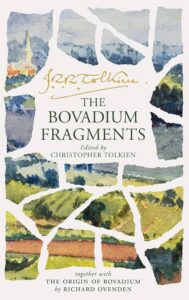 What I didn’t know until I read The Bovadium Fragments by J.R.R. Tolkien, was that for more than two decades, Oxford authorities almost ran a road through the middle of it.
The Bovadium Fragments is unlike anything you’ve seen written by Tolkien. It’s relatively short, pulled and edited from the Tolkien papers at the Bodleian Library by Tolkien’s son Christopher. It has never been published, although Tolkien had apparently considered a magazine to approach. It’s in (literally) three fragments.
The story that exists in these fragments is about an archaeological investigation of two ancient but related cultures and an attempted translation of the language of one of the cultures (the other was considered hopeless). The first fragment is a poem and some supporting text – all in Latin. The second fragment translates that into English, and then it continues a story. The third fragment is a short continuation of the story, using both Latin and English.
As you read through Tolkien’s fragments, you begin to understand what he’s doing. He’s satirizing the proposal then under discussion for a road through the Christ Church meadow, one he believed was turning the automobile into a religious cult. While he was at it, he was also lampooning archaeologists and how farfetched some speculations could be.

Christopher Tolkien
The text includes editorial notes, presumably by Christopher Tolkien, but what really ties the work together is a long essay by the general editor, Richard Ovenden, explaining “The Origin of Bovadium.” Ovenden, the Bodleian Librarian, puts the fragments into their historical context, how Oxford developed as a center for automobile production (who knew?), how the city struggled with traffic problems, and how a 1947 proposal for a road through the meadow was argued, debated, and fought over until it was finally killed in 1971.
The surprise is to see that Tolkien, the Oxford professor and creator of Middle Earth, felt passionate enough about the issue that he played with a possible article to respond. But it’s not a surprise to see how he framed that response – creating a story about another world (and partially using Latin to do it).
 The Bovadium Fragments is a curiosity, something that Tolkien fans will love because it’s Tolkien. But it’s also about Oxford and its 20th century history, its role in automobile production, and the inevitable conflict that ensured with academia.
Ovenden is also the co-editor of The Great Tales Never End: Essays in Memory of Christopher Tolkien. A collection of 10 essays introduced by co-editor Catherine McIlwaine, the authors include academics, Tolkien scholars, and Priscilla Tolkien, Christopher’s sister. Each essay describes Christopher’s scholarly work as well as his contribution to his father’s literary estate. The work Chrstopher did for his father may be one of the most remarkable literary partnerships ever, and the essays describe it.
Related:
Editor of the Legendarium: Christopher Tolkien (1924-2020).
Photo by Sean McGrath, Creative Commons, via Flickr. Post by Glynn Young.
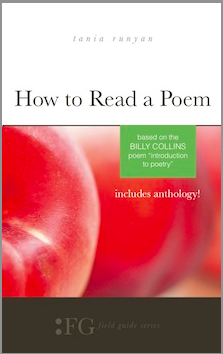

How to Read a Poem uses images like the mouse, the hive, the switch (from the Billy Collins poem)—to guide readers into new ways of understanding poems. Anthology included.
“I require all our incoming poetry students—in the MFA I direct—to buy and read this book.”
—Jeanetta Calhoun Mish
- Poets and Poems: Angela Alaimo O’Donnell and “The View from Childhood” - May 26, 2026
- I Am Haunted by the Civil War - May 21, 2026
- Poets and Poems: Ayala Zarfijian and “A Corner in the World” - May 19, 2026
Leave a Reply