
Sadbook is a surprisingly poetic stick figure
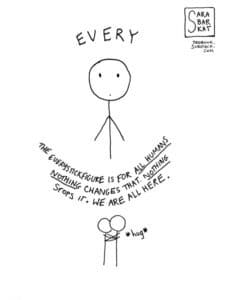
I’ve been following Sadbook on Substack by Sara Barkat for quite a while now. At first, I thought the character might be intended for a younger generation. And Sadbook certainly has that appeal – a kind of updated Charlie Brown. (I don’t want to imply that Sadbook is a male; gender isn’t specified and really doesn’t matter.) And it can be a little odd or slightly offbeat, causing you to turn your head and say “What?”
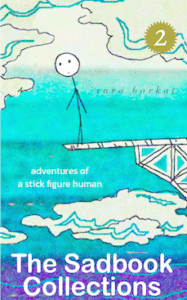
But then I read Barkat’s The Sadbook Collections 2, essentially all of the Sadbook cartoons from 2024 (the first volume covers 2023). And it was then that it hit me: Sadbook is a poet.
 I’m not sure at what point the revelation occurred. It might have been early on, with the cartoon showing Sadbook uploading an ebook, completing the task, and finding the big, glaring typo. Or an almost wordless cartoon of the stick figure swimming in a sea of stars. Or the cartoon that soon became one of my favorites—cooking lentils; Sadbook creates a story of what happens to the lentils in the pot. (I’ve caught myself making up stories like that, watching something sink in the pot on the stovetop.)
Sadbook is also something of a poetry critic, or reteller of famous poems like Shelley’s Ozymandias, Frost’s The Road Not Taken, William Ernest Henley’s Invictus, Poe’s The Raven, Eliot’s The Love Song of J. Alfred Prufrock, a sonnet by Shakespeare, and one of Emily Dickinson’s most famous poems, Because I Could Not Stop for Death. It’s not an easy feat, to encapsulate poems like those in a single cartoon panel, but Sadbook adroitly pulls it off. Although the stick figure does leave at least one profound question unanswered: what did that raven really mean by “Nevermore”?
Confession time: I became so intrigued by the raven’s one-word statement, which the bird says, croaks, and repeatedly “quoths,” that I went to the original poem, read countless times over the years. Sadbook is right! The bird never explains. Then I went down another rabbit hole: what does it mean to “quoth”? It’s an archaic word for “said,” but did Poe use it as Shakespeare used it – only in jest or irony? What if it’s not a statement but a joke or an ironic observation?
You see what Sadbook does to my brain. Just like a poet.
 Barkat is the author-illustrator of recent editions of Robert Louis Stevenson’s The Strange Case of Dr. Jekyll and Mr. Hyde, Oscar Wilde’s The Picture of Dorian Gray, H.P. Lovecraft’s The Colour Out of Space, and Charlotte Perkins Gilman’s short story The Yellow Wall-Paper. She’s also published the children’s book The Midnight Ball, the Indie Excellence Awards finalist science fiction collection The Shivering Ground, and Earth Song, a collection of eco-poetry. She writes and illustrates The Sadbook Collections on Substack, and she’s served as editor for several books, including the popular The Teacher Diaries: Romeo & Juliet, The Joy of Poetry: How to Keep, Save & Make Your Life With Poems, and Twirl: My Life With Stories, Writing & Clothes.
The Sadbook Collection 2 is a thoughtful, creative, sometimes funny and sometimes serious collection of stick-figure cartoons. And it helps to think of each cartoon as a stick-figure poem.
A figure of sticks
and circular lines,
eschews any tricks
but embraces the signs.
You may think it sad,
as it walks through life,
but its spirit is glad,
its heart without strife.
Photo by Phillippe Put, Creative Commons, via Flickr. Post by Glynn Young.

How to Read a Poem uses images like the mouse, the hive, the switch (from the Billy Collins poem)—to guide readers into new ways of understanding poems. Anthology included.
“I require all our incoming poetry students—in the MFA I direct—to buy and read this book.”
—Jeanetta Calhoun Mish
- Poets and Poems: Paul Pastor and “The Locust Years” - June 26, 2025
- What Happened to the Fireside Poets? - June 24, 2025
- “What the House Knows”: An Anthology by Diane Lockward - June 19, 2025
L.L. Barkat says
Glynn, this is such a FUN review!!! 🙂 I think you are right. Sadbook is a poet. (Maybe even a poet-philosopher?)
And I love your poem at the end. Perfect. 🙂
Bethany R. says
Great post, Glynn. I’m a fan of Sadbook! Yes, an old soul in a modern world with a poetic disposition. A treat to follow.