 “It was meant to narrow their possible thoughts.”
My fifteen-year-old daughter was ruminating about Newspeak, remembering it from Orwell’s 1984, noting how the landscape of language could influence a person’s range of experience and boundary-crossing.
She and walking-man Robert Macfarlane might get along, though at her age she would not be invited to drink the free-flowing gin and wine of the wayfarer’s repose and conviviality.
Macfarlane has walked about seven to eight thousand miles in his life, a thousand of which he must have avidly and extensively kept in mind by recording sights, sounds, stories, physical and mental maps—to later gather into a book called The Old Ways: A Journey on Foot, that we might characterize much like he characterized Nan Shepherd’s work The Living Mountain: “a celebratory prose poem…a geo-poetic quest.”
If a person would wish to plumb even a fraction of Macfarlane’s experiences and musings in this 364-page book (and that excludes the Glossary, Notes, Bibliography, and Index, which only a reader like my daughter would insist on perusing as well, bringing the total to around 433 readable, or at least viewable, pages), it would require a certain constitution, or the willingness to acquire it over time—and it would take time to journey through these pages.
The constitution a person would need, or could acquire, is a mix of linguistic curiosity, fascination with painterly images, a sense that it is not important to take anything particular from the journey, a patience in climbing through descriptions of gneiss or chalk in its many variations, and the willingness to be a beginner again in the presence of one so clearly expert on matters of geology, poetry, and history.
It could happen.
In 1984—the year, not the book—I took the most mind-numbing class of my entire educational experience: Geology 101. A dedicated student, I spent hours on end reading a text that I only remember for its maps of magnetic fields and its many lists of rock formations, soil types, and ocean depths. The rest is an unhappy blur. Yet I found myself open to Macfarlane’s geologic and other lists.
Perhaps because Macfarlane framed his listings as early as page thirteen, by asserting: “Say the names of paths out loud and at speed and they become a poem or rite—holloways, bostles, shutes, driftways, lichways, ridings, halterpaths, cartways, carneys, causeways, herepaths.” By the time I’d advanced to his discussion of Central Northern England’s chalk, I had acquired the requisite openness. In fact, I read the chalk chapter aloud to my daughter, and we imagined fictive worlds, names for new breads, classes of kingdoms (partly at Macfarlane’s prompting). See if you might do the same:
…stripes of rock run predominantly north to south, so that if you read the landscape west to east, from Oldham across to Grimsby, you encounter millstone grit (climbing country), Lower Westphalian and Upper Westphalian (coal country), magnesian limestone, Permian mudstones, Permian and Triassic sandstones, Triassic mudstones, Lower Lias, Middle Lias, Upper Lias, Inferior Oolite, Great Oolite, cornbrash, Oxford clay, Corallian, Ampthill and Kimmeridge clays and finally chalk.
Finally chalk.
If you are a person who must reach your destination—chalk or otherwise—posthaste, you will need to evaluate your suitability to take this reading journey. Macfarlane’s lists are many, his pathways non-linear. Meaning-making is sparse, and that is not a criticism so much as an observation. Macfarlane is taking you on his adventures, trying to recapture them with the same “grace of accuracy” he applies to his sea-companion Ian’s actions and speech (he borrows this phrase from Robert Lowell, and it captures his own writing style, should you be the kind of reader who experiences grace through a depth of detail).
It might help if you knew what a sarha was (and is). It might help if you understood the political implications of such freedom in path-making. The section on walking in Palestine will lend you this knowledge. A sarha is “roaming without constraint or fixed plan,” an aimlessness that only the politically free can afford. For the Palestinian who Macfarlane walked with—Raja—the “sarha had become almost impossible. Hills that had once for him connoted freedom had come to feel endangered and endangering.” Still, Raja walks. It is, for him, “a way of defeating the compression of space of the Occupation; a small but repeated act of civil disobedience.”
Upon beginning my reading journey with Macfarlane, I made a decision: I would walk every day. I could not agree with him that journeys cannot be made without walking (ask me about the year I spent sitting outdoors in the same spot every single day; ask me about how it provided the journey inward that Macfarlane claims only walking can do).
Yet. It seemed logical to try him at his word. I should walk. After all, am I not free to do so? To a point, yes. But I recently understood a fraction of Raja’s complex relationship with walking, when I realized how I am confined to the paths my community has set out. It is a confinement of degrees; Raja’s is far, far greater and somewhat frightening. Walking our paved roads, in the same direction, along the same prescribed routes day after day, I marveled that I would be less likely to walk across a neighbor’s lawn (community disobedience) than Raja might be to cross an Israeli boundary line. But then Raja’s sarhas were “an explicitly political act and walking as a means of resistance.” What have I to resist in this semi-urban neighborhood?
Life needn’t be a series of resistances. That can be fatiguing and not always productive. But perhaps life should involve some level of boundary crossing, else we live a kind of Newspeak existence. For Macfarlane, such crossings were harder to come by; here is a man who has been free to walk and boat, and we can see the chronicle of this freedom—from England to Scotland, Spain to Tibet, and places in between.
So we find him making his crossings, instead, in intimate physical ways, such as taking a landscape barefoot or in the torrential rain. Says Macfarlane, “there are kinds of knowing that only feet can enable, as there are memories of a place that only feet can recall.” And he recalls them: hot paths across boulder clay, warm harrow-crushed soil, grass burnished so its blades “flattened together to create a cool surface.”
The most interesting crossings, however, at least to this reader, were those that involved forays into the lives of people, both living and dead—an artist who folds air or water into the center of rocks (and plans to implant a skeleton sculpture in a boulder where no one can see it, the interior space made sacred by an act of creation that will be invisible to any passerby); a collector who has a “library” of “books” that are actually intricate boxes in which feathers, stones, gold leaf will tell you your past or your future; Edward Thomas and his wife Helen, who apparently knew Robert Frost and whose lives were forever changed by a shocking misread of “The Road Not Taken.”
Macfarlane’s crossings can to some extent become ours if, through reading, we allow his language and rich imagery to expand our experience. Still. I have already told my daughter that I think she might someday literally follow in Macfarlane’s footsteps, across The Icknield Way. Some journeys, after all, can only be taken by walking. Some thoughts are only made possible by speaking the language of wayfaring—on your feet.
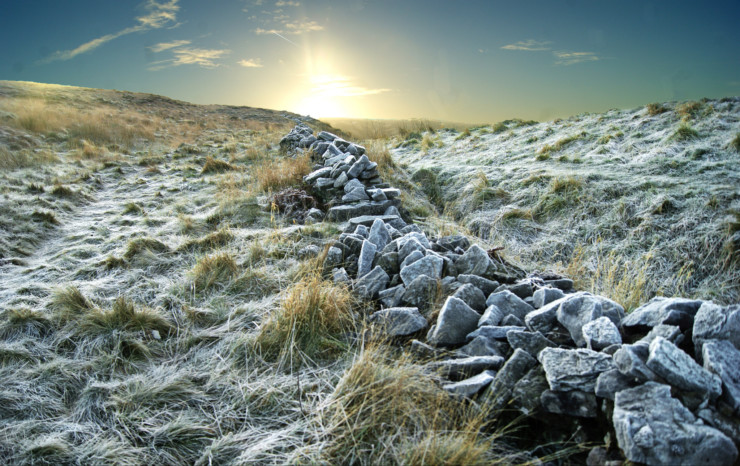
Photo by Simon Harrod, Creative Commons, via Flickr. Post by L.L. Barkat. First appeared in Books & Culture as The Old Ways: Reading, Walking, Boundary-Crossing.
- Learning by Poetry: C’est Fait Par du Monde - November 10, 2025
- Learning by Poetry: Pas du Tout - October 8, 2025
- Found in Translation: Gently May It Sing - September 15, 2025
Bethany R. says
I’m intrigued by, ”an artist who folds air or water into the center of rocks,” and the plan to hide art inside a boulder.
And I’m thinking about your last line, “Some thoughts are only made possible by speaking the language of wayfaring—on your feet.” Taking your brain for a walk can certainly create and/or reveal new connections.
Thank you sharing a bit of your journey through his journey.