
What Is Lyric Poetry?
Lyric poetry is one of those terms we’ve probably heard tossed around quite a bit, though we may forget to ask “What is lyric poetry, anyway?”
If you want to take a moment to ask and try to figure the answer to that question, why not try. We’ll wait (with Apollo). 🙂
“Orestes suppliant to Apollo,” John Flaxman, 1879″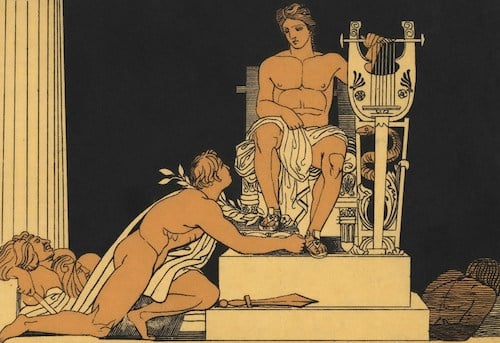
Back when the Greeks were staging poetry, lyric poetry was sung or chanted with a lyre in accompaniment, and it was done so through the first person.
This was in contrast to epic poetry where a narrator (who also speaks in the first person)… narrates something. Fine line? The lyric poem is much shorter and, according to Edward Hirsch, has been around for all time (“as ancient as recorded literature”). Used to convey deep feeling from a solitary standpoint, it plumbs our very experience of being and is therefore an offering of intimacy from writer to reader.
Knowing that the lyric was sung during Greek times lends the tiniest bit of humor to what otherwise might have seemed like ultra-serious poetry from Walt Whitman. After all, there’s something amusing about a lyric poem called Song of Myself. It’s just so… self-conscious…kind of meta.
“I celebrate myself, and sing myself,
And what I assume you shall assume,
For every atom belonging to me as good belongs to you…”
Whitman’s “Song of Myself” also strangely has a touch of non-intimacy to it. And, with 52 parts and over 1300 lines, it feels a bit epic in length. Oh, poet contradictions! To which Walt says…
“Do I contradict myself? Very well then I contradict myself, (I am large, I contain multitudes.)” (Section 51)
Walt Whitman’s Lyric Poetry, Spoken and Sung (But Not to a Lyre)
Do you have a favorite lyric poet? Share in the comments!
Photo by Jason Leung, Creative Commons, via Unsplash.

- Learning by Poetry: Dans la Nuit - March 13, 2026
- Poetry Prompt: Meet Your Muse Terpsichore - March 9, 2026
- What Is a Simile? - February 23, 2026
bethany says
“Whitman’s ‘Song of Myself’ also strangely has a touch of non-intimacy to it.”
Interesting point. It’s been a long time since I read all of it, but from the portions here in the videos, it lands with a bit of a formal feeling. (Now I’m thinking about Dickinson’s “formal feeling.”) Perhaps it’s because it sounds like a declaration to the world rather than the tone in a letter to a friend, for example.
L.L. Barkat says
Yes, and that declaration is bordering on the “epic” in purpose. This poem is far more than meets the eye (ear?) at first. 🙂