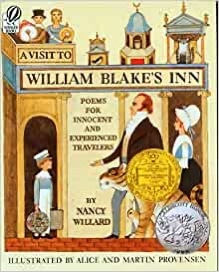
I didn’t know a lot about William Blake when I decided to learn “The Tyger” By Heart, just this poem and his painting The Ghost of a Flea. But as often happens when I set my mind to learn a thing, the thing suddenly seems to be everywhere. And so a poetry collection about trees, led me to a poem by Nancy Willard, which led me to her picture book of poetry titled A Visit to William Blake’s Inn: Poems for Innocent and Experienced Travelers that won both the Newbery Award and the Caldecott Honor in 1982. So each afternoon with my tea, I’d work on memorizing “The Tyger” and then read one of Willard’s poems inspired by Blake.

In the introduction Willard writes that she encountered Blake when she was 7 years old, sick in bed, and her babysitter recited “The Tyger.” A couple of days later Blake’s Songs of Innocence and of Experience came in the mail, with this inscription:
“Poetry is the best medicine.
Best wishes for a speedy recovery.
yrs, William Blake”
The two poets — Blake and Willard — share a kinship with children. It is said of Blake that he wrote “for children and angels.” Willard may not have written for angels, but after writing for adults she moved to writing for children and continued doing so for the rest of her career. Here’s one titled “The Tiger Asks Blake for a Bedtime Story.” See what echoes of “The Tyger” you can hear in Willard’s poem:
The Tiger Asks Blake for a Bedtime Story
William, William, writing late
by the chill and sooty grate,
what immortal story can
make your tiger roar again?
When I was sent to fetch your meat
I confess that I did eat
half the roast and all the bread.
He will never know, I said.
When I was sent to fetch your drink,
I confess that I did think
you would never miss the three
lumps of sugar by your tea.
Soon I saw my health decline
And I knew the fault was mine.
Only William Blake can tell
tales to make a tiger well.
Now I lay me down to sleep
with bear and rabbit, bird and sheep.
If I should dream before I wake,
may I dream of William Blake.
—Nancy Willard
“The Tyger” was published in 1794. (Here is Blake’s illustration.) Like many older poems, this one begs to be read aloud. I found it among the easiest to memorize of all I have attempted because each line moves so intuitively into the next. But take note: the first stanza and last differ by one crucial word.
While I have been spending time with Blake and Willard and tygers, a virus have been wreaking havoc worldwide. Blake’s poetry, which often seems too strange for our modern world, suddenly makes sense. But I chose “The Tyger” long before COVID-19 made an appearance. I found it tucked into a picture book called Fear the Bunny, about why bunnies are scarier than tigers. So my April sojourn with Blake was about how well this poem holds up, even 226 years after it first entered earth’s consciousness. After all that time, it’s still fun to say.
The next time I have a fever, I may visit William Blake’s imaginary inn and read some of his poetry. The Tyger will still be there, burning bright.
Your Turn
Did you memorize “The Tyger” this month? Join our By Heart community and share your audio or video using the hashtags #ByHeart and #MemoriesWithFriends and tagging us @tspoetry. We also welcome photos of your handwritten copy of the poem.
By Heart for May
Photo by OiMax, Creative Commons, via Flickr. Post by Megan Willome.
Browse more By Heart
Browse more The Yellow Wall-Paper book club
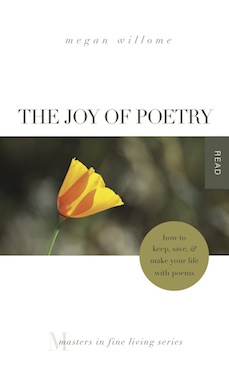
“Megan Willome’s The Joy of Poetry is not a long book, but it took me longer to read than I expected, because I kept stopping to savor poems and passages, to make note of books mentioned, and to compare Willome’s journey into poetry to my own. The book is many things. An unpretentious, funny, and poignant memoir. A defense of poetry, a response to literature that has touched her life, and a manual on how to write poetry. It’s also the story of a daughter who loses her mother to cancer. The author links these things into a narrative much like that of a novel. I loved this book. As soon as I finished, I began reading it again.”
—David Lee Garrison, author of Playing Bach in the D. C. Metro

- Perspective: The Two, The Only: Calvin and Hobbes - December 16, 2022
- Children’s Book Club: A Very Haunted Christmas - December 9, 2022
- By Heart: ‘The night is darkening round me’ by Emily Brontë - December 2, 2022
Leave a Reply