A day of quiet gladness, –
Mount Fuji is veiled
In misty rain.
This is a poem, a haiku by Matsuo Basho, the first great haiku poet. It is considered by some to be one of the greatest haiku ever written. Looking at it you might think, “Really? It’s just three lines. It’s a mere blip of words.” If that’s your thought, I can sympathize with you. The thing is, I want to like haiku, being a lover of poetry, and a poet myself. For some reason, however, I find it hard to sit myself down and really appreciate haiku. It seems like it’s done before I’ve started. After all, most haiku are around three lines. It feels useless to actually sit down and read haiku, unless you plan to read a string of them, but then are you really appreciating them if you read twenty haiku poems in a row?
So I’ve been frustrated in my own efforts to appreciate haiku, and as I’ve pondered why this was so, I’ve decided I can attribute some of the difficulty to the difference between the culture out of which the haiku was created and the culture in which I live.
Originally, the haiku was just one part of a longer poetic form, but Matsuo Basho was one of the chief Japanese poets in the 17th century to make the haiku a stand-alone poetic form. Jack Kerouac, who–believe it or not–was a master of American haiku, wrote that “Haiku was invented and developed over hundreds of years in Japan to be a complete poem in seventeen syllables and to pack in a whole vision of life in three short lines.” This sounds like a nigh impossible task, and one that haiku seems to fail to achieve. But William Howard Cohen in his book To Walk In Seasons: An Introduction to Haiku, further enlightens the design of haiku in comparing its cultural roots to Western ideas of poetry:
“Where the haiku differs from most Western poetry, of which the English and American traditions are a part, is in its nonintellectuality. A good haiku does not interpret itself by a bald statement of its meaning, but presents what we call a ‘pure image, ’ from which the reader is expected to draw out the meaning himself. …To the Western reader, accustomed to a more wordy, rhetorical, philosophical type of poem, the haiku often seems fragmentary and incomplete.”
In these ideas, haiku draws much from Zen Buddhism, with its focus upon meditation, enlightenment, and non-intellectual ways of knowing. Haiku may borrow from the Zen idea of satori, “sudden enlightenment, in which in a flash of insight the Zen student suddenly realizes his oneness with the universe” (Cohen). It also seems to borrow the Zen practice of “bringing together seemingly disparate elements by showing their hidden or unsuspected unity.”
I am not Buddhist, but that doesn’t mean I can’t appreciate some of these ideas. As a Westerner, often implicitly driven by the premise of logic and didactic purpose in all things, and as an American driven by our increasingly hurried culture, I can see why I would have a hard time appreciating haiku. The haiku is an invitation to stop and be still, to pay attention to the details happening all around, and to see the beauty in their connectedness. The haiku is not so much a beginning to an intellectual experience as much as it is an invitation to an aesthetic experience, to hear the beauty of the words, and even as haiku poet Gary Hotham says, to hear the spaces in between the words, to sense the vision of the small image being presented. Hotham, who is not a Buddhist but a Christian poet, also recognizes these values in haiku:
One phrase…expresses well to me the chief goal of haiku: ‘the essence of a moment keenly perceived.’ There is a lot of emotional energy, excitement, and depth in the small events, the brief moments of life. And why not–they are all part of the sweep of history. They are all part of what is significant and important in our lives as God’s creatures. The haiku is a great form for capturing those brief moments in time and recreating the associated states of being.
Perhaps appreciating haiku will be a process for me, but I think it will be a good one. The haiku is a call out of the blur of modern life, and out of shallow thinking and living to a deep place, where one is led to contemplate the image and emotional complexity of the small and the ordinary, and perhaps by doing so, to see the beauty in the ordinary and seemingly mundane, and thus to appreciate the richness of the larger world.
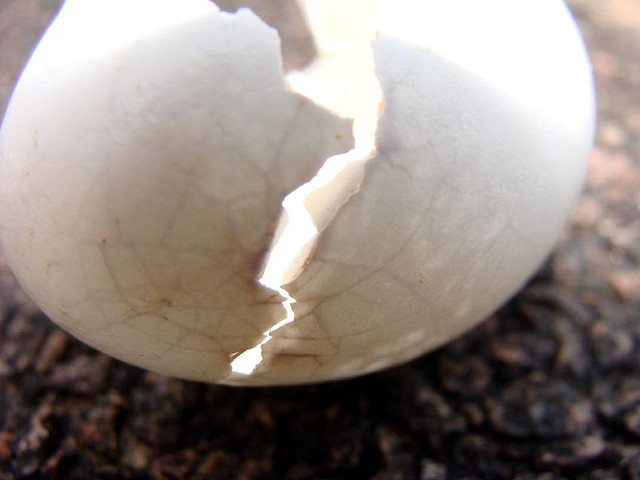
Photo by Kirsty Hall , Creative Commons license via Flickr. Original post by Chris Yokel. This article first appeared at The Curator. Reprinted with permission.
_______________________________
Buy a year of Every Day Poems, just $2.99 — Read a poem a day, become a better poet. In December we’re exploring the theme Haiku.


- Tolkien I Workshop: Session 11–On Fairy Stories - May 12, 2014
- Tolkien I Workshop: Session 10 — The Hobbit, Book vs. Films - May 4, 2014
- Tolkien I Workshop: Session 9–Exploring The Backdrop of The Hobbit - April 27, 2014
L. L. Barkat says
I love that idea about haiku being more of an aesthetic experience than an intellectual experience. It is something we don’t analyze as much as we make space for… welcome into ourselves.
Like the sound of a single chime.
Maureen Doallas says
Wonderful post, Chris.
Haiku’s like sushi.
Each one’s complete in itself:
A life-wrapped moment.
L. L. Barkat says
perfect, Maureen 🙂
Donna says
I love that you are not giving up on Haiku but rather are seeking the pearl, for you, within. I’m certain, then, that you will find it resting there inside all of the “other stuff” getting in the way. I had this same feeling about sonnets!!! Great post, Chris!